
World · Counterpunch · · 1h
Last Songs
English (original) · Read in Deutsch ⇄
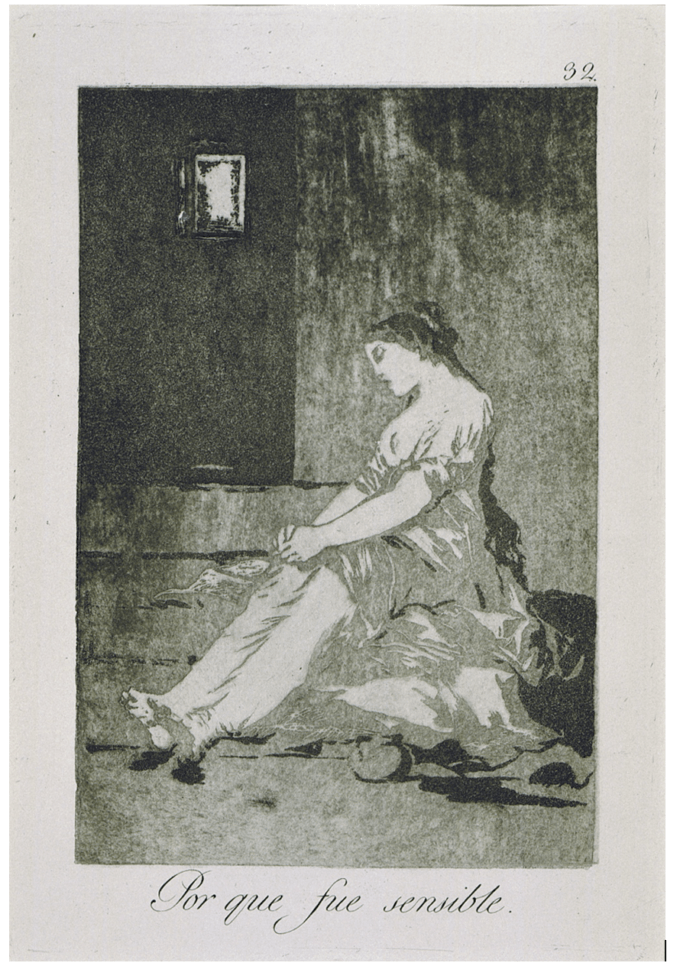
Francisco Goya, Los Caprichos. Plate 32. Por que fue sensible (Because she was susceptible), 1799.
Before the poison began coursing into Christa Pike on Wednesday evening in the Nashville execution chamber, she sang. The melody was unknown to witnesses, but described as “haunting.” The words of the refrain were “I love you.” Joining in at her side was her spiritual adviser, the Reverend Mikey Nochel.
The Nashville Banner reported that after the first attempt to kill Pike was underway, she complained that, “The vein in my arm feels like it’s about to bust.”
“Does it happen like that?” she asked. Noechel tried to calm her: “Relax,” he said. She said that was trying.
The state-sanctioned attempt to take her life continued. She gasped, her body heaving and her legs kicking off her sheet.
At the start of the horrifying spectacle, the curtain had been pulled back so that witnesses could see her. Pike was already strapped to the gurney and, according to one witness, “very emotional and sobbing.” She sang as she wept. Song would get her through what was intended by the executioners to be the hell of her final earthly ordeal.
Pope Leo had called for a stay. After the two injections did not kill Pike, Tennessee’s Governor, Bill Lee, halted further executions. Was it all the prayers that had been answered, when legal avenues had been closed? Pike’s lawyer, Randy Spivey, told reporters that she was alive but in critical condition. Her own voice has yet to be heard again.
The importance of song for the condemned brought to mind Kelly Gissendaner’s execution in 2015. For nearly two decades she had been the only woman on Georgia’s death row and the first woman to be killed by the state in seventy years. Gissendaner sang as she died. A letter on her behalf from Pope Francis had convinced the Georgia Board of Pardons and Paroles to grant clemency.
Eyewitness accounts told of her final rendition of Amazing Grace amidst sobs and bursts of prayer while she lay strapped to the gurney in the purgatorial green-brick execution chamber at the Jackson State Prison. Outside the gates of the facility, anti-death penalty activists intoned the same hymn, one often claimed as the best-known and most-oft sung on the planet.
In the Old West, too, the last moments of the doomed were accompanied by evangelical song. One of the most famous of these scenes comes from the execution of Tom Horn in 1903 in Cheyenne, Wyoming. He’d allegedly gunned down a fourteen-year-old boy during a range war. The Denver reporter John Charles Thompson described the scene:
Would you like us to sing, Tom?” asked [his friend] Charlie Irwin. “Yes, I’d like that,” responded Horn. So, while [Deputy Sheriff] Proctor buckled straps that bound Horn’s arms and legs, the Irwins, each in a rich tenor, sang a rather lugubrious song popular on the range, Life is Like a Mountain Railroad.
Horn’s memoir, published in Denver a year after his death, included letters and statements from his friends, as well as the text of the song (heard here in a version by Johnny Cash). “Life is like a mountain railroad, with an engineer that’s brave; We must make the run successful, from the cradle to the grave; Watch the curves, the fills, the tunnels; never falter, never quail; Keep your hand upon the throttle, and your eye upon the rail.” The book prints all four verses and the chorus, suggesting that the brothers sang the whole thing, until—and perhaps after—the trap door had opened beneath Horn.
A prefatory description imbues the scene with more feeling than does Thompson’s reportage:
Tom Horn counted among his most valued friends the Irwin brothers, Charles and Frank, and rightly so; for when his last moments had come (moments from which the most devoted shrank), theirs were the last friendly faces he beheld—these two, who were there to sustain him, singing, at the scaffold’s foot, with brave, tear-choked voices, a song to cheer their former comrade in his extremity.
Unlike Gissendaner, who repented of her crime and on her deathbed bewailed her commissioning of the murder of her husband, Horn maintained his innocence until the end.
From Old Europe to the Old West, hymns at public executions were meant to repudiate the intransigent or to console those who had admitted their guilt, thus confirming in song that murderers, too, would receive Jesus’ forgiveness even if judicial authority denied mercy. In eighteenth-century Leipzig, Bach’s choir processed behind the condemned to the scaffold while singing Lutheran chorales. Those to be executed had almost always confessed since they had been tortured to do so, not for the purposes of confirming guilt but as a service to the accused so that their souls would be saved.
In many cultures, individuals are equipped with death songs that will carry them across the threshold to the next world. The Lutherans of Bach’s time were instructed to learn chorale melodies that they could sing on their deathbeds to steel themselves against the final assault of the devil. One favorite for these purposes was Wenn mein Stündlein vorhanden ist (When my little hour is at hand), an affirmative major melody with which Bach closes his cantata from 1723, Christus, der ist mein Leben, Sterben ist mein Gewinn (Christ is my life, dying is my gain). If possible, the dying used these hymns to sing themselves to sleep for the last time. The snarling lions and gnawing rats that the devil conjured around the deathbed were as terrifying as the fears of the scaffold, or so claimed many Lutheran pastors: one’s own pious music stilled the demons.
Harry Paige’s 1970 book Songs of the Teton Sioux, one of the most humane and beautiful books of ethnomusicology ever written, contains this deathbed scene, one that in the aftermath of Gissendaner’s execution summons thoughts of that Georgia chamber whose only windows opened onto the observation room:
There are few poets in the records of western civilization known to have sung their swan song, who have faced death with only the armor of song. Yet the Sioux has done this—and still continue to do it. The writer will never forget the old woman who lay dying in the alien sterility of a hospital room in Rosebud, South Dakota, in the summer of 1964. She motioned for the nurse to draw open the shades so that she might see the hills, the sun and the sky. Then, in a feeble voice that held no hint of fear, she began to sing her death song. The words were fragile and confused, but the last part clear: ‘le makoce waste wi kiN wana ehake waNmayakuwe.’ (This land is beautiful. O Sun, now for the last time, come greet me again.)
The spurious calm of the Georgia execution chamber was unmasked by Gissendaner’s distress even as she sang on the gurney, her voice fading before the color of her face turned from “crimson to gray in a matter of minutes” and her “hands [went] from flexing to stillness,” as one eyewitness put it. The crackle of the auto-da-fé may have been inaudible in the death chamber, but it was there.
Gissendaner’s troubled but steadfast singing summons the steadfast voice of Protestant Reformer Jan Hus, who died on the heretic’s pyre six hundred years ago this past July. Hus’s student, Peter of Mladonovice, an eyewitness, relates the last that was heard from his teacher:
When the executioners at once lit [the fire], the Master immediately began to sing in a loud voice, at first ‘Christ, Thou son of the God, have mercy upon us,’ and secondly, ‘Christ, Thou son of the God, have mercy upon me,’ and in the third place, ‘Thou Who art born of Mary the Virgin.’ And when he began to sing the third time, the wind blew the flame into his face. And thus praying within himself and moving his lips and the head, he expired in the Lord.
Back in 2016, the Atlanta nightly news program 11Alive published a 45-second segment of Gissendaner’s final words from the death chamber in which she asks prison pastor Susan Bishop “to let my kids know I went out singing Amazing Grace.” For the time being, her death song itself has not been resurrected from the state department of correction’s audio vaults. It’s hardly surprising that this material has not been released. This song was then a more powerful voice for ending the insanity of the death penalty than the pope’s words.
David Yearsley is a long-time contributor to CounterPunch and the Anderson Valley Advertiser. His latest albums, “In the Cabinet of Wonders” and “Handel’s Organ Banquet” are now available from False Azure Records.
Read the full story at the source
Source: Counterpunch