
World · Counterpunch · · 3h
A Pilgrim’s Passing: Annie Dillard and the Meaning of Life
English (original) · Read in Deutsch ⇄
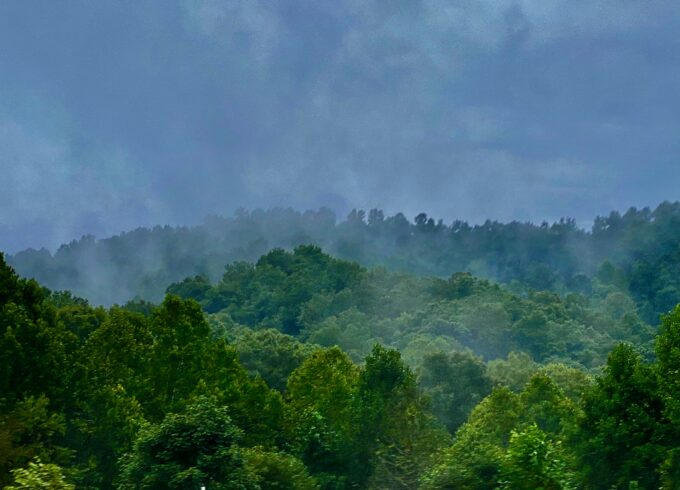
Tinker Creek, Blue Ridge Mountains, Virginia. Photo: Jeffrey St. Clair.
Evolution loves death more than it loves you or me. This is easy to write, easy to read, and hard to believe. The words are simple, the concept clear—but you don’t believe it, do you? Nor do I. How could I, when we’re both so lovable? Are my values so diametrically opposed to those that nature preserves? This is the key point.
– Annie Dillard, Pilgrim at Tinker Creek, Chapter 10, “Fecundity”
Annie Dillard died on Tuesday, September 15. She was 81.
Years ago, when I was a student, I read Dillard’s Pulitzer Prize-winning account of living close to nature, Pilgrim at Tinker Creek. On its face, the book is the essay-like record of a twenty-something’s attempt at a latter-day Walden experiment in southwest Virginia.
Like the Wanderer of Concord, the Pilgrim of Tinker Creek cheats a little, and the reader may be forgiven for thinking that both were roughing it in rustic isolation. In fact Thoreau made frequent sojourns to the Emersons’ house for dinner and apple pie over the two years, two months, and two days he spent in his cabin by the pond. Dillard rusticated with her husband, Richard, in a suburban ranch style rental outside of Roanoke, near Tinker Creek. But let that go. Like Thoreau, too, Dillard’s approach—in spite of a superabundance of biological facts and trivia at her mental fingertips—is literary rather than purely scientific.
But instead of the romantic, year-long romp in the woods one might expect from a 1960s lit major with a thesis on Thoreau, Dillard confronts the decidedly non-transcendent natural world of Darwin. With a background in literature, theology, and bugs, she sees nature less in terms of a theistic reflection or a pantheistic embodiment of the divine, but rather the amorality and brutality of natural selection, its waste and excesses. I remember reading something, around the same time that I first happened on Dillard, about how different the works of Emerson and Thoreau might have been had they lived in the Amazon or Congo Basins, the Galapagos, or the Sahara, rather than the bucolic woods of semi-rural Massachusetts. I was writing my master’s thesis on Emerson, and the idea stuck with me.
I had read Darwin and Malthus years before, but had not fleshed-out all of the inconvenient implications, moral and otherwise, of undirected biological order on human assumptions, and was rattled by Dillard’s unflinching, if at times overheated, perceptions. In Chapter 10, titled “Fecundity”—an idea related to fertility meaning capacity to reproduce—after many pages detailing the wholesale wastefulness and the unthinking, unfeeling cruelty of nature, she writes: “Either this world, my mother, is a monster, or I myself am a freak,” and “we have not yet encountered any god who is as merciful as a man who would flick a beetle over on its feet,” and more economically, “Evolution loves death more than it loves you or me.”
The epiphany leads inexorably to a Nietzschean take on Darwin: nature, far from being a collection of Aesop’s fables to reinforce human values—much less the reflection of a loving God—is absurdly inefficient and profligate. In his critique of the Stoic’s idea of nature as a moral touchstone in Beyond Good and Evil, the other solitary Wanderer of the 19th century writes:
You want to live ‘according to nature’? …what fraudulent words! Nature is prodigal beyond measure, without aims or intentions, without mercy or justice, at once frugal and barren and uncertain; think of indifference itself as a power—how could you live according to such indifference? To live—is that not precisely wanting to be other than this nature?
Perhaps, if Dillard had focused on how social mammals reproduce and raise their young, the picture would have been less bleak than her observations of the eye-opening wastefulness of rock barnacle or ichneumon wasp reproduction (for instance). After all, evolution is not just the tautological “survival of the fittest” of individual selection, but also the nuances and complexity of multilevel selection, including eusociality, cooperation, symbiosis, and, among some mammals, family life and the nurturing of young.
Beneath the many stark implications of her observations is nature’s amorality—its supramorality—and the unavoidable takeaway that there is no deontological basis for morality, and therefore no objective prescriptive meaning to life. Although this is jarring for a novice confronting it for the first time, the British philosopher A. J. Ayer observes that the absence of deontological ethics is a simple fact to be acknowledged, and that it is an error in reasoning to think that things could have somehow been different. As Ayers’s biographer, Ben Rogers, notes in his biography, A.J. Ayer: A life, the existentialists, among others who followed in Darwin’s wake, “had mistaken logical necessity—the absence of transcendent meaning—for empirical disaster.”
Given that the moral basis for traditional religion is founded on the metaphysical and ontological assumption—assertion—of the reality of absolute values, we are left alone with the disquieting facts that there is no loving, personal, or caring God, no afterlife, no universal values, no inherent meaning, no Easter Sunday. We are left with a moral void, left asking: what is the basis for moral agency? What is left? The lack of transcendent meaning, although simple “logical necessity”—would appear to be a disaster for traditional human ethics. Just ask the Grand Inquisitor.
Darwin, like a reluctant force of nature himself, made people see nature as it really is (although it also has characteristics of a Rorschach inkblot), even though it threatened to unhinge the moral basis for how to live. Samuel Butler may be right in a rational-empirical sense that the various Darwinian controversies were nothing more than Victorian “teapot tempests,” but to writers and philosophers, as well as ordinary people, undirected natural order created a void—a crisis—a with real repercussions. Without giving an inch on his theory, Darwin himself tried to assuage Victorian sensibilities ravaged by his theory with the austere consolation that “There is grandeur in this view of life…” The Existentialists and other modernists saw opportunity in Darwin’s moral void, for along with the potential horror of being untethered from absolute values was the newfound freedom to choose one’s own, and then try to live up to them. But for much of the traditional mainstream of Darwin’s time and ever since, grandeur and freedom were a scant comfort relative to what was lost.
In many religions, including Christianity, God fulfills two all-important roles: that of Creator and that of a basis for values. In On Human Nature, Edward O. Wilson writes,
If humankind evolved by Darwinian natural selection, genetic chance and environmental necessity, not God, made the species. Deity can still be sought in the origin in the ultimate units of matter, in quarks and electron shells… but not in the origin of species.
God may thus be tenuously defended as a possible creator of the cosmos in rearguard theistic arguments and in the bad-faith prosecutorial badgering of entertainers like Ben Stein. God may also be marginally defended, as Spinoza’s and Einstein impersonal “God is Nature” (Deus sive Natura) creator and creation of a pantheistic universe that includes all things, good and evil. But ever since Darwin, God may not be reasonably defended as a basis for a universal standard of values—Dillard’s account of ichneumon wasp reproduction pretty much nails that one down. Even if there if there is a higher creative intelligence or ordering principle to the cosmos, it is apparently neither interactive nor moral. Some believers adopt a teleological approach and read “intelligence” out of an alleged “design,” but there is no universal morality in the natural world. So much for Providence, or as Woody Allen observes in Getting Even, “Not only is there no God, but try getting a plumber on a weekend.”
For Wilson, morality does come from nature, although not in a way that is satisfying, much less comforting to the faithful: the human capacity for ethics is the product of a kind of social intelligence—a cognitive matrix perhaps like the human capacity for generative grammar—shaped by tensions between individual selection and group selection (we are thus a naturally off-balance creature). Nature provides the hardware, nurture provides the software. This basis for semi-cooperative social behavior is a randomly sculpted gift from nature, shaped by environmental pressures, and empathy and altruism exist in other social creatures as well. Thus “morality” may extend beyond the human genome in varying forms and as dictated by the evolutionary tracks of other mammals and birds. It is therefore inaccurate to say that these creatures are not moral agents, but the morality varies from species to species and is not objective and universal.
If we are perceptive, like Dillard, we will see the constant reminders around us that creatures—including human creatures—often suffer and die horribly, without greater meaning or any meaning at all. We are all potentially Job without the possibility of salvation: to live is to risk catastrophe, and all that nature “owes” us is a chance, if that. It is an unpleasant and mostly unspoken fact that most people die in abject horror, and that the best and worst of us alike suffer haphazardly. Most often when we attach a greater meaning or justification to suffering and death, we are merely engaging in a personalize myth-making or protective self-delusion. Denial and rationalization are the twin pillars of human psychology. We all do it.
The upshot of all of this is that there is no singular prescriptive meaning to individual human existence, and by extension, to human civilization, nature, and the universe. Outside of the descriptive truth rendered by scientific discovery (and the formal truth of logic and meta-mathematics that seems to underlie the workings of the physical universe, and scientific application via technology and engineering), there is nothing like permanent progress, only temporary measures, jerry-rigs, stopgaps, frequent wrong turns, countervailing trends, and backsliding. Our only tools are the slender reeds of reason, moderation, and empathy.
Blue Ridge Mountains, near Tinker Creek, southern Virginia. Photo: Jeffrey St. Clair.
Anyway, I knew all of this before reading Pilgrim at Tinker Creek, but Dillard helped put the problematic aspects of nature vis-à-vis human delusions of progress and transcendence into sharper focus for me. She connected the dots and underscored the contradictions. And then there was the artistry: sentence after sentence, page after page, chapter after chapter, nobody writes this well, I thought in my twenties (I am still impressed, although somewhat less jarred when I revisit her Chapter 10). For years she was the standard by which I measured the writing of other authors. In this sense, I suspect that she is for people my age what Henry Beston was for an older generation. The Outermost House was an influence on Dillard’s writing.
To my own twenty-something sensibilities, her perception was superlative, as was her ability to express what she saw in what seemed to be impossibly perfect language. Hers was an odd and interesting mind and she was wonderstruck and perfectly honest in her writing, even when Nature affronted her sensibilities. Calling it like she sees it, she writes:
Look: Cock Robin may die the most gruesome of slow deaths, and nature is no less pleased; the sun comes up, the creek rolls on, the survivors still sing. I cannot feel that way about your death, nor either of us about the robin’s—or even the barnacles’. We value the individual supremely, and nature values him not a whit.
After I heard the news about Annie Dillard last week, I picked up the old marked-up copy of the book that had so impressed me all those years ago (I also have a hardback, first edition copy in near mint condition that I found in a used bookstore a few years ago, but it’s mostly for show). Rereading “Fecundity,” I realize that, just as I cannot go back to an Emersonian view of nature, nor can I return to Dillard for more than a few seconds with the eyes I read her with almost 40 years ago. When I read her, a momentary vacuum opens, and my subsequent reading and understanding rushes into the void almost immediately. It reminds me of something that Jedediah Purdy, another impressive stylist, wrote in his 2019 book, This Land Is Our Land: The Struggle for a New Commonwealth.
At one point, depressed by political developments in the United States, Purdy goes into a wallow of solitude, a Thoreau-like return to the moral instructiveness of a “naïve” response to nature—“a kind of second naïveté that one returns to after time away.” I think that all of us who are attracted to nature know what he is talking about and may choose to occasionally re-immerse ourselves in writings that come home to us like old friends, friends that we can no longer fully welcome. We long for and may attempt to return to these works with the lost pre-Darwinian wonder of youth, or the moral superiority one felt after reading of Walden for the first time, or Pilgrim at Tinker Creek. The best we may do is to read it as a kind of fiction, and as with fiction, employ the suspension of disbelief.
In reading Purdy’s words, two thoughts occurred to me. On the one hand is the idea expressed by Ron Powers in Ken Burns’s documentary, Mark Twain, on Clemens’s last return to Hannibal, his boyhood home: “When you become unsure of who you are now, you go to who you were when you knew who you were and try to read back out of that.” Fair enough. But on the other hand, you can’t repeat the past, Jay Gatsby, and you cannot unlearn what you now know. My sense is that Jed Purdy, even in despondency, knows full well who he is and does not really need to be reminded what his “non-negotiables” are. He asserts a third consideration: that this re-immersion in nature “would never be an escape from history and social life into a greenwood idyll. It would be a way of getting another angle of vision on the same social facts, the same greedy and unequal humanity.” In a depressed state, some people self-medicate with ice cream, chocolate, or chicken soup. Others choose scotch or Malbec. Purdy chooses reorientation by returning to nature. Who can blame him?
I suspect that it is always difficult when an author’s first book is their best, and this was the case with Dillard. An American Childhood, Tickets for A Prayer Wheel, and The Writing Life are all good—and I tried to read her fiction only once, her novel The Living—but none matched the first. In some ways, her prose reads like poetry, and yet I liked it better than her verse. Written in her mid-to-late twenties, Pilgrim at Tinker Creek won the Pulitzer Prize in 1975. She was the youngest woman to have ever won for General Nonfiction.
Coming back to the book so many years later, it still packs a punch, perhaps seeming a little too worked up and manic to mature eyes. Dillard herself seems a little remote, self-focused, and youthful—a writer who might not even need an audience (the book might have just as easily been called Alone in the Woods). Like the creek itself, my taste in reading has moved on a bit since Dillard. She has been superseded in nonfiction by Justice Holmes, Bertrand Russell, Karl Popper, Roger Penrose, John Gray, and Lee Smolin. Likewise, my nature reading has shifted away from the literary to the scientific, to biologists, sociobiologists, and paleo-biologists, like Lynn Margulis, James Shapiro, Niles Eldridge, and Edward O. Wilson, whose On Human Nature, won the Pulitzer three years after Dillard. Still, there will always room on my shelf for Pilgrim at Tinker Creek.
Dillard made it impossible for me to go back to an earlier, more naive perspective on nature—to Emerson and Thoreau other than as historical markers that were largely outdated at the time they were writing. But rereading her reminded me how I used to feel when reading her. Now, she too, in all of her precocious disillusionment, has become a part of my intellectual past, less as an oracle from another time, like Thoreau, than a traditional figure.
All the same, if you haven’t read Pilgrim at Tinker Creek, do yourself a favor. Keep your youth in your back pocket, Kerouac-like, and in doing so, insofar as it is possible, try to read it afresh with eyes that are still capable of being earnestly shocked and wonderstruck, or else to remember a time when you could have been.
Michael F. Duggan blogs at realismandpolicy.com.
Read the full story at the source
Source: Counterpunch