
World Autonomies
The children in revolt
by Francesco Demitry from lundimatin, #541, 10/11/2026 They learn to wait for the bell, the bus, their turn to speak, permission to go out, for the day someone deems them old enough to understand the
English (original) ·Read in Deutsch ⇄

by Francesco Demitry
from lundimatin, #541, 10/11/2026
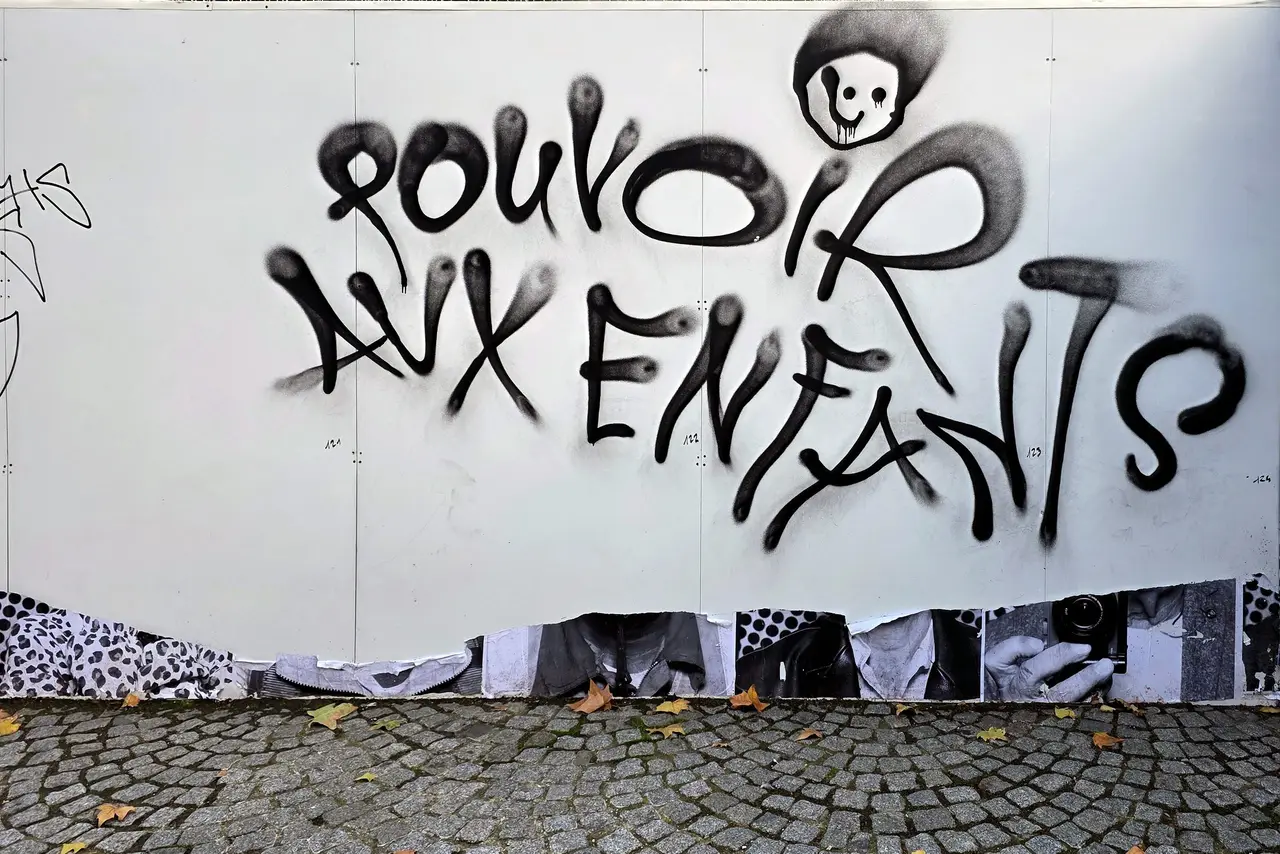
They learn to wait for the bell, the bus, their turn to speak, permission to go out, for the day someone deems them old enough to understand the world. They learn to become alienated. They learn to keep quiet, to be silent. Then, one morning, they overturn the tables in front of the gate, and the town discovers they exist.
The young people who have occupied the streets in Italy and France in recent weeks are not mere ambassadors of hope, nor are they the innocent mascots of a political establishment running out of words. They are bodies that are hungry, that are cold, that feel anger and desire, that know overcrowded classrooms, dismantled services, and a mortgaged future. In France, the mobilisation began in the Parisian suburbs, where students denounced the deterioration of schools, vacant teaching positions, and the lack of nurses and social workers. It spread to more than a thousand schools across the country. In Italy, students led the marches against the high cost of living, rents, low wages, rearmament, and the war economy. In Genoa, thousands of people entered the port to protest the transit of weapons. Different stories, but on both sides of the Alps, the same melody is emerging: that of a generation rejecting a world it is supposed to inherit, a world that is already closed.
To whom does a school belong without teachers? To whom belongs a city where the bus is too expensive, where housing is becoming unaffordable, where the park is fenced off and the courtyard sold? School is where inequality is laid bare: a crumbling building in a working-class neighborhood, a replacement teacher who never arrives, a closed workshop, a dry tap. Our address should not determine our future, some French high school students have written. Capitalism seeks to transform space into destiny, assigning each person a piece of the city and calling the distance between those who can cross it and those who must remain confined to their neighborhood or be evicted a matter of merit.
Governments respond with budgets and decrees. They announce recruitment and controls, deploy law enforcement. On November 5th, in France, as unions and students took to the streets again to demand better wages, public services, and education, the state deployed a significant security apparatus. In Italy, a few days earlier, police water cannons had dispersed a march in Turin. Faced with people forging their own path, the authorities presented the bill: order. But a public square is not a classroom that can simply be brought into line. The square is overflowing; it is bursting at the seams. Those who are protesting cannot simply be asked to raise their hands and wait for their demands to be reviewed by the appropriate department.
Luis Buñuel found an extraordinary image of how a social class, that of the old petty bourgeoisie, manages to survive everything; even the disintegration of the world around it. In The Discreet Charm of the Bourgeoisie, six characters are constantly trying to sit down at the table, to have a meal, to re-establish the small order of their habits. But something intervenes each time to interrupt them: a corpse, an army, the police, a story of violence, a dream that invades reality. The world knocks on the dining room door, and dinner is inevitably postponed. And the most disturbing thing is not that these people continue to desire their meal, but that each catastrophe seems incapable of changing anything in their lives. The bourgeoisie possesses this extraordinary capacity: to absorb interruption, to transform conflict into an annoyance, a minor inconvenience, history into a conversation that must be interrupted, always with decorum. Even when everything falls apart, the napkin is folded, the glass refilled, the appointment postponed. But it is above all in The Phantom of Liberty that Buñuel pushes this intuition to its most radical consequences. A group of bourgeois is invited to dinner and cordially ushered around a table surrounded by toilets. The guests sit down, lower their trousers, relieve themselves, and, in the meantime, smoke while conversing amiably. They talk about travel, current events, social conventions, without anyone seeming to find anything strange about the situation. The indecency, if there is any in this scene, lies elsewhere: in the act of eating. When they are hungry, the guests discreetly withdraw to a small room to eat their meal alone, discreetly asking where the kitchen is, with the same shame as if they were trying to conceal something improper. In a matter of minutes, Buñuel overturns the entire edifice of convention: what civilization considers private becomes public, what is celebrated as a ritual of conviviality becomes a practice to be concealed. This is not mere provocation, but a radical critique of the social construction of decorum, of the artificial separation between the body and its representation, between material needs and the forms by which a society decides to make them acceptable. Eating and defecating belong to the same material continuity of life, but the bourgeois order distributes them into different spaces, times, and hierarchies, establishing what can be shown and what must be hidden. The body, with its needs, its biology, and its excesses, becomes something to be administered, disciplined, and, above all, made presentable.
Is not this one of the first operations by which children are educated? Proper posture, not getting dirty, not shouting, not touching, not running, asking permission, learning to control every bodily action. School thus becomes a small factory of decorum, where even vitality must learn to occupy its assigned space and respect a predetermined time. Children who disrupt this order are not simply disobeying the rules: for a few moments, they make visible the body that the social order seeks to domesticate.
This is why their revolt is so dangerous: they do not want to be invited to this table, do not ask to take their place, do not demand a larger portion of the same meal. None of that. Their revolt disrupts the ritual and reveals its violence. They ask who built this room, who set the table, who cooks, who stays behind the door. They don’t want to sit at the table, but to rearrange the house and leave.
Artaud sought in the body a language withdrawn from the control of the masters. Young people find it again in dissonant choruses, footsteps that disrupt traffic, painted placards, overlapping voices, even in battles of aura. The body in the street produces and imposes the programme, tests it, transforms it. Michaux would have recognised in these signs an unstable geography, a writing made of shifts, stains, and inventions. The protest has neither a center nor a phrase that can summarise it. It is made up of a multitude of gestures seeking a polyphonic composition: who holds the banner, who distributes water, who brings Maalox, who stops in front of a police cordon, who returns the next day, who joins the workers’ procession, who participates from afar.
Gianni Rodari knew that imagination is not a pastime that adults grant children once their homework is done. It is a political faculty that allows us to overturn words, to change the rules of the game, to discover that the world could have been built differently. In his grammar, error can become invention, an unexpected combination can open a path, an absurd question can reveal and dismantle the absurdity of habitual answers.
But what would happen if we applied this lesson to the city? What if, instead of teaching children to adapt to available spaces, we allowed them to invent others? What if the closed gate became a door, the abandoned lot a garden, the street a meeting place?
Children are not subjects unfamiliar with rules, but rather those who can demonstrate how contingent they are; and sometimes, how unjust they are.
Here, Colin Ward becomes an important ally. The city is also what children make of sidewalks, abandoned lots, and the passageways between buildings. Play is a practice of appropriating the world, an ability to organise oneself without waiting for permission.[1] Nietzsche explained that we must relate to the world with the same seriousness as a child at play. Taking children seriously means recognising their political power and competence: forging alliances, inventing provisional rules, transforming a place, and caring for those left behind. When students block the school gate, the question must be what can be done together outside of the intended and pre-established use of this space.
There is another cinematic alliance I would like to mention: that of Harold and Maude in Hal Ashby’s film [of the same name]. Harold is a young man from a wealthy and privileged family, surrounded by objects, opportunities, and attention that never reach him (or from which he escapes). He constantly stages his own death, as if only the representation of the end could make visible an existence that others do not see. His mother, a bourgeois woman, tries to correct him by entrusting him to “experts” and attempting to make him respectable through marriage and social conventions. But then Maude, a woman approaching eighty, arrives unexpectedly, seemingly from another world. Maude attends funerals, steals cars, listens to music, indulges her desires, runs away and mocks the police, uproots a tree from the asphalt and carries it into the forest, returning it to a land where it can continue to grow. She does not want to teach Harold how to become a respectable adult, but shows him that it is still possible to let life flow through him, that there are encounters capable of reawakening the senses, that the world is by no means a possession to be kept, but a material to be transformed. Their alliance is based neither on resemblance nor on mutual reassurance. Together, they create an experience that neither of them could have generated alone. One generation can influence the other, reactivate its desires, open unexpected pathways. Maude takes Harold out of his home and returns the world to him as a sensory experience. And this tree replanted in the forest becomes more than an ecological gesture: it demonstrates that a life can be rescued from its assigned destiny and placed within a different network of relationships. It is about making possible again what does not yet exist.
Italo Calvino bequeathed to us cities that cannot be reduced to their walls, their monuments, their owners. Cities made of desires, memories, encounters, invisible relationships. Invisible Cities inhabit the possibilities that a real city contains but that its economic order prevents from being realised. Every neighbourhood could be another neighbourhood, every street could lead to an encounter rather than a parking lot, every empty space could become the site of a shared life. The lightness that Calvino offers is the gesture of one who manages to free the world from the weight of hierarchies, to imagine passages where power has chosen to build walls for its own benefit. Children do this constantly because they have not yet accepted that the harshness of the world, of which they are nonetheless aware, is the only thing that is possible one.
And there is something else that adults have taught children: time. Everything must be in its place; every activity has its appointed time; every desire is postponed until the opportune moment. The day is divided into segments, the body trained for punctuality, curiosity interrupted by the sound of the bell. We tell them that play must find its place in the schedule, as if it were a break from real life, the one in which we are (and must remain) immersed. Yet, it is precisely in this break that something escapes the measurement of production. A child can spend an entire afternoon (a lifetime) following an ant or a stream, inventing a city with three cardboard boxes or empty water bottles, following a path that leads nowhere. In economic terms, this means producing nothing. But that is wrong. On the contrary, the child produces relationships, discoveries, possibilities, and a quantity (and quality) of world that no indicator could ever quantify.
It’s also a question of time subtracted. Families have to rush to work, juggle schedules, pay for services that replace time spent caring, and be exasperated by children’s insistent demands. Teachers have to fill out forms, chase deadlines, and respond to administrative procedures. And the children? They must learn early, as early as possible, to be efficient, independent, and competitive, so as not to burden the bureaucratic and efficient organisation of real life. Life is thus constantly prepared, organised, and postponed. But when exactly does this life begin? When does the preparation finally end, and when does the right to inhabit the world begin? At what time? The promise of a better future becomes a perverse form of discipline, used to demand and justify the sacrifices of the present. Young people are told that one day they will be able to choose, provided that today they learn to obey. Their eruption into the streets challenges us and shatters this temporal blackmail. They are not simply asking for a different future: they are clamouring for a present where it is possible to live differently.
The children in revolt are the high school students in the streets and the children staring at closed shop windows, the striking workers, the parents struggling to make ends meet. They are the inhabitants of neighbourhoods without gardens, of villages where schools are closing, of territories ravaged by factories or highways. They are those who are asked to adapt to an increasingly uninhabitable planet. They are told that adaptation is a virtue, not a polite way of surrendering. Their revolt turns the question on its head: how do we dismantle the world that prevents them from truly inhabiting it?
Let us not, however, make the mistake of thinking that this would mean replacing adult politics with a children’s politics, as if two separate worlds existed and one had to finally take the place of the other. Revolt does not need a new identity to preserve, a chosen generation, or a savior figure come to redeem past defeats. Its movement is, fortunately, more unpredictable. A teenager blocking their school, a parent defending time for care, a teacher in a precarious situation, a worker going on strike, a resident preventing the overdevelopment of their neighbourhood can all recognise themselves in the same struggle without sharing the same history, the same language, or the same vision of the future. They do not need to become alike to find common ground. They must be able to mutually transform their possibilities.
An alliance is neither the sum of pre-existing interests, nor an agreement between organisations that decide to support each other. It is rather an encounter that transforms those who take part, unleashing previously nonexistent capacities. When student mobilisation meets workers’ strikes, when the right to education is intertwined with the right to housing, when the fight against war meets the struggle for territorial defence, it is not simply a matter of adding demands to a checklist. What changes is the way we perceive the conflict. What appears to be an individual problem reveals itself, as always, to be a social relationship. What seems like a simple local issue demonstrates its connection to a much larger economic machine.
This is why it is not enough to ask ourselves what children lack (resources, infrastructure, teachers, green spaces, time, affection…). Their presence cannot be understood through a kind of “catalogue of deprivations”. Desire, once again, does not arise from a void that someone should finally fill. Desire is revolutionary because it has the capacity to encounter, to combine, to build. An occupied courtyard, a communal kitchen, a school open to the neighbourhood, a garden rescued from neglect are not temporary responses to a lack, but genuine creations of reality, capable of bringing into being relationships that were previously nonexistent, of transforming a space, of generating new shared imaginaries. Revolt also begins in this way, when a possibility ceases to be merely conceived and becomes a practice.
And there can be no ecology without this capacity. Children are told that they must protect nature separate from the city, that they must recycle and turn off the lights, while adults continue to organise extraction, consumption, exploitation, and destruction. Ecology is not a virtuous behaviour to be added to the school curriculum, perhaps during extracurricular hours or dedicated subjects. Ecology is a question of the relationships between human beings and other forms of life, between bodies and environments, between those who decide the fate of a territory and those who are forced to endure it. What does it mean to talk about the future to a child growing up beside a polluted road, in a treeless suburb, in a territory where water is privatised or land is given over to speculation? The ecological crisis is not a distant threat. It is already distributed, in space and in bodies, according to a very precise class geography.
The children’s revolt connects the school with the river, the playground with the forest, the port with the neighbourhood, because children know that no form of life can be isolated from the relationships that make it possible. It is a politics of interdependence, a practice of alliance between heterogeneous worlds. A felled tree, a dried-up spring, an animal driven from its habitat—these too tell a story about this same world order that would have students silent and adults docile. There is no external environment that needs saving after society has been put back in order. Society is already an environment, made up of bodies, infrastructure, emotions, dependencies, and conflicts.
Perhaps we need a clandestine approach to possibility, in the sense of wresting life from prescribed destinies by reopening this administered future, which we treat as an already exhausted possibility. We must preserve a shared possibility at the heart of the catastrophe. We must not ask children to save us. Entrusting them with the weight (and the guilt) of our absolution would be the ultimate form of exploitation. Instead, let us ask that their presence transform our way of deciding, producing, and inhabiting. Revolt is life taking up space, here and now, in this very moment. If the streets are filling up again, it is because diverse bodies, often at odds, have discovered that they can walk together without becoming alike.
The city belongs neither to those who govern it nor to those who buy it. It belongs to those who traverse it, care for it, disrupt it, and reinvent it. One morning, the children overturn the tables, open the gates, and occupy the sidewalk. And the city, which wanted them in line, is forced, for a moment, to learn from them the most difficult verb: to begin.
[1] [T.N. See: Colin Ward, The Child in the City (1978), The Anarchist Library.]