
Anti-fascism Autonomies
Intifada and fascism. Resisting humans, affirming monsters
by Rodrigo Karmy Bolton from Ficción de la razón, 27/10/2026 It has become fashionable, thanks to sociological bureaucracy, to claim that the danger of any uprising is that it leads to fascism. That f
English (original) ·Read in Deutsch ⇄

by Rodrigo Karmy Bolton
from Ficción de la razón, 27/10/2026
It has become fashionable, thanks to sociological bureaucracy, to claim that the danger of any uprising is that it leads to fascism. That fascism can capitalise on it, turn it into an electoral and political enterprise, and triumph by harnessing its power and transforming it into a force. They used to say that revolt expresses “anomie” – that is, a normative mismatch with social dynamics – and that it was “violent” and “senseless” in that it involved burning things, looting shops and disrupting the “normal” flow of events. Now they say it leads to fascism and that, for that reason, it must be avoided at all costs. That if Le Pen wins at the French polls, it will have been due to the undeniable revolt; for if Kast won in Chile, his victory would have been due precisely to that. The revolt would be anomic, violent and, moreover, reactionary. Nothing could be more of a threat to progressivism than the people taking to the streets; nothing could torment its pedagogical mindset more than a crowd on a war footing.
But there are certain things here—too long-standing, too antiquated—which, nevertheless, must be recalled: first and foremost, the argument that revolt leads to fascism (however complex it may be) obscures the question of why fascism exists, why it arose, if not from decades of violent neoliberal reforms which have literally left people on the streets, landless, with no place in the world. How are we to interpret the case of 87-year-old Maricarmen, who was evicted from the house she was renting because she could not pay the rent? Evicted from their homes and left out in the open, the people today are all Palestinians; they are all Maricarmen: they live landless, homeless, with a longing to return. Neoliberal reforms that have been imposed across the globe and which have now entered a new phase in their process of intensification, where they have had to resort to “so-called primitive accumulation” to escape the stagnation that their own model – their own “civilisation” – has produced.
In its various forms, neo-fascism—steeped in melancholic passions and capitalising on public panic—has been the means by which the model has chosen to realise itself, accelerating its processes of accumulation. To this end, it needs to bury any form of state-legal framework capable of curbing or containing its momentum, thereby hastening the fulfilment of a sort of “parousia” of capital in which, at last, capital encounters no restraints whatsoever and is definitively consolidated upon the earth. A new process of plunder, dispossession and conquest of the earth has begun to consolidate the new machine of death: the artificial intelligence corporations that have made war the leap through which they seek to break free from their own stagnation. Led by the super-rich, the violent process of acceleration through which they set out to appropriate new lands is meeting with resistance.
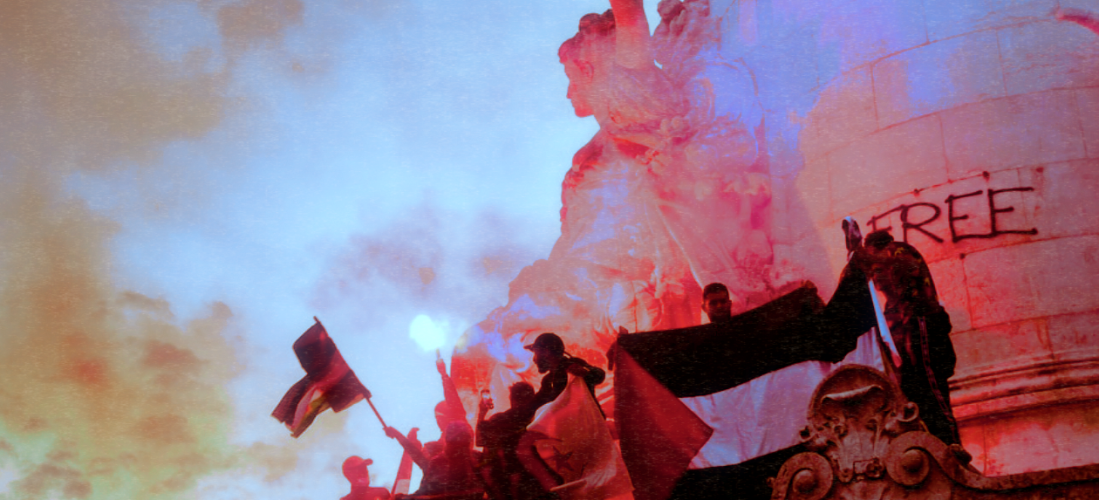
The global intifada—which is nothing other than a field of multiple interdependencies—becomes the disruption of worlds rising up against the levelling imposed by capital. Whilst the latter strips peoples of their lands, their landscapes and their places, the intifadas disrupt this levelling to reweave interdependencies between worlds precisely where capital and its globalisation seek to triumph: without distance, without fissures, without chasms—merely bodies pressed together. Capitalism reveals itself today in a completely transparent manner. There is no need to dream of a “behind-the-scenes” force manipulating history; it is enough to experience what happens every day: psychological disasters, the proliferation of genocides, the frantic efforts to work in the informal sector, widespread precariousness, and the systematic exclusion from our cultural, social and political rights. The repeated discourses of the old fogies who thought they were lecturing us after the October uprising—claiming that the uprising was lawless, violent and, moreover, that it would lead to fascism—believed themselves to be effective, but strictly speaking, they have been nothing but empty words, like all pedagogy today.
Young people have taken to the streets. Uninterrupted, for years now: today in France, Spain and Albania; previously in Chile, Iraq and the United States. The old fogies tell young people that they are “apolitical”, that they admire Spider-Man rather than Lenin, and they resort to the same old rhetoric about order: what applies to the uprising applies to “young people” – lawless, violent and, ultimately, “fascists”. Young people, too, are supposedly “fascists”. Not only should they go to the psychiatrist to manage their ADHD, depression or panic attacks, but they should also listen to the old fogies so they can lecture them on what democracy is and why it should be respected. And then comes the “left”: who really cares about that discussion at the very moment of our mass murder? Who could possibly care when it comes to the destruction of our life force? The bureaucrats will be satisfied, but always unhappy. For they believe that unhappiness is the norm. The sheer scale of the intifadas, their spill over at regional and global levels – spill over which, in turn, has been channelled into mapping new flows of insurrection across the globe, flows that remain invisible to the canons of representation – has flooded the Earth and has continued to do so for some time now. The intifadas lay bare the transparent corruption of public power, the war inherent in private power, the ecological disaster into which we have been plunged, and the massive devastation that has become an everyday reality.
Well, it is not the intifadas that lead to fascism. It is the violence of the state-capital, implemented over decades of neoliberalism, that underpins its stage and provides its space. The super-rich are its director; the apparatus of control and security, its stage. The intifada becomes their threat, the monstrosity that looms before the upright “humans” who besiege and devour the masses. For it is not a question of establishing a “civilisation” to make us “human”; rather, it is that the “humans” have waged an endless war against any form of life that transcends their models. The Palestinians, the poor, the migrants are not human. They become monsters. And this is precisely the war between humans and monsters. We – like every living being – are nothing more than monsters inhabiting the interface between worlds. For centuries, the “humans” have sought to assert their dominance over the monsters. And when they have wiped them out, they have annihilated themselves. Our happiness on earth lies in inhabiting our monstrosity, travelling ceaselessly between worlds; and so, like Gabriela Mistral in “Poem of Chile“, we sing of the journey, we sing of our inhabiting the interface—that place no satellite can locate, yet which smoulders within us like the eternal fire through which the voices of the dead never cease to mingle with those of the living.
The bureaucrats will try to convince us – yet again – that life is meant for ruling and not for inhabiting; that play is useless, that stupidity serves only the master and the boors who accompany him, and that “success” and “profit” are the only things that matter. The literature of our bodies is good for nothing more than being sanitised by the “experts” in monsters, those who, at the slightest hesitation, declare us terrorists. That is what is at stake in the European uprisings, because it is what has been at stake in the various uprisings that have erupted over recent decades: not a programme, not a political project, not an electoral machine, but something far less significant yet perhaps far more threatening: a vital passion that yearns desperately to inhabit, a literature of bodies intertwined at the interface of worlds. A literature of monsters, the misfits who belong nowhere, who have been cast out for being too old, perhaps ugly, for being useless or simply for being poor. The intifada is against the “humans”, now that they have cloaked themselves in Zionism, now that, once again, they believe themselves to be “chosen” to occupy the Earth.
In any case, the plan is clear: just as in Palestine, to expel us, annihilate us, lock us away. Fascism only comes about thanks to the bureaucrats who concoct the fiction that revolt leads to fascism, thanks to that left which wants nothing to do with insurrection, which turns a blind eye to street violence, thereby leaving the dirty work to the police. Returning to the Earth means populating the interworlds, at the interface where they intersect, in the resonances that each carries of the other, where each is a mixture and their plurality is variegated rather than individualised. Fascism is not merely a friend of bureaucracy but rather bureaucracy itself, at its most efficient, whose ultimate form crystallises in AI and its imperialist corporations.
Nothing can renew our spirits without embracing our monstrosity: the interregnum is our place, monstrosity our way of existing on Earth. If “humans” – monsters devoid of affection, devoid of eroticism—have denied their monstrous condition by repeating “resentment” as the condition by which they tame their passions to play a part in a highly technological machine of mass murder, precisely so as not to be “affected” by the very efficiency of the task they carry out, we must affirm it: we are the monsters who declare war on the “humans” and their arrogant civilisation. Neither animals nor humans. Monsters: creatures of the interface who dance amongst the multiplicity of worlds and their interdependencies.
October 2026