
World · Africa Is a Country · · 48m
Who gets to speak for Eritrea?
English (original) · Read in Deutsch ⇄
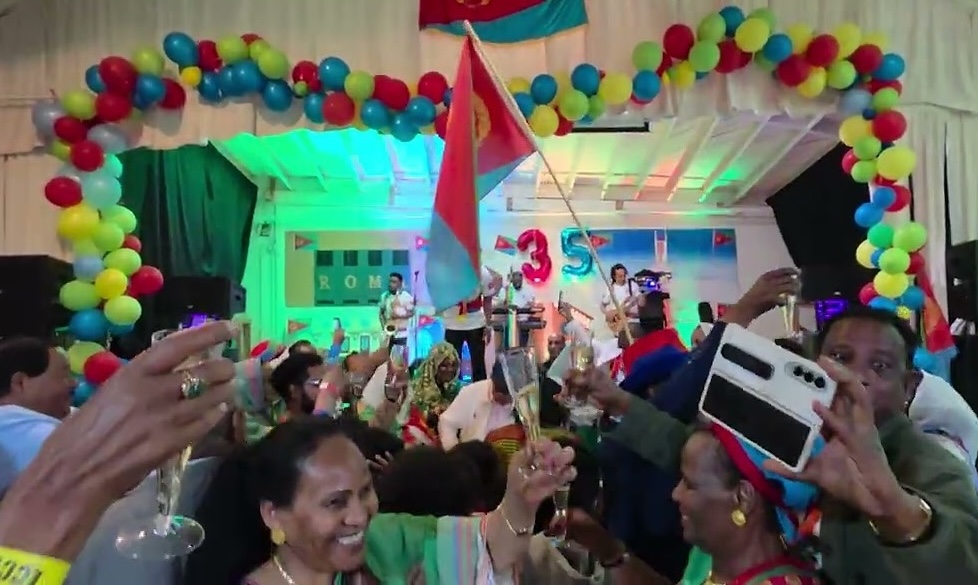
Eritrea made its Miss World debut earlier this month, becoming one of the newest countries to join the competition since its founding in 1951. Miss Eritrea Snit Tewoldemedhin not only represented the country on this global platform for the first time — she won the People’s Choice Award. This achievement is a remarkable demonstration of Eritrean diaspora mobilization, but it’s not what stuck with me following the competition. In reality, the last beauty pageant I watched was probably Miss Congeniality, but as an Eritrean, it was impossible not to notice the paradox of Eritreans voting for the first time from a scattered diaspora, while those inside the country remain largely shut out of participation due to severe restrictions on internet access. It was equally impossible to overlook the irony of Miss Eritrea wearing a newspaper gown while representing a country with no freedom of the press.
Following 30 years of struggle, Africa’s longest war for independence, Eritrea officially gained sovereignty from neighboring Ethiopia in 1993. Since then, the country has remained a one-party state with no formal elections since independence and no free press since 2001. While the world’s attention was on the September 11 attacks in the US, Eritrea shut down all independent newspapers and detained prominent dissenters, including journalists, politicians, and veteran liberation fighters. The Committee to Protect Journalists (CPJ) is presenting its 2026 International Press Freedom Award to the Eritrea 16, marking “the 25th anniversary of the silencing of independent Eritrean media and the arrest of some of the world’s longest-detained journalists.”
Though voices in the country are silenced, migration statistics speak louder than words. According to a 2025 report by the Migration Policy Institute, “one-third of the Eritrean-born population of about 6 million is estimated to live abroad,” citing indefinite mandatory military service, torture, and repressive humanitarian conditions as the cause for the growing exodus. Despite knowing the dangerous journey ahead, many Eritreans continue to flee across the border to neighboring Ethiopia or Sudan, and often onward toward horrific conditions in Libya, which has been the subject of many civil society protests in the European diaspora in recent weeks, including Justice for Eritreans’ September 12 protest in London.
This isolation has taken on sharper stakes as tensions between Ethiopia and Eritrea have escalated over Ethiopia’s ambitions for Red Sea access. Earlier this year, AFP documented accounts on both sides producing AI-generated war footage — from Ethiopian tanks entering Eritrea’s port of Assab to Eritrean forces detaining Ethiopian leadership — images realistic enough that many viewers believed them genuine. Eritreans inside the country, with no internet access and no independent press, have no way to see this content, let alone respond to it.
In this vein, I’ve noticed a trend of tourists and diaspora visitors framing the lack of internet as refreshing, while subsequently sharing these narratives to their audiences for views and income. A newer member of the diaspora, 30-year-old Feven (pseudonym), spent the first 27 of her 30 years in Eritrea and believes the diaspora has a responsibility to speak accurately about the situation there. She shared, “Most of the good content I’ve come across comes from pro bono creators (Eritrean Public Media (EriPM), One Day Seyoum (ODS), Radio Erena, etc.). Although the people deserve to be fully or partially paid for their efforts, I can only envision grants as the way forward, in order to maintain a balance between the quality and the sustainability of the content.” Vanessa Tsehaye, executive director of ODS, shared that beyond limiting Eritreans’ interaction with the outside world, this isolation also denies the world exposure to the country’s multiplicity of perspectives. Vanessa is the niece of Seyoum Tsehaye, whom the organization is named after, who previously served as the head of the Eritrean state broadcaster Eri-TV, before imprisonment. Twenty-five years on and his whereabouts remain unknown.
Snit is clearly intelligent and accomplished, a neuroscientist, educator, and disability rights advocate. She’s also been highlighted as the “African Queen” by the country’s Ministry of Information, spoken at the annual Eritrean Festival in the US, and partnered with the Embassy of Eritrea to speak at my own alma mater, American University. The point of this article isn’t to attack her, but to contextualize the massive response she’s received since Miss World, emphasizing that Eritreans are hungry for representation. The question is who gets to represent Eritrea, and what does that representation mean? Snit was born and raised in Eritrea, but leaving the country was the price of her platform.
Bee, who was born and raised in Eritrea but primarily has lived outside of the country, told me, “So much of our creative work seems focused on nostalgia and making Eritrea look beautiful and uncomplicated. I say this as someone who has been creating content for almost 10 years. I started out doing the same thing, teaching Tigrinya, sharing cultural traditions, and introducing people to Eritrea through a very beautiful lens. But I have grown. I don’t want to only show people the Eritrea that makes us feel good. I want to see art and content that is willing to tell the truth about what Eritreans are actually experiencing.” Adiam (pseudonym), a London-born advocate who has traveled to the country, echoed Bee’s sentiments, sharing that although she fears repercussions for herself and her family, she ultimately believes those in the diaspora have a duty to tell the truth and carry the testimonies of Eritreans who have fled.
I think about Eritrean American Bsrat Mezghebe’s novel published this year, I Hope You Find What You’re Looking For, where I felt represented as a diaspora Eritrean. It’s notable that for much of the book, 13-year-old Lydia is piecing together the truth about her martyred father, which her mother, former rebel fighter, has buried beneath her own unspoken grief — not out of politics but the quieter trauma of what she survived. That kind of inherited silence is a common reality for our diaspora too. I recently posted a TikTok about the book and many comments simply responded with pictures of Snit. Most probably didn’t even realize I was a government critic. Unconditional support is both the beauty and the Achilles heel of our diaspora: as Vanessa from ODS shared, many public figures don’t share critiques even when they hold them, for fear of alienating their audience. I can speak firsthand to the stark contrast in response I receive when I speak on Eritrean history versus when I share humanitarian critiques.
The country is young enough that those who fought for its independence continue to organize and advocate for its future from the diaspora. Samuel Ghebhrewhiet, a journalist in exile, joined the liberation army as a 16-year-old in 1982 and later published “Eritrea Viewpoint: I Fought for Independence but I’m Still Waiting for Freedom” for BBC in 2001.
Hanna Petros Solomon, who fled Eritrea, has told her story more than once. In November 2018, she and her sister Meaza sat with ODS and spoke about growing up with both parents disappeared — their father, a former minister of defense turned G15 dissident, was arrested in 2001, their mother was arrested two years later, and neither has been seen since. Three years later, Hanna appeared again in PBS Frontline’s Escaping Eritrea, describing what she survived after being caught trying to flee the country. Recently, she gave her account again on BBC Tigrinya. Tigrinya is the most widely spoken language in Eritrea, although I don’t speak fluently enough to follow in full. Three platforms, three audiences, the same testimony, because no single one of them reaches everyone who needs to hear it. Hanna has since studied clinical psychology, a way of turning what she survived into something she can offer back.
That same instinct, the belief that documentation is itself a form of resistance, drove Michael, an Eritrean man living under an alias in Addis Ababa, to secretly film conditions inside one of the country’s most notorious prisons for Escaping Eritrea. He placed the camera into his jacket pocket to secretly gather footage despite sharing that the consequence of being caught would have been execution. Eritreans are acutely aware of the power of the media, and some have gone to extraordinary lengths, at real personal risk, to make sure their stories exist somewhere that can’t be shut down the way the newspapers were. The contrast of his shaky footage and the curated clips by diaspora and foreign visitors in the same Asmara streets is striking.
Bee pushed back against this framing in the creator space: “Social media rewards nostalgia because nostalgia gets engagement. But you can love Eritrea, miss Eritrea, and still tell the truth about Eritrea. I want more content that creates real conversations and actually asks what we can do to make things better.” Every person quoted here, myself included, spoke freely because none of us live inside Eritrea’s borders. That fact is not incidental to this piece. It is the piece.
Feven, the 30-year-old who left Eritrea at 27, told me that while she wholeheartedly supports Eritrean public figures with family in the country who may be silent due to the government’s consequences, she cannot stand public figures who act like the country is fine despite never experiencing the reality of living there. It’s easy to assume how one may or may not be impacted by the dictatorship. While I believe we all have a choice in how we speak about our country, those choices weigh heavier for some, depending on their family’s geography, political ties, or personal relationships, in a community that is both tight-knit and polarized. My primary sacrifice for speaking is travel to the country, but as Feven noted, others may have family or other reasons that heighten the risk of sharing honestly within a community that has normalized an absence of free expression.
On Snit’s win, Bee said, “For me, representation is more than wearing the Eritrean flag or Eritrean clothing. It is about what you choose to say when you finally have a microphone. I don’t think Snit represented the Eritrea that I know. And that is what disappointed me most, not that she won, but that we had such a rare opportunity to tell the world something deeper about Eritrea, and she chose not to use it.” Adiam said the win frustrated her because it showed how great Eritreans are at mobilizing and how much care there is for the visibility of the country, but it highlights the irony that this was the first time Eritreans had been able to vote for something. She acknowledged feeling a sense of pride and admiring Snit’s disability rights advocacy, but said she is disappointed that this platform hasn’t served as a gateway for issues of real significance to Eritreans, especially when money spent on votes went to Eventista, the Miss World voting platform, rather than toward something that could have made a real impact in the community.
We live in a time when it’s easier than ever to surveil one another and to judge people by what they post or engage with on social media, but these issues aren’t black and white. I think about how Eritrean American lawyer Haben Girma has called for the release of American-born Ciham Ali Abdu, imprisoned as a teenager in Eritrea and not seen since 2012, while also praising Snit for her disability rights advocacy. I highlighted the same dichotomy in my last publication with Africa Is a Country, on how government critics can still celebrate sports representation. Within the polarized Eritrean landscape, there are many shades of gray worthy of interrogation, rather than forced assimilation into a reductive narrative.
I write on Eritrean human rights because as much as I enjoy celebrating my heritage, I cannot ignore that a simple shift in birthplace would have placed me in a completely different reality. Vanessa said she often thinks of a burning house analogy: Someone is stuck inside, watching their own people pass by with no interest in helping them. It reminds me of the cover of 2001 Magazine, the zine she spearheaded and I edited during my time volunteering for ODS. The publication title commemorates the year the free press was shut down, and features pieces from writers and artists across the diaspora. Columbia Journalism Review later called it “A Return to Independent Eritrean Journalism.”
Snit won the World Designer Award for her newspaper dress in the same month Eritrea commemorates 25 years without any free press. This paradox begs the diaspora to question: Who gets to represent Eritrea and why? Ultimately, as you read these words from a member of the diaspora, Eritrean residents remain invisible under enforced silence, with no agency over their own narratives. As Bee shared, “I think it is important to remember that silence does not mean people have nothing to say. Sometimes silence is what happens when people don’t feel safe enough to speak.”
Read the full story at the source
Source: Africa Is a Country