
World · Africa Is a Country · · 2h
What Europe’s migration deals are really buying
English (original) · Read in Deutsch ⇄
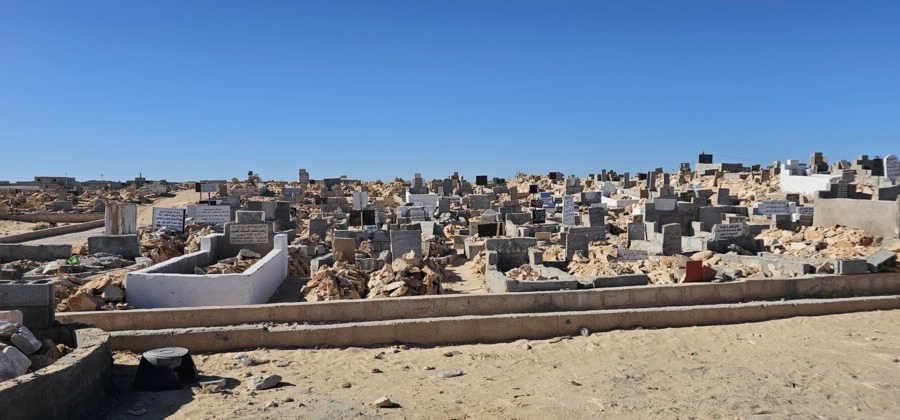
The gravestones are barely visible. Scraps of text scratched into wet cement, left to harden in whatever shape they took. Some have no text at all, just a slight rise in the sand, a low dune along the wall at the far edge of the cemetery in Nouadhibou, Mauritania’s second-largest city and its main Atlantic port, where the Sahara meets the sea. The representative from the municipality walks ahead of us, pointing towards the fringes where the unidentified are buried. Bodies too decomposed to name by the time they reached shore. He has requested a new cemetery, 25km out of town. They are running out of space.
We are still standing there when three cars pull up. A battered red Mercedes, followed by two gendarmes in green uniforms who nod at the municipal representative. On an orange stretcher, a white plastic body bag, slightly open. A body has just arrived. The men who came in the cars are from the community — here to try to identify it.
This is what the European Union’s migration partnerships look like from the ground.
Nouadhibou sits on a narrow peninsula on the Atlantic coast, roughly 700km north of the capital Nouakchott, close to the border with Western Sahara and within reach of some of the world’s richest fishing grounds. Since 2006, it has also been the main departure point for migrants attempting the Atlantic crossing to Spain’s Canary Islands. It is this geography — coastal, peripheral, strategically placed — that nakes it the epicenter of the EU’s latest migration partnership.
On March 7, 2024, the European Commission and the Mauritanian government signed a migration deal worth €210 million. The agreement was driven in large part by pressure from Spain, whose interior ministry had recorded a sharp surge in Atlantic arrivals. European officials praised the results. New figures from Frontex, the EU’s border agency, show that detections on the Western African route fell by 63 percent in 2025, driven by sharp drops in departures from Mauritania, Morocco, and Senegal. Spain’s government calls it a success.
We spent two weeks in Mauritania, in Nouakchott and Nouadhibou, interviewing coastguard officials, human rights defenders, municipal representatives, government coordinators, EU and IOM (International Organization for Migration) representatives, fishermen, and migrants. What we found behind the falling numbers tells a different story.
These deals are not simply outsourcing border control. They give states with poor human rights records a mandate, and substantial financing, to do what European governments cannot do at home: detain people without due process, deport them without legal procedure, and sweep entire urban neighborhoods clean of black migrants and refugees in the middle of the night. In exchange, the EU gets the statistics it needs to present the policy as working.
The Tunisia deal, signed on July 16, 2023, was the first iteration of this model. A week later, speaking at a conference in Rome, European Commission President Ursula von der Leyen was explicit about her intentions: “We want our agreement with Tunisia to be a template. A blueprint for the future. For partnerships with other countries in the region.” She has repeated the claim since, including in her State of the Union address that autumn. The EU went on to sign a similar deal with Egypt in March 2024, with President Abdel Fattah el-Sisi, who came to power in a military coup and has presided over one of the most sweeping crackdowns on civil society in the country’s modern history. Tunisia’s President Kais Saïed, meanwhile, took executive control of the country in July 2021 and has since granted himself unchecked powers to govern and legislate in a rolling power grab. Mauritania is the latest country to be brought into this framework. Understanding what the blueprint produces on the ground, in each of these countries, is not a peripheral concern. It is the point.
In Nouadhibou, that point has a name.
Kamara Mamadou is dressed in a blue shirt, with a striped scarf and a small traditional hat. A retired French teacher, he now helps people navigate a system not designed to receive them — spending years providing legal assistance to detained migrants in Nouadhibou. He is the regional coordinator of AMDH (Association Mauritanienne des Droits de l’Homme), Mauritania’s main human rights organization. We meet him on the fifth floor of our hotel, the Atlantic wind pressing at the windows, France 24 running in the background with breaking news from Iran and Lebanon.
He begins with Victor Hugo: “Quand on ouvre une école, on ferme une prison” — when you open a school, you close a prison. What he is describing, he says, is the inverse: a school converted into a detention facility over the summer in Nouadhibou. That is the first shock he documents. The second is the treatment. “It’s inhuman.”
Arrests happen at night. Police, gendarmes — and, he notes carefully, the Spanish Guardia Civil, operating alongside Mauritanian forces on Mauritanian territory. During raids, phones and belongings are confiscated. People are loaded onto buses and driven south to the Senegalese border or the Gogui-Mali crossing, expelled not through legal procedure but through logistics. The IOM’s voluntary return program, he says without hesitation, is not voluntary. People sign because they have no alternative.
The EU has provided a great deal of money, Kamara says, and the state has been given carte blanche to deploy it as it sees fit. When European delegations visit, things get cleaned up. Detention sites are emptied. Walls receive a fresh coat of paint. The delegation leaves satisfied. The violence and abuse return.
What makes the Mauritanian case particularly sharp is that the consequences extend well beyond migrants. Kamara himself, a Black man, now carries his identity documents wherever he goes. Without them, he could be stopped and deported, regardless of citizenship, regardless of birthright. The enforcement apparatus, calibrated to identify Black bodies as presumptively foreign, cannot reliably distinguish between a Malian migrant and a Mauritanian national.
When we arrived in Nouadhibou, we spent several days trying to speak to migrants. The neighborhoods where migrant communities would rent small rooms were largely empty. Police had swept through them. People were hiding and afraid to talk.
Nouadhibou used to be, as Kamara describes it, a melting pot — Senegalese, Malian, Gambian, Guinean workers drawn by the fishing economy and a port that needed labor. That city still exists in memory. What has changed is the fear. Communities that once moved openly have learned to disappear.
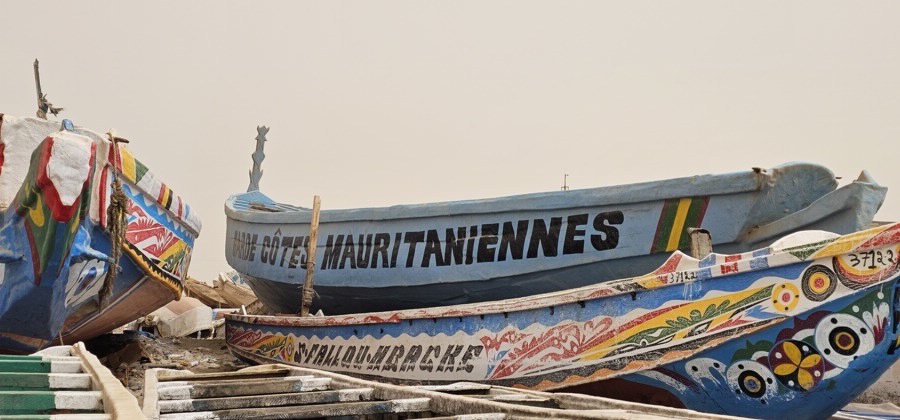
What is also driving people out is the Atlantic itself. In 2024, according to the NGO Caminando Fronteras, nearly 10,000 people died or went missing attempting the crossing to the Canary Islands — making it the deadliest migration route in the world. Of those, around 6,800 had departed from Mauritania. Traditional fishing pirogues, built for coastal waters, carry up to 200 people into conditions they were never designed for. The distance from Mauritania to the farthest Canary Island is close to 1,000 miles of open Atlantic.
In the offices of the Mauritanian coastguard, the senior officer and captain who receives us sits behind stacks of paper and pulls out his phone. He shows us footage from July 2025: a large pirogue from Guinea-Bissau. Dead bodies on a beach. A man badly beaten — violence erupts in the narrow space between 200 people on open water. Then he pauses on one image. A woman lying dead on the pier. Beside her, still alive, a child of two or three years old.
“It is a tragedy! Even trained military, physically strong men — this will haunt you for life,” he says, crossing his arms. “Maybe not now, but later.” He is grateful we came. When people from outside witness this, he reflects, it reminds him that what he and his staff endure every day is not normal and should never become normal. “It is not normal.”
It has nonetheless become routine.
In Brussels, that routine looks like success.
The EU’s migration partnerships follow a consistent logic: money and concessions in exchange for control. Each agreement is framed in the language of partnership and shared interest. Each produces a metric — fewer crossings — that European governments can present as proof of effectiveness.
What the metric does not capture is displacement. When routes close, people do not stop moving. They find longer, more dangerous paths. The sharp rise in Atlantic crossings over recent years is itself partly a consequence of tightening in the central Mediterranean and on the Libya-Tunisia route. The geography of death shifts; the death toll does not fall.
Nor does the metric capture what happens to those who are stopped. The people Kamara assists — detained in converted schools, deported without legal process, stripped of their belongings in overnight raids — do not appear in the statistics as a cost. They appear, if at all, as a success.
In a hotel resort bathroom, we met Binta, from Freetown, Sierra Leone, working as a cleaner at a hotel in Nouakchott for roughly two to three US dollars a day, sending what she can to her children and father back home. She has been in Mauritania for two years, but wants to leave. Over the week, we tried to reconnect but couldn’t get in touch. Upon leaving the field, a voice message arrived. She had been detained by the police. The crackdown had swept through, and the silence we had registered as simply a gap turned out to have been an arrest.
To understand what is happening on Mauritania’s coast, it is necessary to look east, toward a Sahel the EU’s border partnerships tend to treat as a source of pressure to be managed rather than a crisis to be understood.
In Nouakchott, in his office, just next to the remains of the G5 Sahel headquarters, we meet Cheikh, the government coordinator responsible for development and refugee response in Hodh Ech Chargui, Mauritania’s eastern region, which shares 1,200km of largely unmarked frontier with Mali. The numbers he gives us are striking. Mberra refugee camp was established in 2012 for 60,000 to 70,000 people. It now holds somewhere between 258,000 and 300,000 — with new arrivals every day. More than 40% of the region’s entire population is now made up of people who fled Mali. Mberra, he says quietly, is becoming the second largest city in Mauritania after Nouakchott.
The people arriving are fleeing a conflict that has fractured beyond simple description: jihadist armed groups, separatist factions, and a government whose operations are now conducted alongside Russia’s Africa Corps. Each targets communities perceived as aligned with the others. Civilians flee in all directions, across a border that exists on paper but not on the ground, toward family members on the other side who absorb them without registration.
This is the regional context the EU’s Mauritania partnership largely ignores. The pressure building on Mauritania’s Atlantic coast is inseparable from the collapse of state authority in Mali, the proliferation of armed actors across the Sahel, and the displacement of hundreds of thousands of people with nowhere stable to go. Treating Mauritania as a buffer, paying it to hold the line, addresses none of this. It adds another layer of coercion onto people already moving between armed groups, state violence, and open water.
Cheikh himself makes the development argument clearly: you cannot stop migration at Nouadhibou. By the time someone reaches the coast, the decision has already been made. Investment must go upstream — into border communities, agriculture, livelihoods, education. He makes this case to EU delegations regularly.
Not everything we encountered pointed in the same direction. At the yellow building housing Nouadhibou’s municipality, a well-kept garden out front, sunflowers, red roses, and palm trees, the deputy mayor receives us. She is a politician who takes visible pride in what her office provides. We visit the municipal school, where Senegalese, Malian, Cape Verdean, and Mauritanian children learn together. “We tell the children they are all number one,” she says. The municipality receives no EU funding. Its logic of service provision, at least here, includes everyone.
It is a small thing, and it does not undo what is happening in the streets and at the border. But it is a reminder that the hostility generated by the EU’s partnerships is not the only possible response to the same reality. Other choices are being made, by other actors, in the same city.
The cemetery representative — in his black suit, white shirt, and sunglasses — who walked with us through the sandy graves is also a municipal employee. He documented the dead, prayed for them, requested more space for them, and was present when the body arrived on the orange stretcher. He did not look away.
Back at the hotel lobby, France 24 runs on a loop in the background. Analysts are being asked about the people fleeing the latest US and Israeli strikes in Lebanon and Iran. The coastguard officer told us the boats now carry Syrians, Afghans, and Bangladeshis — people who have crossed the Sahara to reach the Mauritanian coast and attempt the Atlantic. As long as wars continue and states collapse, these routes will draw people whom no partnership agreement will deter, because what they are fleeing is worse than the crossing.
The EU presents itself, especially in the current moment of global fracture, as a defender of a rules-based international order, a normative power committed to human dignity and the protection of the vulnerable. These are not empty words. They reflect a genuine tradition, one that matters more, not less, as that order erodes elsewhere.
But they cannot coexist with a policy that pays authoritarian governments to detain people in detention centers, deport citizens by mistake, and leave the unidentified dead in unmarked graves at the edges of cemeteries that are running out of room. The falling numbers that European governments cite as success are not a measure of solution. They are a measure of how effectively the violence and death have been moved out of sight.
The question the EU has not answered, and has largely avoided asking, is what kind of international actor it intends to be. A bloc that exports its values, or one that outsources its borders. A partner to the vulnerable, or a financier of the states that contain them.
In Nouadhibou, the answer is already being written. In wet cement, in letters that barely hold their shape, at the edge of a cemetery only expanding.
Read the full story at the source
Source: Africa Is a Country