
World Africa Is a Country
The country that never grieved
A new experimental documentary from LA-based South African filmmaker Advik Beni explores the ties between history, culture and personal memory.
English (original) ·Read in Deutsch ⇄
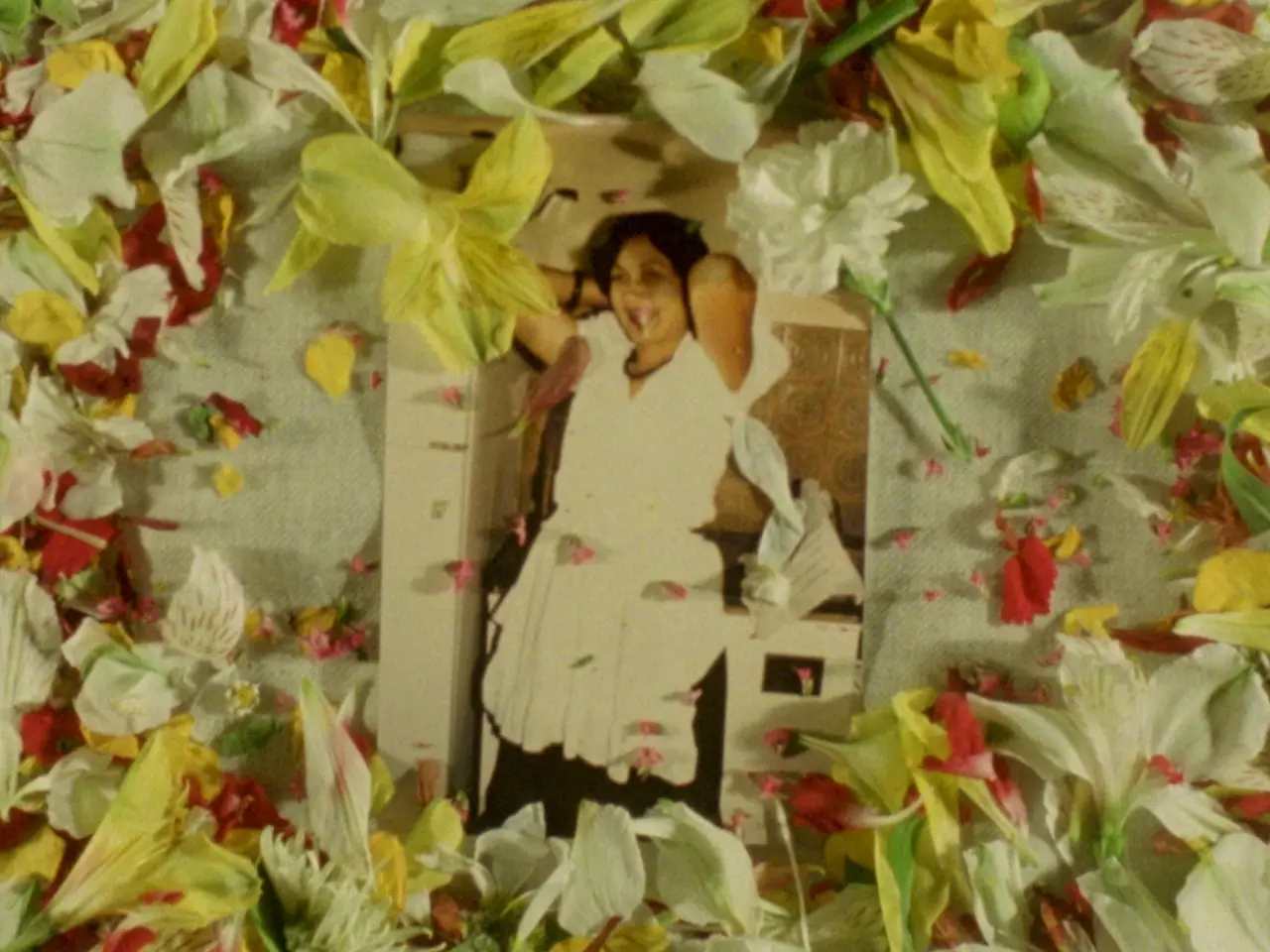
It is said that the best films are those that truly begin only once they’re over. When the film’s images are embedded in your memory, its noises echo in your ears, and its themes steep in your thoughts. This is not to say the viewing experience itself isn’t transformative, but when films reach for something higher than distraction and pure entertainment, they offer something you take home with you, a meditation.
Advik Beni’s feature debut, Mother, you have not died yet. But you will. And when you do, you will finally be alive again, is one of those meditations, and it’s rooted in mourning: for a mother, a country, a city, and an identity. It’s teeming with texture, pictured in warm, cotton-pulpy celluloid, and elevated by a sound design that balances the granular and mosaic. It blurs the lines between fact and fiction, and while there are moments that too obviously remind you that you’re not watching a documentary, its grounding in the factual gives the film a unique brilliance.
The film’s simple plot, of a middle-aged woman in Cato Manor taking care of her ailing mother, betrays the contours of memory, culture, family, and history the film traverses. Mother, you have not died yet is an experimental documentary that makes the political personal. Similar to Milisuthando Bongela’s acclaimed self-titled film, it rummages through personal and family archives to explore the sinews of what South Africa means to South Africans in the many iterations of what it has been. It centers its personal and historical inquiry around the reverberating question of what it means to be Indian in post-apartheid South Africa.
It’s not the first film to explore South African Indian identity, but it’s the first I’ve seen that attempts to reconcile the beauty, grief, and conflicts that form part of Indian identity in South Africa. The country’s first Indians came as indentured laborers in the 19th century to service the growing sugar plantations in KwaZulu-Natal. The ethno-national group wove its own identity into the tapestry of South Africa’s growing industrialized cultural landscape; yet its relationship with Black South Africans has been tumultuous. Many of these frictions and wounds merge in Cato Manor, a neighborhood in the port city of Durban originally inhabited by former Indian indentured laborers. Appropriately, Cato Manor is where Mother, you have not died yet, takes place. The city bears the weight of historical racial violence between Blacks and Indians, and the preservation and decay of its first inhabitants’ heritage.
I talked to the writer & director of the film, Advik Beni, a South African filmmaker, programmer, and teacher based in Los Angeles. In the interview, we try to peel back the layers of their ambitious feature debut and put its kaleidoscope of ideas into focus. Mother, you have not died yet had its world premiere at the FID Marseille film festival this year, where it won the Audience Award and recently celebrated its North American debut at the Camden International Film Festival.
Tsogo Kupa
I can see overtures between your work and Milisuthando Bongela’s. Why do you think this experimental and auto-ethnographic form of storytelling has been useful when trying to navigate what it means to live in a post-apartheid South Africa?
Advik Beni
It’s like at the forefront of every work I make. So our industry is so new, but we find a lot of the films falling into a sort of European, Western model of filmmaking. And it’s not just a South African issue. A lot of countries that have gone through this history of colonialism adapt to that Western model of storytelling. But for me, one of the beautiful things about being South African is our type of storytelling, our oral traditions. And this goes cross-culturally. So that’s something I always try to adapt into cinema, which is like an impossible task. As soon as you write or record orality, it’s not orality anymore. It loses the beauty of it, which is that mutability, that ability to change and adapt and go in with humor, or pull away the humor from an audience. You can’t really do that in cinema. But I think it’s something, as South African filmmakers, we should be trying to do, which is to find our own language and our own form of filmmaking. And for me, it’s fallen between this world of experimental essay, ethnographic, and the personal, because I think, like all countries, but more so in South Africa, the personal is inseparable from the political. I think we should be trying to read, rethink, and question: why are we making a film that looks like a French film or like an American film? Why do our stories need to live in those vessels? Like, why don’t we try to build our own vessels that are more true to our own upbringing and surroundings?
Tsogo Kupa
There’s a heavy use of archive in your film, and one of the concerns that the main character in the film continuously brings up is the idea of losing heritage, losing a language. So, oral storytelling takes huge prominence in the film, as does the role of the archive. How did you approach not only making your adaptation of archive in a very textile and deconstructive way, but how did you take on the responsibility of creating your own archive?
Advik Beni
I’ve always felt this dichotomy, and this is completely false, and it’s just in my mind, but there are those who really want to preserve the archive. And these are, a lot of times, institutions. And there are those who completely want to burn the archive. And this is not a binary that actually exists, but it’s the way my mind works. I try to find the in-between space. And I stand between both schools; I understand the beauty in holding on to history, but it’s who has the power, who’s holding on to this history, and whose history. And I can speak as a South African Indian that our archives are not held in those institutions in any sort of tangible way. It’s held in the recipes being passed down, in the photo album of your loved ones, and in people pointing out and telling stories. Like those moments hold our archives. So for me, this film was trying to play with that concept; it was taking those official archives, for example, the 1949 riot image, and creating this kind of bricolage collage effect by putting these other archives, which I think are just as important, these oral histories, these thoughts, these imaginaries. Because we often don’t have the resources to properly archive. How do we incorporate what we believe and our thoughts and our histories alongside that which is more stringent? For example, getting an image from Getty Archives, that exists in these structures that say: “yes, this is real”, but ours don’t exist in the structures that say: “yes, this is real.” Outside of us putting it forward and saying, “No, it’s real.”
Tsogo Kupa
One of the interesting things about archive, especially in the way that you described it, and how it also appears in your film, is navigating this idea of the gaze. As African filmmakers, you’re constantly wrestling with the colonial gaze. In this film, gaze manifests itself in different ways. How do you confront your own gaze in the film?
Advik Beni
I mean, the protagonist is my auntie. So we have a very close relationship, and the film kind of was built upon a conversation about the country. It was never a film at first. It was just a discussion on how to explain South Africa to anyone outside of its borders. But then became something wholly different when my aunt’s mother passed away. And then this idea of reenactment entered, and it was just a kind of experiment. Like, I try to adopt a model of filmmaking that focuses more on the process than the product. And that’s complicated because the product needs to be something. After all, in this world that we live in, of capitalism and whatnot, you need a good product to start your next process. But for me, putting that emphasis on process, putting that emphasis on the process that is not hierarchical, that is hybridized, that allows an exchange between everyone on the project. I think where gaze tends to be problematic is when you’re pasting something onto a subject, or you’re painting something onto a character. But if there’s exchange, if there’s dialogue in that process, if they are authors of it as well as you. I think it’s really important because you want the community to be in conversation with the piece whilst you’re making the piece, not just once you make it and put it out there. There was a spine to the film written in a sort of treatment form, but it was all about those people who were enacting and reenacting parts of the film to give what they wanted and to block out what they didn’t want.
Tsogo Kupa
I think there’s a very interesting way in which all the different aspects of filmmaking speak to each other. It’s a film that you feel like you can touch, that it’s moving, hypnotic, slow, and transcendental. What is the intentionality behind making a film that’s so sensorially rich, and the relationship with your team to achieve that?
Advik Beni
I came to LA for the California Institute of the Arts, and the reason I came here is that they teach you how to make film on celluloid. So I’ve always been used to using my hands and using the physical medium to tell a story. My producer and animator of this film (Nehal Vyas) is incredible at stop motion, and we worked together on how to bring those archives to life in a new form, bringing them back, making them a part of the image. So for me, that’s one part of it. It’s just my love for that kind of tactile experience. It was important for me to shoot this film on Super 8 and 16. And even though travelling from South Africa to LA to process the film was scary, it was something really important because that medium, the physical medium itself, it’s not designed for black and brown skin. It was literally made with test subjects, which were white people. So the exposure and the physical chemistry of the film are designed to have proper exposure for white skin. So that act of just trying to shoot my own landscape, my own people, the people around me, felt like a sort of very small rebellion. My people never had the privilege to own film at that time because Kodak boycotted South Africa, so there was no access except for the white oppressors to come from places like the UK to shoot our skin. I mean, now I have access. Let me use that same medium that we didn’t have access to in the ‘70s, ‘80s, ‘60s and shoot people and places which were never shot on that medium.
Tsogo Kupa
And the sound design?
Advik Beni
I think a big part was before shooting; I wanted to record with five mics. Like, did we use all five mics? Absolutely not. But you’re getting audio from both left and right, pointed at different angles of the room. You’re getting different kinds of surroundings that aren’t necessarily in the scene. I think it’s very important to me to capture the sort of spatiality of Cato Manor, because it’s a place I used to go constantly growing up, because that’s where my granddad lived and my auntie lived, and she always cooked for us. The memory that’s triggered whenever I go there is just the sounds. It’s everywhere. It’s within the kitchen. But you also hear the dog from next door; you’re hearing somebody skating down the road; you’re hearing a taxi go past with music. All of that sound is constant. Then I think in the more experimental essay section with the voiceover, it was just capturing this liminal space, because for me, that space is sort of an ancestral realm in many ways, a space where the mother is alive and dead and she’s speaking to the mother, her actual mother, but also the reenacted mother. So for me, it was just capturing that liminality through sound, that between us, nothing’s quite settled. But her voice is settled, but the surroundings are not quite settled.
Tsogo Kupa
I’m interested in the use of repetition in the film. What’s the motivation behind the use of routines and repetition throughout the film?
Advik Beni
I would see the same act of gardening and cooking, and that was just something I admired so much. But I think another part of it, which looks at the bigger picture, is that the film itself is about cyclicality and repetition. It’s about that final sequence; without giving too much away, it looks at that 1949 riot and it looks at the 2021 riots, and that’s not shocking because we know that tensions were there, but that cyclicality is disheartening. So, conceptually and structurally, that’s when I started to understand that South Africa is a country that didn’t properly grieve for the end of apartheid. We kind of put a plaster over a bleeding wound and hoped for the best. And I think what we’re seeing, like 30 years afterwards, is these wounds slowly starting to open again. So for me, that cycle is happening. That’s all we can, as South Africans, hope for. That we can find a place where we can just actually create tangible repair and tangible shift. I think a lot of people have to survive in some way, and our routines help us to give us something. “Oh, I’m going to wake up today. I’m going to do the gardening. I’m going to cut the wood. I’m going to do my prayer.” You know, it gives you a sense of knowing, even if the larger world around you is unknowing.
Tsogo Kupa
In my experience with the film, there are three acts of grieving. So you have the grieving of Durban before the 1949 riots, where there was some semblance of unity between Blacks and Indians before the riots. There’s also a grief of the solidarity between Black and Indian South Africans in the late ‘70s and ‘80s. There’s also a broader grief around Durban as a city. So how do you feel like your film also grieves with Durban as a location as well? Because Durban feels like a location, but is also its own character in the film.
Advik Beni
It’s my city. But as you said, it’s so complicated because it also has the highest concentration of Indian people. And that relationship to Black people is so tenuous, and it’s been up and down over the years, and thinking through the history of a place like Cato Manner, which was so pivotal in the fight against apartheid. So it’s embedded in the film, through that archive of the riots and the barbershop, which is a barbershop that has been in my family for 70 years. Still in Durban, there’s a lack of integration in a way that’s really harmful in the long run. And it’s something I noticed within my own community is just sort of, why is it that my population, my people, are trying to take this hierarchical approach? And yes, it has to do with the system, has to do with the lack of care from the city. It’s also the lack of infrastructure. Those feed into each other; they’re inseparable. It creates those tensions. And with the 2021 riots, we saw that too. But then there were so many things layered on top of that. It was that lack of infrastructure, the tiredness of people who have been disgruntled for so long because they’re being pushed down. And of course it’s going to come out in ways that are not fun and not beautiful, like it’s going to come out in ways that are harmful to people. And that’s completely inseparable.
Tsogo Kupa
As someone who works between two countries, how do you reconcile making cinema that is very rooted, genuine, and offers insight to South African audiences while also being accessible to a global audience?
Advik Beni
Whether this was truly accessible to a global audience, I think, is a question we’ll still figure out as it shows more, because I do think it’s very specific to South Africa to delve into Cato Manor; it’s very specific. But I think this idea of sort of tensions between two communities that were both subjugated, yes, at different levels. It’s something that rings true throughout; even here in LA, you see, see these kinds of tensions occurring. So for me, that’s the thing that makes it sort of universal. It’s not something South African-specific, but much more heightened in South Africa because of its history. So it’s a battle. It’s something that I will stand strong on, though. We’ve got to find our own language. We’ve got to find our own places. The festival system is something that’s not completely beneficial for filmmakers. It’s beneficial for the festival. So it’s also like a give-and-take; we know why we want to be in those festivals. It’s like there’s a weird balance and a weird tension there as well. But I think as filmmakers, we’ve got to just believe in, as cheesy as it is, our own stories. I think more importantly for us as South Africans is, like, how do we want to tell the story? We don’t want to be fetishised. We don’t want to be looked at as this kind of other. We want to be telling it our way for our people. And if you resonate with that, cool. But it’s for us. It’s for us to figure out because we’ve got things to figure out. We’ve got lots of things to figure out, and we should be doing it now.