
World Africa Is a Country
How Lula’s army beat the algorithm
The digital campaign behind Lula’s victory demonstrated the possibilities of popular mobilization — and the dangers of fighting the far right on its own terms.
English (original) ·Read in Deutsch ⇄
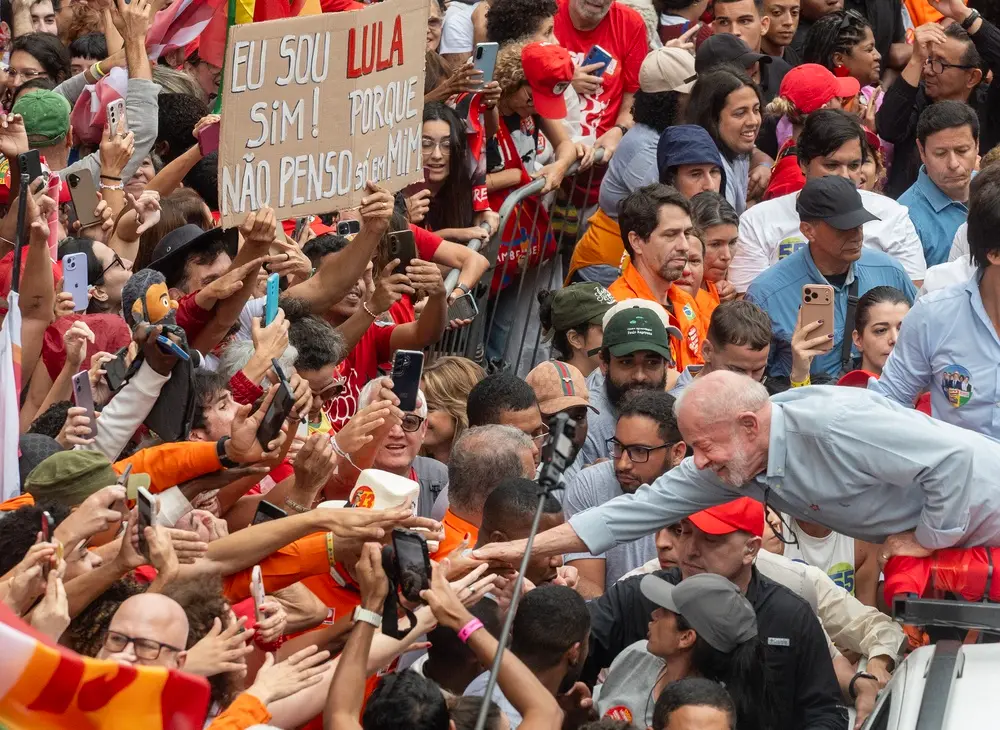
The outcome of recent elections in Brazil carries exceptional political and moral significance. In the runoff on October 25, President Luiz Inácio Lula da Silva won a fourth term with about 52 percent of the vote, defeating Flávio Bolsonaro, a senator and the eldest son of former president Jair Bolsonaro. It was a geopolitical victory not only for South America, but for the entire world — offering hope that it is still possible to free ourselves from the far-right extremist wave. In the contest between Latin America — “Prospero’s mirror,” as Richard Morse called it in his 1988 book O Espelho de Próspero — and Prospero himself, the United States, the main political victory in South America has come from the left.
Daron Acemoglu, a professor at the Massachusetts Institute of Technology and author of What Happened to Liberal Democracy?, argues that Brazil’s 2026 presidential elections are the most important elections outside the US. In an interview with BBC Brasil, he states that “much of the enormous concentration of economic power we see in the United States has been driven by technology companies that control information.” According to Acemoglu, the alternative could be “a liberalism that serves workers, based on shared prosperity, public services and democratic participation, drawing on the experience of Brazil’s first Workers’ Party (PT) governments in the early 2000s, which gained international visibility through their social policies and the active role of the state.” Perhaps, by returning to his roots, Lula can not only fulfill his often-repeated promise to “make the best government in the history of Brazil” during this final term, but also strengthen the increasingly influential role of the South in building an alternative international order.
Tensions between Washington and Brussels could strengthen Brazil’s position as a political alternative to North American pressure, especially given Lula’s interest in international mediation, most recently in Ukraine, and Europe’s increasingly right-wing shift under Ursula von der Leyen.
In a region where only Brazil and Uruguay are not governed by the right, and given the strained relations with the US, Brazil will need to strengthen its integration with the BRICS countries, particularly by consolidating relations with China and, indirectly, Russia, thereby strengthening its role on the international stage and promoting a more multipolar world order. According to journalist Jamil Chade, for the first time since the 1964 coup that established the military dictatorship, Brazil has become the center of “the largest foreign offensive in its recent history.” Washington considers the country strategically important for consolidating its hegemony in South America, containing Chinese expansion, and gaining access to resources, particularly rare earth minerals. Limiting the independence of Brazilian foreign policy has therefore become a priority for the US. Aggressive US policy and practice against the sovereignty of other nations has found further room to expand through the unlimited freedom and impunity with which major high-tech multinationals operate (see this research by Sleeping Giants Brasil).
Lula’s victory did not come on a level playing field. Following a complaint from Lula’s campaign, which alleged that Meta repeatedly reduced the visibility of his posts while promoting content from his opponent, the Superior Electoral Court (TSE) asked the company to explain itself. Meta attributed its conduct to “technical problems.” The interference affected not only the campaign but also independent media outlets. The National Forum for the Democratization of Communication subsequently launched the campaign Meta, Não se Meta (“Meta, Don’t Interfere”) and organized a series of demonstrations, while a group of 13 US lawmakers sent a letter to Mark Zuckerberg requesting clarification regarding the allegations of unequal treatment. The TSE eventually ruled in Lula’s favor, ordering Meta to “ensure its artificial intelligence tool applies identical criteria to both candidates.”
Politics is now conducted through posts, Instagram videos and online comments on networks controlled — or, if you prefer, moderated — by the high-tech companies at the top of the global economy. All are aligned with the political establishment. Brazil’s 2018 elections illustrated this dynamic: the UFBA researcher Tatiana Dourado documented 346 false stories circulated during the campaign, exposing how social networks, particularly through the dissemination of information via WhatsApp, enable digital manipulation and allow tech companies to influence elections in any democracy. In 2022, Brazil was once again at risk. But perhaps memories of the deaths caused by the government’s public-health policies during the pandemic, and of the country’s international isolation, ultimately prevailed. This year’s election period saw record allegations of interference: funding from the US; interference by Meta and the TSE; pressure from right-wing businesses such as Zona Sul, a supermarket chain that urged employees to “vote consciously” to change Brazil, implicitly backing the anti-PT candidate; false WhatsApp claims that voters’ individual taxpayer numbers (CPFs) had been blocked; and, on election day itself, the obstruction of public transport, allegedly orchestrated by high-ranking figures in the country’s federal and state politics.
Lula’s army
In response to the results of the first round and the reported levels of interference and obstruction, the Exército do Lula (Lula’s Army), led by André Janones, a federal deputy from the Rede Sustentabilidade party and a strategic ally of the PT, employed the same tactics as the evangelical pastors backing the candidacy of what Lula’s supporters call the “militia clan” — a reference to the Bolsonaro family and its alleged ties to Rio de Janeiro’s paramilitary militias. Its weapon was delirium. Janones engaged on digital turf, creating a WhatsApp channel that directed the masses online, instructing them to copy, paste and post his content — videos, hashtags, Google searches — followed by the command: “Make it explode!” During the final week of Lula’s second-round campaign, the channel boasted nearly 11 million active followers.
According to Felipe Pena, a political commentator and journalism lecturer in the Department of Social Communication at the Federal Fluminense University (UFF), Janones’s achievement lay in his understanding of digital natives — those born with access to the internet — and his ability to identify the right format, language and communication strategies for reaching this electorate. In the days leading up to the election, Instagram, X, TikTok and Facebook feeds were flooded with images of people making the letter L for Lula while wearing the colors of the Brazilian flag. The gesture went viral thanks to coordinated actions by Lula’s Army, joined by many celebrities. Janones organized what was described as “the largest livestream in Brazilian political history,” with 21.69 million views, a peak of 773,400 simultaneous viewers, an average of 403,700 viewers, more than 174 million chat reactions and 13.46 million messages. A mixture of anxiety and adrenaline became increasingly palpable through the compulsive reproduction of WhatsApp messages and the ever-faster sharing of content across social media. The goal was to “drive the algorithm crazy,” and it likely succeeded. Though the PT campaign initially kept its distance from the channel, Janones was soon fully integrated into the president’s campaign team. Following Lula’s victory, the PT expressed its desire to invite the deputy to join the party and to give him a position in the president’s fourth term. Lula also linked the election result to the way he intends to conduct his next term. He has promised to expand popular participation in decision-making and stated that “digital communication will gain considerable ground.” Janones is expected to do the same. Some have already identified him as a potential presidential candidate in 2030, a possibility he himself has not ruled out. If the PT has failed over the years to create a successor to Lula, Janones appears to have created the opportunity for himself.
The Janones phenomenon has also taken hold of imaginations beyond Brazil, with invitations from Spain’s Pedro Sánchez, Mexico’s Claudia Sheinbaum and Peronist leaders in Argentina.
Detachment from reality
Janones’s media campaign took off following the second debate between the two presidential candidates. Both debates were a horrifying spectacle. During the first, Bolsonaro spent the evening hovering behind Lula, imitating Trump’s propaganda strategies, and displaying the word “corrupt” on the palm of his hand. Lula initially tried to maintain a minimum level of decency, but eventually had to descend to his opponent’s abysmal level, because this now seems to be the only way to reach voters. The second debate reached one of its lowest points when Flávio Bolsonaro called Lula “nine fingers,” prompting the incumbent president to explicitly accuse him of being a militia member.
A petition calling for fact-checking during TV Globo’s broadcast of the presidential debate, which gathered more than one million signatures, was, unsurprisingly, rejected by the network. According to the results published by the website Checagem ao Vivo, 63 statements by Lula and 103 by Bolsonaro were analyzed. Of the statements made by Lula, 58 were classified as factual and five as “not quite accurate.” In Bolsonaro’s case, eight statements were deemed factual, 54 false, 37 inaccurate, and the rest inconclusive. Even Folha de S.Paulo, traditionally critical of the president, had to acknowledge Lula’s superiority in his confrontation with Flávio Bolsonaro.
The disconnection from reality underpinning the PL’s campaign was such that, in São Paulo, people gathered in support of Bolsonaro carrying an inflatable missile and calling on the US to bomb Brazil. These same people describe themselves as fervent patriots. Patriots like their candidate, who, following a decision by Supreme Court Justice Alexandre de Moraes requiring him to surrender his passports to the Federal Police in Brasília within 24 hours, fled to Argentina after the deadline expired, before traveling on to the US. Just as his father had done, the defeated Flávio Bolsonaro refused to accept Lula’s victory, even though the declaration came from his own ally Nunes Marques, president of the TSE. While Flávio Bolsonaro was being ridiculed around the world, Senator Sergio Moro, the judge who ordered Lula’s arrest and is affiliated with the PL, declared that “Brazil is not experiencing institutional normality and, therefore, Flávio’s departure from the country is understandable.”
A flagrant coup attempt
There is no doubt that what unfolded live on the night of Brazil’s last presidential election was criminal, amounting to a violation of both the constitutional principle of judicial impartiality, in the case of the Superior Electoral Court, and the right to vote, in the case of the private companies and political representatives behind the transport shortages. It also amounts to a brazen attempt at a coup d’état. Nunes Marques, president of the TSE, the person who should guarantee respect for the constitutional voting rights of Brazilian citizens, openly demonstrated that he favored the son of the man who had appointed him to the court he currently heads.
Beginning on Saturday, Brazil’s two largest low-cost airlines, Gol and Azul, as well as LATAM, canceled flights, citing maintenance requirements and technical problems. Most were bound for the Northeast, Lula’s region of origin and, historically, the PT’s main electoral stronghold. A similar situation occurred in Bahia, where Salvador’s mayor, a Bolsonaro ally, ordered 75 buses to remain in their depots. According to Folha de S.Paulo, he blamed union members who allegedly wanted to place PT stickers on bus windows. Following a complaint by the Brazil of Hope Federation, a PT-led coalition, the Regional Electoral Court of Bahia ordered the immediate restoration of the entire fleet and issued an arrest warrant for the city’s mobility secretary. A similar shortage affected São Paulo, where Mayor Ricardo Nunes was accused of reducing the bus fleet and increasing road checks. According to the PT’s state president, only 60 percent of buses were operating; the party sought the arrest of the municipal secretary for urban mobility and transport, Celso Jorge Caldeira, for failing to comply with the TRE-SP ruling requiring the entire fleet to operate free of charge.
For this reason, with the agreement of both candidates — a position the losing candidate later sought to deny — a request was submitted to the TSE to extend voting hours in the states of São Paulo and Bahia. It was accepted by Supreme Federal Court Justice Cristiano Zanin, despite the TSE president’s attempt to delay the decision. Anyone who arrived at their polling station before its scheduled closing time was guaranteed the right to vote. The problem was that many polling stations had been relocated without prior notice. According to CNN Brasil, the TSE recorded changes at more than 400 polling stations. Similar abuses were recorded in the Brazilian Amazon, where the obligation to provide transportation for voters in rural areas is particularly significant: people often have to travel for hours, sometimes even days, to reach their polling stations. Against this backdrop, the former minister for Indigenous peoples, Sonia Guajajara, denounced the Superior Electoral Court’s refusal to grant general authorization to the National Foundation for Indigenous Peoples, the Special Secretariat for Indigenous Health and the Ministry of Indigenous Peoples to use their facilities to ensure transportation for Indigenous voters. President Lula also called for the arrest of mayors responsible for electoral offenses arising from the obstruction of voter transport, describing the situation as “abominable.” Authorities are proceeding with the removal of mayors involved in the transport disruptions and reporting the responsible private companies.
Online and in the streets
Despite all the criminal actions that characterized the second round in particular, Brazil managed to accomplish a historic feat by re-electing Lula for a fourth and final presidential term. But if social networks, thanks to Lula’s Army, managed to counter Meta’s unfavorable algorithm, the success must be attributed to an explosive combination of networks online and in the streets. On one side, an army on the internet; on the other, a mass mobilization in which millions of voters who had abstained in the first round returned to the polls. It was an extraordinary team effort involving media and generations, the internet and street demonstrations, older people — including the president himself, who is 81 — and young people, who made a significant contribution to these elections.
Following the first-round defeat, 2,000 students from the Federal Fluminense University in Rio de Janeiro took to the streets of Niterói. The following day, students from the Federal University of Pernambuco in Recife joined them, followed by students in at least 13 states and the Federal District by October 7. In 1992, the National Union of Students brought thousands of students into the streets with their faces painted in the colors of the Brazilian flag to demand that Congress impeach President Fernando Collor de Mello and to protest against corruption. The caras pintadas (painted faces) returned to the streets in 2026 with the Estudantes com Lula (“Students with Lula”) campaign, declaring that “democratic confrontation is in the DNA of Brazilian students.” Like all mobilizations, the campaign aimed to convince undecided voters. Older people across the country were accompanied by relatives and friends, enabling them to cast their votes in support of democracy and against dictatorship, convinced that every single vote counts. Many images of older voters showed people originally from the Northeast, like Lula himself, reflecting a longstanding alliance with the president and with a homeland repeatedly insulted by both Bolsonaro father and son. Young people represented, in part, workers angered by the labor reform package proposed by Bolsonaro, and students who had benefited from state-supported education initiatives — including ProUni, Pé-de-Meia and the quota systems for university recruitment — introduced during Lula’s administrations.
Against all the attacks on public transport, in a demonstration of the motto “Brazilians never give up,” mutual-aid groups emerged to provide lifts and alternative transport, both within cities and between states, circulating useful information from one end of the country to the other through videos, posts and audio messages. One noteworthy initiative was the discreet mobilization of people working with Indigenous communities. Through solidarity networks, they organized fundraising several days in advance to ensure that the constitutional right of Indigenous Brazilians to vote would be respected if the responsible public authorities arrived late or failed to intervene. Any attempt to deny Indigenous peoples access to this right is particularly serious, as it reinforces the intentions expressed by Jair Bolsonaro during his 2019–2022 presidency to revive the dictatorship’s assimilationist policies, which sought to erase Indigenous peoples as distinct ethnic groups and integrate them into wider society as ordinary workers and citizens.
Another important factor in the victory was the breadth of alliances formed between the cultural and political spheres — a massive stand in favor of Lula among prominent figures in cinema, music and the arts. One of the most notable political alliances was with Erika Hilton, a Black transgender socialist who became the most-voted congresswoman in Brazilian history and a driving force behind the constitutional amendment abolishing the six-day working week. This historic victory for Brazil’s working class — and Bolsonaro’s opposition to it — increased voter turnout in Lula’s favor. Similarly, the alliance between right and left, exemplified by Vice-President Alckmin, Lula’s longtime rival, highlights the distinction between political opponents and incompetent, fanatical and criminal adversaries.
Violence in the wake of defeat
Violence spread throughout the election campaign and continued in the days following the vote, prompting lawyer Marco Aurélio Carvalho, coordinator of Lula’s electoral campaign, to denounce the escalation of political violence linked to the far right.
Four Lula voters were killed by Bolsonaro supporters. According to a report published by CartaCapital, Ewerton Rodrigues da Silva, 34, was shot three times following an argument provoked by Bolsonaro supporters. Anderson Pires Bolandin, 35, collapsed after being shot next to a fuel pump and died in the ambulance; Sebastião Dusso Braga Neto, 34, was shot in the abdomen and died of his injuries despite receiving medical treatment. Environmental engineer Marcelo de Oliveira Rocha, 30, was declared brain-dead after being brutally beaten in the early hours of Saturday, October 24. City councilor Iara Pimentel (PT) was targeted in a planned attack during a motorcade on Saturday night. Maria das Neves Filha, president of the Federal District branch of the Brazilian Women’s Union, and Edilamar Melo, president of the Gama Youth Association, were violently attacked by a retired military police officer. Paolla Paullyne Freitas Araújo de Alencar Vital, a trans woman and former city council candidate in Alagoas, was shot and killed, and Elisabete Martins Chaves died after being hit by a car. Numerous other cases of non-fatal violence were also recorded.
While people celebrated Lula’s victory, APIB — the Articulation of Indigenous Peoples of Brazil — and numerous Indigenous associations reported cases of murder and violence against their communities following Bolsonaro’s defeat. The Ministries of Indigenous Peoples, of Human Rights and Citizenship, and of Racial Equality are working together to request investigations into reports of violence against Indigenous peoples, quilombola communities and Afro-Brazilian religious communities. The minister of Indigenous peoples, Eloy Terena, a member of the Terena people, reported on social media that he had contacted the Federal Police to investigate allegations of deaths and violations against Indigenous populations in Mato Grosso do Sul, where Indigenous leaders reported murders and threats to poison water sources used by their communities. The Federal Prosecutor’s Office gave the municipality of Tacuru 48 hours to clarify the poisoning threats. In the same region, the home of 90-year-old Guaraní and Kaiowá spiritual leader Roberta Ximenes, known as Ñandesy Roberta, was set on fire, destroying sacred objects used in traditional rituals.
No less violent are the manifestations of structural racism — the legacy of the country’s history of colonization and slavery — which persist in Brazilian society regardless of the election outcome, perpetuated by the growing political influence of the Bolsonaro militia clan and its allies in government. During a Bolsonaro support event, a Black man was seen being walked on a leash by a man dressed in yellow and green. As reported in O Globo, the man denied that the act was racist and justified it as a form of “satire,” concluding: “If I offended any Brazilian, that was not my intention.” The newspaper itself referred to the white man by his full name, while identifying the man who had been brought there in chains simply as “the Black man.”
The reaction of the business class to the election outcome confirmed how deeply intertwined race and class assumptions are. CartaCapital reported that Lula’s victory caused Brazil’s financial markets to open the week in decline, triggering the automatic trading-halt mechanism three minutes after the opening — a mechanism that had not been activated since the beginning of the pandemic in March 2020. The backlash was not limited to the stock market. The day after the election, cases were reported of transport companies dismissing employees who had supported President Lula’s re-election. On the same day, a large ice-cream chain in the interior of São Paulo state announced on social media that it would no longer provide food assistance or make donations because it was “tired” of helping people who preferred to “live off state assistance.” In response, the Ministry of Labor and Employment announced it would investigate reports of threats of dismissal, harassment and other forms of electoral coercion targeting workers who supported Lula.
The future of political participation
One particularly striking comment from one of the “recruited” by Lula’s Army was an observation about how Bolsonaro supporters must feel when they are indoctrinated around the clock by their extremist conservative leaders, often evangelical pastors: “It has only been three weeks since we joined the WhatsApp groups, sharing, commenting, liking posts, and we are already feeling unwell. Now imagine this being the daily routine of a Bolsonaro supporter. They spend all day doing this. No wonder these people end up in psychosis, drinking detergent and praying to ET.” He refers to the ANVISA case: after the agency suspended batches of Ypê detergent over bacterial-contamination risks, Bolsonaro supporters accused it of political persecution, with some activists even pretending to — or actually — drink the product in protest. The episode resurfaced in September when Congressman José Medeiros mocked supporters who “pray to aliens and drink detergent.”
Images from the two campaigns circulating online and in newspapers clearly illustrate the opposing forces. On one side are gatherings of children holding weapons, people on leashes, women holding whips, missiles, brawls, punches and shouting. On the other are students with painted faces; young people helping the elderly reach the polls; very elderly people dressed in red, proudly displaying their number 13 stickers; jubilant workers; Indigenous people traveling to vote by navigating the vast Amazonian rivers; and buses full of smiling people. On one side, hatred; on the other, if not love, then humanity.
If the internet has increasingly been programmed in recent years to generate and amplify hatred, Bolsonaro supporters, subjected to digital brainwashing, respond in the streets with the same violence that has been normalized online. For this reason, Lula’s Army “general,” Janones, repeatedly instructed people not to respond, not to insult and not to interact with their opponents’ videos. Anger is often more a product of online manipulation than of a person’s true nature. Janones managed to break this trend — at least temporarily. The evidence can be found in the enormous response of mutual aid, the assistance offered to strangers, and the many humorous posts and messages of thanks that appeared after the goal had been achieved. One post reads: “Social media, groups and algorithms: all these elements influence our mental health. Major technology companies promote radicalization, misogyny, homophobia, conspiracy theories and psychosis.”
Political participation is driven by the desire to exert influence over the world in which we live. When politics becomes detached from reality and from people, this alienation inevitably extends to political participation itself. It is in this sense that the importance of the phenomenon triggered by Janones can be acknowledged: despite its contradictions, it succeeded in awakening a desire for political engagement that had seemed dormant. However, while there are reasons to thank Janones for this awakening of new forms of making policy, the mobilization he generated must not be confused with a solution to the problems that have brought us to this point. An increase in the existing delirium cannot be the answer. This dynamic is not so far removed from evangelicalism. Rather than empowering people to exercise self-determination and develop independent thought, it promotes obedience to seemingly unquestionable orders. Political participation must not become a new form of submission, even when it is presented under the banner of a legitimate cause. It is also in this light that Lula’s recent transformation in political communication must be considered. If, until just three weeks ago, there were complaints about the inability to reach the masses online, it is nevertheless questionable that, in such a short time, his channel — created in response to the risk of the Army channel being shut down — has begun publishing daily videos about the day-to-day lives of the president. It is almost as if viewers were watching a kind of Big Brother at the Planalto Palace.
For the first time in an electoral process marked by the far right, the progressive camp set the course of the debate, and it did so through a common denominator: starting with people who were highly critical of the Lula government’s communication methods, it created a climate of mobilization not seen for decades. Mídia Ninja, an independent journalism and action collective that emerged in the context of the major protests against the PT government and the mobilizations against the World Cup and the Olympics in 2014–6, alongside 342 Artes, a collective mobilizing cultural icons, produced incisive coverage combining memes, news and supportive videos from well-known artists. Piauí magazine provided extensive coverage of the ties between the businesspeople and bankers who colluded with Bolsonaro, and of the reasons why he might have sought to flee. The Revelando project, created with the Calma Urgente podcast team, reconstructed the criminal activities of the Bolsonaro family and their allies in an educational format. Behind these initiatives are professional journalists, fact-checkers and researchers working with ICL Notícias, The Intercept Brasil, CartaCapital and other outlets. They were joined by the strength of independent Indigenous communications, which allowed information to circulate beyond local networks: APIB Oficial, Midiaindigena, Amazonia Coiabamazonia, Apoinme_brasil, Arpinsuloficial, Cons.terena, Yvyrupa.cgy and Sostabajos, as well as the social-media accounts of Sonia Guajajara and Celia Xakriabá, among many others.
Lula’s intention to make his final presidential term the best of his political journey is evident in the determination with which he has begun, focusing on social initiatives and almost confirming Acemoglu’s suggestion at the beginning of this article. Such a return would also mean revisiting the legacy of Gilberto Gil’s tenure as minister of culture during Lula’s first presidency, which represented one of the most revolutionary steps in integrating digital culture and technological thinking into the Brazilian state, anticipating and shaping crucial debates on copyright, network architecture and data flows. It is time, perhaps, to return to those principles — and to reject the tone of the traditional press.