
Repression Unicorn Riot
Europe’s Broken Promise: From Open Camps to High-Tech Prisons
Starting in Greece, Europe’s ‘migration management’ system treats people on the move as criminals, steals their dignity and normalizes high-tech surveillance and movement restriction. The post Europe’
English (original) ·Read in Deutsch ⇄
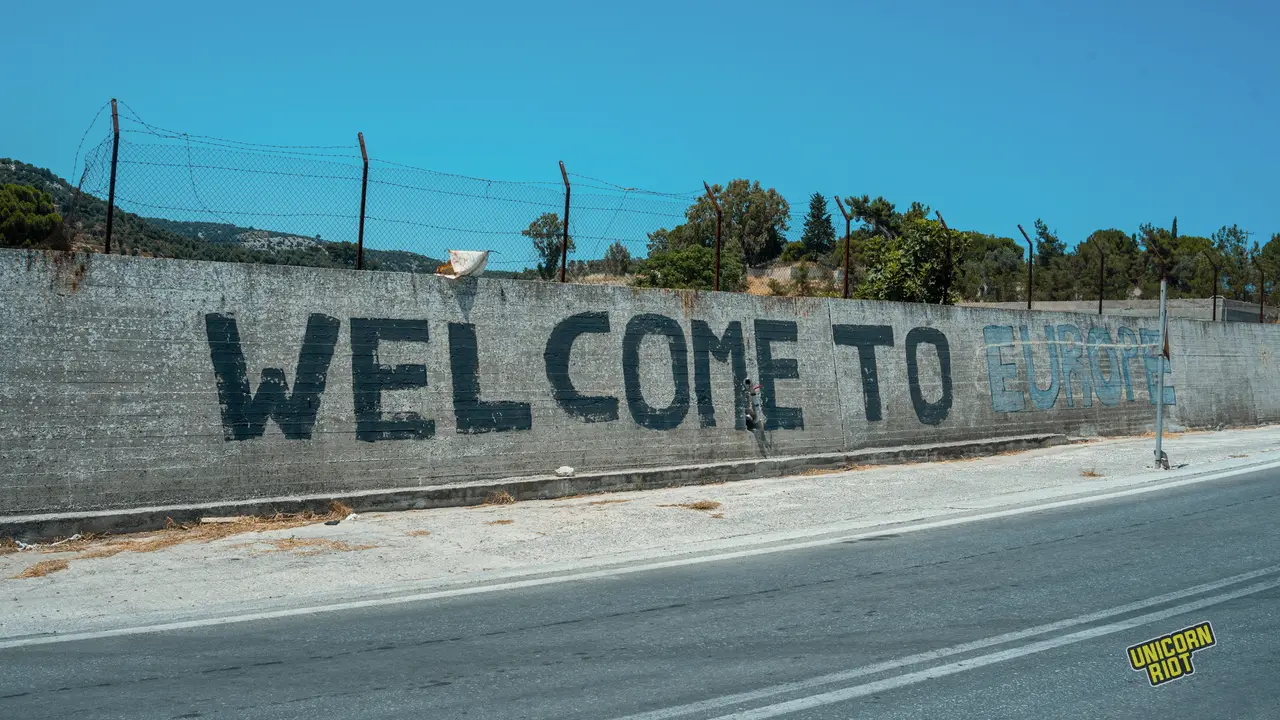
Greek Islands – In 2015, the Greek island of Lesvos was the epicenter of the so-called migration crisis. With arrivals reaching 2,000 people per day, images from the island reflected the solidarity of the locals. Fishermen were seen pulling people out of the water and elderly women took care of newborns in village squares. The islanders’ response of solidarity with people fleeing war was so remarkable that they were nominated for a Nobel Peace Prize.
For a while, Lesvos was a place that functioned as an in-between, an island that people stayed for a little bit and then left to continue their journey to Europe. But after the EU-Turkey deal in 2016, the islands were turned from places that people passed to places that people were held. From passageways they became waiting rooms in closed camps on the edge of Europe.
And this is how Moria was built, the camp that in the following years would become a symbol of Europe’s brutal containment and inhumane policies and treatment against refugees, migrants, and people on the move.
Moria camp, formally known as the Moria Reception and Identification Center, was the largest refugee camp in Europe. It was originally built to hold 3,000 people, and had help up to 20,000 people at peak times before it burned down in 2020.
The conditions in the camp were horrible. There was no running water, no sewage system and almost no healthcare. People were living in limbo in makeshift shelters waiting years for their asylum decision.
It was a place of suffering and a mental health crisis unfolded with reported suicide attempts, self-harm, panic attacks and anxiety.
Yet, the camp allowed the residents to have some agency. Showing resilience, the residents built a mosque, a barber shop, and a makeshift oven.
Residents showed solidarity with each other and organized themselves to push for better living conditions, cleaned up the camp, and ran schools.
In September 2020 Moria camp burned to the ground.
Six people, five of them minors, were arrested and charged with arson and were dubbed the Moria Six. Greek authorities claimed the fire was deliberately lit by camp residents. The Greek Minister of Migration and Asylum at the time, Notis Mitarachi, posted to social media that “the arsonists of Moria have been detained [and] the safety of everyone is guaranteed.”
However, Forensic Architecture later reconstructed the events on the night of the fire from hundreds of videos and testimonies and found the fire most likely came from improvised electrical connections among flammable tent-like shelters in hot, dry, windy conditions. This conclusion was supported by Lesvos fire department’s own report. Prior to the September 2020 fire, there had been 247 fire outbreaks in the camp.
Of the six people charged, two were tried as minors and released after four years. The other four were initially found guilty but then released after three and a half years in prison after they were acquitted of the charges and cleared in 2025.
As the chapter closed on Moria, the European Union made promises that there would be “no more Morias.”
What replaced Moria in Lesvos, supposedly as a temporary solution, was the Mavrovouni camp, often called Kara Tepe. Facing the sea just outside of Mytilene are rows and rows of the same white containers. It looks like every other camp in Greece with no sign that anyone has made the place their own.
It exists to keep people in containers, fed and counted, and almost nothing else. Compared with the chaos and terror of Moria it is an improvement but there are still issues with sanitation, water and electricity.
The biggest additions are the restricted movement of residents and the intensified surveillance. Security guards stand at the gate. No journalists or NGO workers can enter freely.
Residents have their life controlled by police, private security and various procedures with set times to come and go mediated by ID checks and bag searches at checkpoints.
While this model is far more restrictive than the one seen in Moria, the country has unveiled even more strict systems for future immigrant camps.
See UR’s Three-Part Series titled Crete: Frontline of the New EU Migration and Asylum Pact – Part 1: Locked Up and Criminalized: People on the Move Face a Broken System on Crete’s Shores; Part 2: A Failed Reception System in Crete Turns People on the Move Into Political Targets; Part 3: Greek Trials Turn Migrants Into ‘Smugglers’ and Minors Into Adults
In early 2021, Greece rolled out its new plan for the islands. It described how €276 million in EU money would replace the old reception centers across the Aegean with a new system of closed controlled access centers, or CCACs.
Journalist Lydia Emmanouilidou, who has reported on the camps for years, explained on the Failed Architecture podcast that the EU and Greece promised the new camps would be a supposed revamp of the previous ones, acting as more humane, more secure versions.
However, the new model camps are heavily guarded and surveilled. Resembling fortresses, the camps are ringed with double rows of barbed wire and covered in cameras that feed back to a control room in Athens. They now exist on five islands: Samos, Kos, Leros, Lesvos, and Chios.
Though the equipment in the new centers is high-tech and costly, the conditions for the people living there have not improved. There are no doctors or social workers, no legal support, shortages of basic goods, low quality of food and the problems go on.
The first one opened on Samos in 2021, and it is the best preview of what was to come. Amnesty International called it a “dystopian nightmare,” pointing to overcrowding, a lack of beds, people housed in canteens, too little running water, and almost no medical care.
Residents are allowed out only during set hours and must scan their fingerprints every time they enter or exit.
The neglect that constructed the horror of Moria has not disappeared. It has been replaced with a panopticon that researchers have called a “torturing environment.” An environment constructed and weaponized.
Related: Inside Greece’s Refugee Camps, Gender-Based Violence Is Built Into the System
At the center of the panopticon is the Control Room – the central surveillance hub set up inside the Ministry of Migration and Asylum in Athens – which is equipped with AI, biometric tools, and predictive software meant to spot fires and so-called suspicious activity, crowds, and movement in and around the camps.
People on the move fleeing war or seeking a better life are subjected to this intrusive surveillance system that has now been normalized. Every movement by residents in these closed centers is monitored 24/7 by cameras and AI.
Two main systems – dubbed Centaur and Hyperion – run the show. Centaur uses cameras, sensors, and drones to control the perimeter of the camp and Hyperion controls the gates.
According to Ella Dodd, advocacy coordinator at the legal aid organization I Have Rights, two Israeli companies play a key role in the Centaur system, supplying military-grade surveillance technology that has likely been developed and tested on Palestinians. That same technology, she reports, is “now being repurposed for asylum seekers, many of whom are also Palestinian.” Seen in that way, the cameras watching asylum seekers on a Greek island are part of a much larger story linking Europe’s modern-day borders to older, ongoing forms of colonial control.
Beyond social control, the system has been used against residents. Centaur was used at least once to break up a demonstration by Syrian and Palestinian refugees at the Samos camp resulting in five residents being arrested.
Additionally, these systems have not been legally compliant. Greece’s Data Protection Authority (DPA) has ordered the Ministry of Migration to pay the highest fines in the country’s history. In April 2024, DPA fined the ministry €175,000 over Centaur and Hyperion after finding that the ministry had failed to cooperate with its investigation and that its data protection impact assessments were substantially incomplete and limited in scope. The ministry was ordered to bring the systems into line with EU data protection law within three months.
Nowhere is Europe’s future direction clearer than at Vastria, the new camp being built to replace the current one on Lesvos.
Vastria sits deep in the pine forests of Lesvos, more than 30km away from the town of Mytilene. A single road is the way in and out. Public transport is not a viable option and it’s a seven-hour walk if residents need to reach a hospital or a lawyer. The camp, constructed like a fortress, sits next to a landfill and is part of the protected Natura 2000 nature reserve.
The region is at high risk for wildfires, and is an area without a real evacuation plan. Echoing the ominous end of Moria, this situation draws many similarities.
Locals from all sides of the political spectrum don’t want the camp there and have tried to stop its construction based on the camp’s non-compliance with a number of regulations and the environmental implications.
Construction sits at 95% complete and Nikos Panagiotopoulos, the previous Migration and Asylum Minister, said the camp represents “an obligation of Greece to the European Union that is funding it.”
This goes to imply that Vastria isn’t just a Greek project. It’s a European project as Europe provides the money and political support.
While the facade of the construction of a better system of migration fades, what emerges is a narrative aiming to justify these conditions that are constructed not only in the camps but also in the borders of Europe and in the general migration policy in the name of security.
At Moria, volunteers and journalists could get in, and that’s why the world knew what was happening. Since then, Greece is making access much harder for reporters and aid groups while turning migrants into smugglers and minors into adults.
Solidarity itself has been criminalized, with activists and volunteers prosecuted under Greece’s new law 5275/2026, which toughens penalties for smuggling-related offences and targets organizations working with migrants through more administrative control and harsher sentences tied to organizational membership.
When the witnesses are shut out and the people helping are treated like criminals, what happens behind the fences gets harder to see. And what can’t be seen is easier to ignore.
Various organizations have called for the abandonment of these policies. Legal Center Lesvos together with other groups has demanded an immediate halt to Vastria’s construction. In a statement they released earlier this year, they warn that the camp has been designed to hold people for long periods, partly as a detention center for those waiting to be deported, in line with the priorities of the EU’s new Migration Pact.
Once it opens, they expect more asylum seekers to be detained without good reason, and more people to be held before deportation in conditions that could become harsher and less safe.
Vastria will be the blueprint for this new generation of Pact camps. What happens in Lesvos is not isolated only to the Greek territory, it’s the future.
With people’s dignity being taken away in a controlled space where residents are treated as targets and criminals and are stuck in lengthy waiting games for their next move, this is containment by design. Europe calls it migration management.
The walls, cameras, and remote locations don’t just keep people in, they keep people out and help control what kind of life is allowed inside.
The question isn’t how to fix the camps, but whether they should exist at all. What a camp does today is only part of the story. The rest is what it makes acceptable tomorrow. And what gets tested on refugees or oppressed people at the edges of a continent rarely stays there.
Cover image by Niko Georgiades for Unicorn Riot with images contributed by Sophia Potsi and Romanos Lioutas – Additional edits by Sean Summers for Unicorn Riot.
Follow us on X (aka Twitter), Facebook, YouTube, Vimeo, Instagram, Mastodon, Threads, BlueSky and Patreon.
Please consider a tax-deductible donation to help sustain our horizontally-organized, non-profit media organization: