
Politics Tribune
Veteran Politics
Ex-military officers now play an influential role in the Labour Party, filling the void left by the working class.
English (original) ·Read in Deutsch ⇄
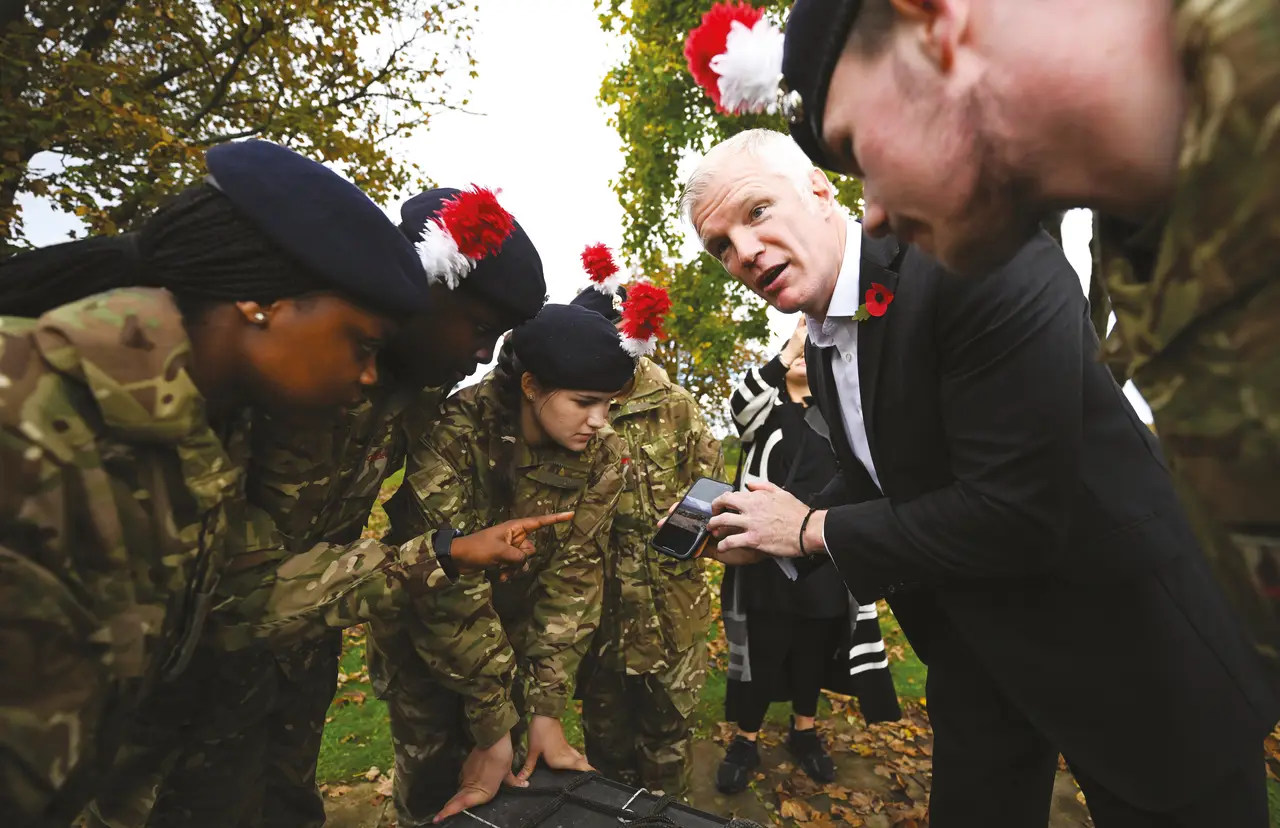
Britain has long had military men sitting in its Parliament, but something has changed. Once it was assumed that most former soldiers in the House of Commons would be Conservatives. Yet in recent years the uniform, the gun and the salute have been especially attractive to the other party of government. The thirteen Labour MPs who are military veterans have come to play an outsized role in the party’s sense of itself. When workers dreamed of turning the world upside down, the army might have looked like an enemy. Now, with its love of tradition, hierarchy and unimpeachable patriotism, it figures as a hazy image of what Labour politicians imagine the ‘authentic’ working class to be, a class they feel they have lost and must work to regain.
Admiration for the military is therefore a sign of a broader decay in the ambitions and the imagination of socialism in Britain. Soldiers replace trade unionists as images of the proletariat, with Labour firing metaphorical shots at the unemployed and literal ones at the enemies of Britain’s rulers. While such imperial loyalties are nothing new, the innovation is to present them as integral to progressive politics via this association with the ‘ordinary citizen’: the imagined everyman who loathes rootless elites and sees khaki as the colour of patriotic pride.
A Class Redefined
Keir Starmer’s approach, Labour insiders said in 2020, would be ‘flags, forces, family’. A leaked internal presentation advised that veterans and other ‘patriotic’ signifiers should be used to appeal to ‘lost’ conservative voters. This was partly an attempt to draw a contrast with Blairism. Where New Labour had celebrated free markets and projected a whirlwind image of the future — cool, dynamic, unequal — in post-Brexit Britain all the talk was of a working class ‘left behind’ by globalisation. An institution representing the nation and the state seemed the perfect nostalgia trip amid pessimism about the trading floor and the investment bank. The call was for something old-fashioned, comfortable, stable. The military is a perfect carrier for this sentiment because it does not really threaten finance capital — only its vibe is different, which makes it ideal for politicians seeking to change not the world but the mood music.
The conservatism of the military was also crucial for a second reason: to establish a contrast with the left. Given the scale of discontent about inequality, Conservative campaigns against Jeremy Corbyn rarely concentrated on his economic programme. Instead they cast him as a traitor to the nation, with former heads of the army and the security services briefing the press that he was not to be trusted. Socialism can be imagined here as the property of sandal-wearing hippies, weirdos outside the national community. Their marginality is confirmed by their scepticism about Britain’s imperial ventures, their strange obsession with state violence far from view.
These two drives were combined in a key Starmer advisor. At university, Claire Ainsley had been an anti-war socialist militant; she then worked for the Quaker-founded Joseph Rowntree Foundation. This is not the start you might expect for a story about a militarist, but by the time she became Labour’s policy chief in 2020, she was on a slightly different track. Ainsley’s personal manifesto, The New Working Class (2018), was at first glance a radical text; she stressed that preponderant images of the working class had to catch up with the new reality, where workers in Britain were less likely to be found down a mine or building ships than making sandwiches or nursing the elderly. She found a working class now (who can still be surprised by this?) more female and more multi-ethnic than in the 1950s.
But in relaying her interviews with workers, Ainsley gives us tale after tale about their conservative attachments, including strong admiration for the army. Her assumption is that if some workers say they like something, then ‘working-class politics’ must mean championing that thing. Objective needs and interests are conflated with subjective feelings and identities. Through this elision, and through her careful selection of evidence and anecdotes, she arrives at the conclusion that bowing to people in palaces is more important than policies that would bring real material benefits for those on low incomes: more social housing, health and safety at work, paid holidays, secure pensions. In a bizarre twist, class politics now means support for another class.
Loyalty to the army therefore emerged as a signal of the new class politics of the post-Corbyn era. By the summer of 2024, the strategy had fully taken shape, with Blue Labour theorist Maurice Glasman’s call for ‘faith, family and flag’ echoing in Labour’s slogans. Keir Starmer gave a speech at the Fusilier Museum in Bury labelling Labour the party of national security, with ex-military parliamentary candidates clustered somberly around him as he spoke. Most of them received targeted donations from Morgan McSweeney’s anti-left campaign vehicle Labour Together. Several of the candidates said their core motivation to enter Westminster was to continue their ‘service’. The unasked question was: service to what?
Three Birds, One Stone
Veterans inevitably excite the press. Ex-paratrooper Dan Jarvis won a 2011 by-election for Labour after a campaign he’d codenamed ‘Operation Honey Badger’. Ever since, he has been touted as a potential leader, eliciting gushing admiration simply because of his military credentials. Journalists give him monikers like ‘steely-eyed messenger of death’, and they mean it as a compliment. The ‘death-dodging’ former special forces officer Al Carns received a similar welcome when he landed in parliament after the last general election. A commentator in the Times described the new arrivals as irresistible heartthrobs who had ‘turbocharged [her] arousal levels’. In the USA, a former Marine tells me, this kind of thing is called ‘troop-fucking’.
When Starmer entered Downing Street he wasted no time parachuting the veterans into top positions. Jarvis would play a draconian role as security minister, implementing the government’s raft of restrictions on free expression. Carns became a defence minister, Mike Tapp was installed at the Home Office, and former Intelligence Corps colleague Louise Sandher-Jones and retired RAF officer Calvin Bailey both ended up in the Ministry of Defence. Ex-soldiers who refused to tow the militarist line, like Clive Lewis, were kept out in the cold.
The majority of Labour’s new veteran politicians were privileged ex-officers, not working-class squaddies. Having spent most of their working lives leading the lower orders into a succession of failed imperial wars, they were hardly reflective of the voters Labour hoped to win. But part of the army’s appeal was its ability to produce quiescent MPs of the kind the party has sought since Blair. These are people trained for the ‘unthinking obedience’ with ‘an exquisite capacity for keeping in step’ that Norman Dixon diagnoses in his classic book On the Psychology of Military Incompetence (1976). It’s hard to imagine a better apprenticeship for doing just as the whips say.
Starmer’s military turn was also about scraping at the dregs of shattered public trust. Despite abject failure in recent conflicts and multiple ongoing scandals (endemic racism and misogyny, sexual violence and war crimes among them) the military remains one of the few British institutions that still registers high levels of public trust. Politicians seeking buy-in for the British state can scarcely appeal to the image of the police, elected politicians, journalists or civil servants: all have taken a battering in the last decade and a half. But Labour and Tory governments alike have found they can still lionise soldiers in a bid to defend their shared commitment to US foreign policy. There is always another vanity project like Gordon Brown’s ‘National Recognition of our Armed Forces’ report, always another charity drive or public ceremony, which allows them to perform support for the troops.
Alignment with the military therefore killed three birds with one stone: repositioning Labour as the party of patriotism and tradition with the help of pliant journalists, identifying a training ground for obedient MPs, and harnessing an institution to revive faith in Britain’s crisis-ridden establishment.
Back to the Future
Still, none of this worked for Starmer in the end. An ungrateful military hastened his demise, as the army’s top brass, demanding ever-higher defence spending, coalesced with civil servants in the Ministry of Defence and then managed to secure ministerial resignations. Prime Ministers are often doomed by the causes they adopt, but here the lesson runs deeper: while Labour wanted to invoke the military as no more than a vibe, the fact is that it remains a powerful institution which is hostile to most social progress — and which has proven its willingness to mobilise against elected politicians when it doesn’t get its way.
Some say it no longer makes sense to speak of a ‘Labour’ Party, since it long ago abandoned its aspiration to represent working people. Blair bemoaned Labour’s split from the Liberals at the start of the twentieth century, wishing instead for a broad progressive party akin to the US Democrats. It’s true that the name can feel like a hangover from a lost past, an inappropriate label for the left flank of the lanyard class. But the recent turn to military candidates suggests a further mutation. Labour now wants to talk about class again, but in an imperial vein.
The Labour Party, as Richard Seymour has observed, is rooted more firmly in Victorian liberalism — with its commitment to global capitalism and empire — than to either of its supposed influences in Marxism or Methodism. The British military, which appears to be a quintessentially national entity, is in reality an institution that plays second fiddle to American empire. It therefore not only allows elite politicians to recast high-ranking officers as salt-of-the-earth lads; it also acts as a tool for recasting cravenness to US power as fearless British nationalism. As working-class flourishing remains elusive, ‘working-class politics’ comes to mean the politics of working-class death.