
World Tribune
Dispatch from Italy: ‘Blockade Everything’
Farmers, truckers, students and dockworkers are shutting down the country.
English (original) ·Read in Deutsch ⇄
Since the beginning of October, truck drivers and farmers in southern Italy have blocked highways, ports, warehouses and logistics districts for days at a time. As a result, supermarkets from Campania to Puglia and Calabria to Sicily have run out of fruit, vegetables and toilet paper. Petrol stations and airports are short of fuel, McDonald’s had to close for several days due to a lack of supplies, and Naples, the largest city in the south, is teetering on the edge of economic collapse. By the end of the month, shortages had worked their way up the Apennines to northern Italy, hitting the richest parts of the country, too.
This isn’t the first time in recent years that farmers in Italy have taken to the streets; they also protested against EU agricultural reforms and rising fuel prices after the start of the war in Ukraine. But those actions struggled to gain support and visibility. This time, what began as spontaneous protests against a cost of living crisis has brought much of the country to a standstill, and it’s just getting started.
The immediate cause of the crisis is clear. Iran’s closure of the Strait of Hormuz in response to US and Israeli aggression has pushed up fuel prices in Italy by almost 30 percent and agricultural diesel by more than 40 percent. The prices of basic goods and oil derivatives essential to agriculture like fertilizer and pesticides have surged with them.
While this impacts everyone, intermediary figures like farmers and truckers in the south, Italy’s agricultural heartland, are among the most exposed. As employees of small and medium-sized businesses, they’re already squeezed by the low margins imposed by the Grande Distribuzione Organizzata (GDO), the large retail chains that dominate the food market as an oligopoly. The GDO system is organised on just-in-time capitalism principles, as supermarkets ensure profits through the constant movement of goods with minimal stockpiles or ‘excess’ labour. In periods of crisis, the GDO offloads shocks onto truck drivers and farmers through one-sided contracts that leverage the power differential and force them to cut costs or face unemployment — a phenomenon tied to the long history of racialised labour exploitation in Southern Italy’s agro-industrial districts. As inflation eats into their already thin margins, workers are walking off the job and taking their vehicles with them. With no backup stocks as a matter of principle, supermarkets and petrol stations are defenceless against these disruptions; the crisis, therefore, is immediate and highly visible.
ENI, one of Europe’s largest oil companies and a firm actively pursuing oil extraction off the Gaza coast, tried to stem discontent by capping the price of fuel at €1.99 per liter. This did little to improve the situation, as the company was accused of using this price reduction as an image-washing maneuver while it continued to profit at the expense of the people. The government, meanwhile, responded to the simmering crisis by offering future tax incentives, direct financial aid to the affected sectors and a temporary delay on business debt payments. Large companies with the ability to absorb rising costs and wait for long-term government refunds accepted these terms, while small operators that needed immediate cash and instant relief at the pump continued the blockades.
As the protests continued, the government stopped negotiating and turned to repression. Police cleared blockades, identified, searched, and pressed charges against protestors camped at highway junctions, and began escorting trucks delivering basic goods to their final destinations. But many disruptions are still in place, and unlike in 2022, the truckers and farmers’ protests have received huge popular support. People bring food to the blockades and respond to calls for demonstrations in their thousands, blocking highway junctions and ports in acts of mass disobedience.
The national media has played down the crisis imposed by the blockades, instead focusing their outrage on other spontaneous revolts against the high cost of living. Two weeks ago in Milan, young people, mostly racialised, stormed the centre of the country’s financial capital, looting international brand stores and clashing with the police. Though vilified by the press and the government, the rioters’ message — ‘they never saw us, now they finally do’ — received broad public support from a population worn out by rising costs and by a bleak horizon of war, repression and growing poverty.
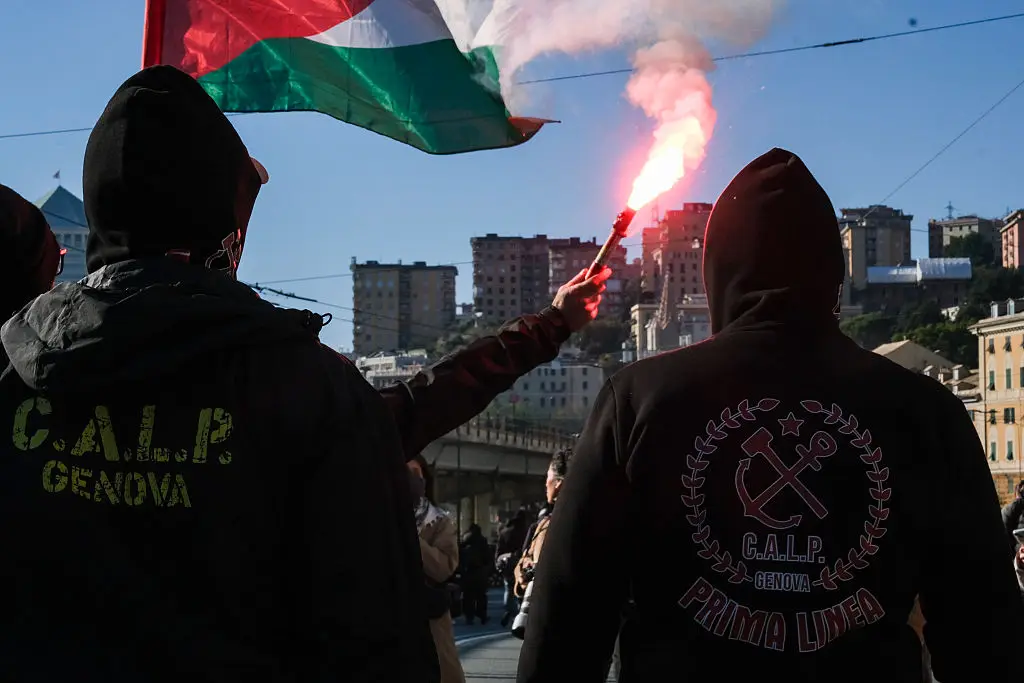
The movement reached new heights last Friday, as dockworkers holding a day of strikes in solidarity with Palestine spurred mass demonstrations across the country. Tractors marched alongside other protestors in Rome, ring roads were blocked in Milan and Bologna, and ports were closed up and down the coast as the dockworkers united with farmers and truck drivers, young people protesting against the high cost of living and racialised exclusion from society, and migrants organising against a new immigration detention centre near Naples.
It’s become clear for all to see that the same war economy that produces genocide in Gaza and war in Iran has made life unliveable for many in Italy, too. The slogan that sustained mass uprisings for Palestine a year ago has returned in full force, and is only getting louder with each passing day: ‘Blocchiamo tutto’.