
Germany · taz · 5h
Civil society in Saxony-Anhalt: carry on, somehow
Deutsch (original) · Auto-translated to English
A menacing siren. That's what you hear first when the first election forecasts come over the cell phones of the approximately 200 people who gathered on the cathedral square in Magdeburg for the rally of the Saxony-Anhalt Weltoffen civil society alliance. The siren sounds from the converted campaign vehicle of the Center for Political Beauty. Smoke also rises from it.
Almost nothing happens on the pitch at first. Shocked, some people hold their hands to their mouths and can hardly believe the initial forecast. 44 percent for the AfD, which is said to be just one seat short of an absolute majority - that's even worse than many here expected. It takes five minutes until some try to encourage each other with a “All together against fascism.”
In Arneburg - a very small town with just under 1,400 inhabitants northeast of Stendal - Max Heckel has his own tactic for dealing with the election forecasts: he wants to ignore them as best as possible. That's why he's celebrating a kind of anti-election party on this election Sunday. He tells taz that he would rather grill and sing karaoke than look at blue bars. Either the AfD will celebrate its triumph today, or it will cast doubt on the election: “I don’t want to do either,” says Heckel.
Heckel is known for his clear stance against the right, now also nationwide: He is a teacher at a secondary school in Stendal. The wife of Ulrich Siegmund, the top candidate of the right-wing extremist AfD Saxony-Anhalt, works as a teaching assistant at the same school. Last year in March, two students asked Heckel whether he would vote for the AfD. He said no and justified his position in clear words. He then received a warning from the school authorities because he had violated the “duty of neutrality”. Heckel is defending himself legally.
On this day, at 6 p.m., he sits in front of the “Anker” – his cultural hall in Arneburg – with a self-made fag. About 25 people are already there. There is a “duty of confidence,” he says. Then he gets up to clean the grill. But across the street, a couple is already whispering, hunched over a cell phone. “Oh shit,” a woman shouts when she sees the blue bar. Max Heckel is trying hard not to get involved - will he be able to do it all evening?
It had remained quiet in Magdeburg throughout the day – very quiet. There were more journalists out and about in the city center than passers-by, and their number was only topped by the number of right-wing streamers and influencers who, without being asked, pushed their microphones into people's faces and posed in front of German flags. Otherwise, many Magdeburgers sat in the sun in cafes. Feared right-wing demonstrations did not materialize.
“But that’s not the all-clear,” says Meike Schubert, who is active in the anti-racist campaign here, to the taz on the cathedral square in the afternoon. “Our assessment is that they are waiting because they think they have this thing in their pocket.” In anti-racist and anti-fascist circles, people are therefore prepared. In addition, it is now important to continue the protest of the last few weeks. Because we could also learn something from this elsewhere in Germany, she thinks: “After all, fascism doesn’t stop at the country’s borders.”
After 6 p.m. she told the taz that the election results made her “sad, but also determined.” She is worried about the violence that could come now. At the same time, she is sure: “We will continue to oppose racist incitement.”
In the weeks before the election, civil society in Saxony-Anhalt stepped up again. On the eve of the election, over 20,000 people celebrated democracy on the cathedral square in Magdeburg, and 2,000 anti-fascists marched in Halle. There were actions in almost every corner of the state.
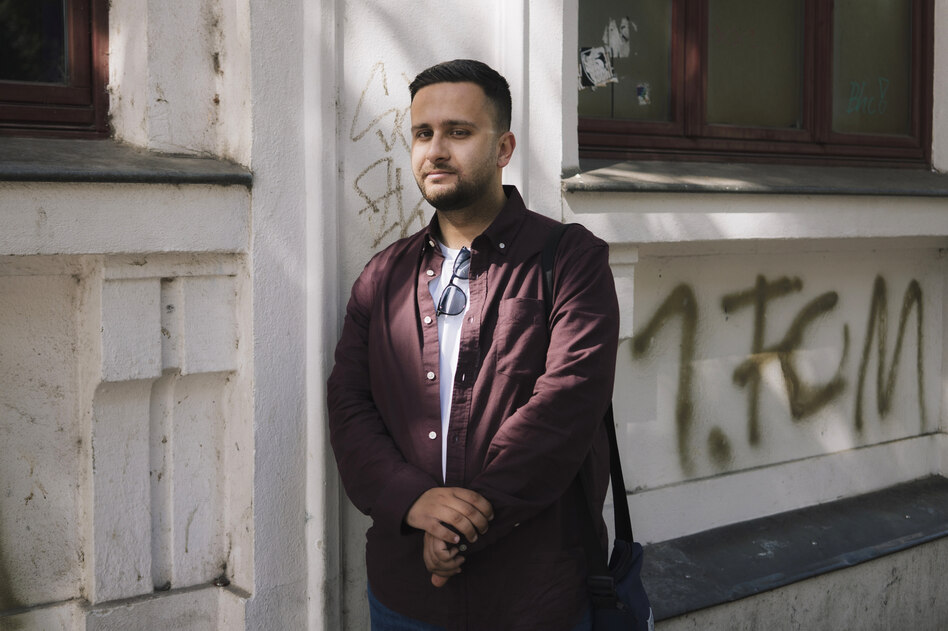
Saaeid Saaeid also traveled a lot. The spokesman for the refugee council looks tired when taz meets him at Hasselbachplatz in Magdeburg at lunchtime. Yesterday he spoke in front of thousands at the big democracy festival, and immediately after the interview he sat on a podium at a cultural festival. “I'm totally exhausted,” admits the 26-year-old, who himself fled Syria to Germany. But he did everything that was possible and that makes him feel good. “Now all we can do is wait.”
He is hopeful that the mobilization of the migrant community for the election went well. “Everyone who is allowed to vote has already voted,” he says. Although, as he emphasizes, this was made difficult for migrant people. And not just because the majority of the 200,000 people with a migration history in Saxony-Anhalt do not have the right to vote because of their residence permit, says Saaeid. But also because of intimidation by the right.
The Refugee Council therefore advised people with a migration background to vote by post. Recommendations for behavior were sent to the community for the evening: don't go out alone, avoid public places, and it's best to stay at home. Racist riots are to be expected.
Saaeid explains the situation in a composed and professional manner: The work of the Refugee Council is only funded until the end of the year, and what happens next is unclear. The hostility has increased in recent weeks; just yesterday he was mobbed by right-wingers on the sidelines of the democracy festival. Many in the migrant community would consider leaving Saxony-Anhalt.
But he plans to stay and carry on, says Saaeid. "People with a migration history are part of Saxony-Anhalt. We have family, social contacts and businesses here." That's why there is no other option than to keep fighting. “But we need support for that,” says Saaeid. He is now relying on civil society, which has shown great solidarity in the past few weeks. And he has “confidence that there are institutions in Germany that protect the constitution.” The coming weeks will probably show how resilient they are.
Read the full story at the source →
Source: taz