
Germany taz
Youtuber about energy transition: “Everyone has a little prepper in them”
Andreas Schmitz explains on YouTube as “The Battery Doctor” about solar systems and heat pumps. A conversation about strict bans on politics and feelings of freedom. more...
Deutsch (original) ·Auto-translated to English
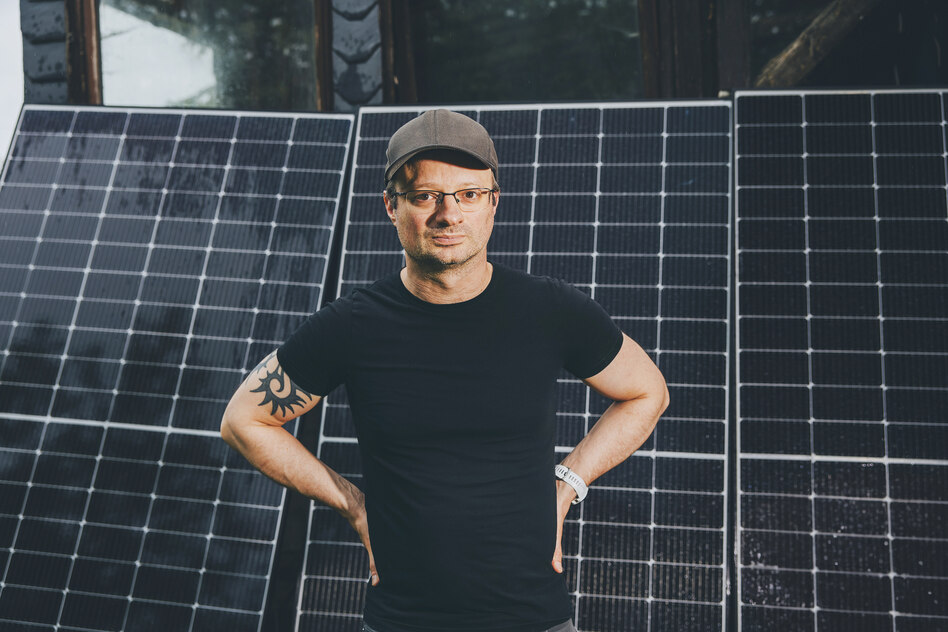
A long bus ride into the country, a single-family home on the edge of the forest, there are toys in the front yard, and PV modules are installed on the roof. Andreas Schmitz lives here with his family, and here he records YouTube videos in which he, as a battery doctor, tries to put the hysterical discussion about the energy transition back on a scientific footing. He studied mechanical informatics and mechanical engineering, and today he still works part-time at the German Aerospace Center (DLR) in Cologne in the area of mathematical optimization and artificial intelligence - and will soon be giving orientation to half a million people who have subscribed to his YouTube channel when it comes to photovoltaics, heat pumps or storage.
taz: Mr. Schmitz, when you started YouTube ten years ago, did you think that your channel would become this big?
Andreas Schmitz: No, not at all. I had absolutely no idea about YouTube and fell into it by accident.
Schmitz: That was pretty banal. A friend was interested in photovoltaics and I wanted to give him a small, foldable PV module with a USB plug so that he could charge his cell phone. I didn't think anything of it, for me this technology was just a gimmick. Back then I was subject to the usual prejudices. Then the module sat around with me for a little longer. I once took a voltage tester, held the thing up to the window - and was amazed at the amount of electricity that came out. Only then did I check: This isn't a toy at all, you can use it. Two weeks later I had all the balconies full of PV modules.
Andreas Schmitz, born in 1982, completed two courses, doctoral thesis “Mathematical optimization methods”, works – now only part-time – as a scientist at the German Aerospace Center (DLR) in Cologne.
As a “battery doctor,” Schmitz and his team now explain to more than 450,000 subscribers on YouTube whether a heat pump or an electric car makes sense for them, whether they can buy a home storage system or make one themselves. Lately the channel has become increasingly political; Schmitz explains how our energy system works and what politicians need to do to make it fit for the future. The battery doctor is increasingly being invited as an expert to hearings in Berlin; a Bundestag petition he initiated has led to balcony power plants being significantly easier to install since 2023.
Schmitz: Yes, it escalated a bit, I'm generally inclined to do that. That was just the beginning. I thought: Now I have so much electricity that I can't use at all, now I want a battery too. I watched YouTube videos in which used lithium batteries were screwed together and thought: You're all crazy, this is going to explode. Two weeks later I screwed together a battery myself from used lithium batteries. That was fun, a totally crazy trip.
taz: As an engineer, you know the technology, but where did the need to make films about it and put them online come from?
Schmitz: That was rather vague. On the one hand, I probably felt the need to share myself, even if I really didn't expect it to reach anyone. Then I realized that there was a lot of skepticism about the technology, and I wanted to do something to counter that. Besides, I had a camera anyway and thought it would be interesting to use an editing program. That's how it started.
taz: Was there a moment when you realized this had potential?
Schmitz: The first time I was amazed was when someone I really didn't know left a comment. Then I realized I was reaching someone. The interest then became really intense with the war in Ukraine and the energy crisis. Until then, my audience was more of a hobbyist community. People who wanted to build something themselves. But when the Ukraine thing started and electricity prices rose, people wanted to become independent. And that's exactly what I wanted.
This text first appeared in wochentaz, our weekly newspaper from the left!
Every week, wochentaz is about the world as it is – and as it could be. A left-wing weekly newspaper with a voice, attitude and the special taz view of the world. New every Saturday at the kiosk and of course by subscription.
taz: How do you see yourself? Are you a hobbyist, a nerd?
Schmitz: Yes, hobbyists definitely. And I can live with being a nerd. That's also the core of the community: a bunch of engineers, nerds, hardcore hobbyists who met on the Internet.
taz: How would you describe your motivation? Why are you putting so much energy into it?
Schmitz: The motivation has changed. At first it was mostly curiosity about YouTube and crafting. It will always stay that way, I just like tinkering and have this thirst for knowledge, I didn't become a scientist by chance. And it's the same for others, because I get an incredible number of inquiries: I want to buy a heat pump, how big does it have to be, what can I do wrong and how much should it cost? Concrete questions to which finding good answers is often difficult.
taz: Because there is so much false information out there.
Schmitz: Exactly. That's the other reason I do all this. People are being systematically frightened, I find that crass. I don't want to claim that there are no problems with the energy transition. This is a huge, very complex project, no question. But creating a huge fear of this is grossly exaggerated and, above all, counterproductive. Because fear paralyzes you and you can't move forward. That's totally stupid. I often get emails that say: I heard that we have the highest electricity prices in the world and that we are dependent on electricity imports. But both are very complex topics, and you can't say both in general terms. Taking away people's fears and educating them has now become a great motivation.
taz: So you could say that you have developed from tutorial videos to political education?
Schmitz: I don't see it as political at all. I would describe it more as science communication. The topics often have political aspects, but we put them together with the help of our now large network of scientists from the energy sector.
taz: Fear mongering is a political strategy. Doing something about it is also political.
Schmitz: Yes, of course that’s true. But sometimes it is also very simple. For example, there are influencers who sell emergency generators. They make a profit when they successfully scare people that the network will soon collapse.
Schmitz: No, the big blackout won't happen here. Everything is relatively safe in this country. Because you have to say this: the power grid is really cool, there are a lot of security mechanisms. It's amazing what's behind it in terms of engineering. That's incredibly cool, you don't have to worry about running out of juice everywhere tomorrow. So absolutely this is total nonsense. Which doesn't mean that we don't have to do anything on the power grid.
taz: Where does this widespread fear come from?
Schmitz: There are people who really believe in it and others who actually make a profit from it. They defend themselves because their substance feels attacked. However, I wasn't aware of this at the beginning until the first threats came.
Schmitz: More than that. It sometimes went so far that it was announced that someone would be coming to my house soon. My family has also been threatened, but that is rare. That really threw me off track for a while, so I thought about quitting the YouTube channel. I've now learned to deal with it.
taz: Was that a concerted effort by fossil lobby groups?
Schmitz: My impression was: No, these were more individual actions. I actually think it's still working for me. Women are much more affected by attacks online, and the tone becomes much harsher. Smart women who, best of all, still have a somewhat foreign look, like Mai Thi Nguyen-Kim...
taz: … the presenter of the Yotube channel and the ZDF neo show “MaiThink X” …
Schmitz: ... they are affected much more severely than I am.
taz: Under one of your videos you wrote: "Misinformation, polarization, trench warfare. That's the real problem." What exactly did you mean by that?
Schmitz: I don't see much polarization among the people themselves. An example: In our internet forum, there is a strict ban on politics. Although there are people from different camps who have completely different political views, everyone gets along really well. It's really nice to notice: If you help each other practically, then it works, then these fights don't happen, because people actually don't want it. They want a functioning PV system on the roof and a heat pump in the basement, and no longer have to be afraid of rising electricity prices or of freezing. Even the biggest skeptics soften when they produce their own electricity, then it's no longer just about savings, but also about this feeling of a little freedom.
taz: That sounds great. So what's the problem?
Schmitz: I see a very strong polarization in the media and in politics, it's really blatant. Too often things are very loud and not differentiated enough - on both sides. And unfortunately there are too few people in the media who are sufficiently intelligent and instead prefer to parrot false information. By that I don't just mean Bild or RTL, but also the public broadcasters, which are often not much better. They have an educational mandate and I think that is often violated.
taz: But it is significant that you have to completely shut out politics so that things remain peaceful in the forum. And doesn't the issue automatically become political if the federal government restricts how much of my PV electricity I can still feed into the grid?
Schmitz: That's right, it will be difficult. That's why we have an area in the forum that is unmoderated and only visible to members. People can bash their heads in there, and whoever wants to do that: congratulations! Otherwise we simply don't want that, as soon as the discussion moves from the technical to the political, it is no longer solution-oriented at all.
Schmitz: Your example: I see that we have stress in the power grid. But I miss someone asking the simple question: How do we solve this? What do we do with the north-south problem? Do we need thicker cables? Where is the best place to put the batteries? How many gas power plants do we need for stabilization? And how do we best achieve this economically? These are all technical problems for which there are technical solutions. So let's get a few scientists together and see whether solution A or B or C makes the most sense, and then we'll come up with a great plan and see it through. That's what everyone would want, right?
Schmitz: No, I certainly don't see it. The core questions are no longer discussed at all. The only thing that matters is: You suck. No, you suck and you lied! You don't try to solve a problem together. That was the case with Economics Minister Robert Habeck, who was just being annoyed all the time and couldn't implement his ideas, some of which were quite good. And conversely, Katherina Reiche is right on a few points, but they are also drowning in these trench warfare. I'm worried that nothing will happen in the end.
taz: You have started petitions that should simplify the installation of balcony power plants and small storage systems. As a result, you have often been invited to the Bundestag as an expert. How did you get to know politics?
Schmitz: Because of the petitions, I was in contact with many politicians. I'll say: I don't have any more with most of them.
taz: Not even with the specialist politicians?
Schmitz: I admit, I can talk much better with people who are more knowledgeable about the subject. This applies to the experts of the vast majority of parties, some of whom are not completely clueless. Some have a more economic orientation, others want more climate protection. That's okay, these are technical and economic orientations that differ a little and the people should be able to choose between them. But then Markus Söder simply claims that electricity price zones would destroy the industry. There are a thousand calculations that say this is not correct.
taz: So far, Germany is a single electricity price zone in which electricity always costs the same at any given time - regardless of whether the wind is blowing or the sun is shining in my area. Experts believe it would be fairer and better for the grid if we divided the country into several zones - and electricity would then be cheaper where it is produced.
Schmitz: Electricity price zones would be totally good for the entire country in the long and medium term. But Söder's statement then determines the discourse.
taz: You sound pretty desperate.Schmitz: Desperate, that's true. But it's no use, I'll still try to see everything as objectively and from the technical side as possible - and bring a bit of reason into the discussion.
taz: On the other hand, the thumbnails you use to announce your videos are often very sensational. An example, even with Trump capitalization: "This network collapse changes EVERYTHING! - The truth is BRUTAL!"
Schmitz: I know the criticism. I'm not always comfortable with it either, but our success proves us right. We can immediately see the difference in the number of hits whether we announce the clip seriously or – I would say – rather bluntly. Because unfortunately it's like this: The consumer claims that he doesn't want that, but if you make the title sensational, you can immediately see live how the viewer numbers go up. This is how YouTube works.
taz: You even made a video about why you use clickbait like that.
Schmitz: Yes, especially to explain to our community of hobbyists and nerds why we do it, because they don't like it at all. I now have people working full-time for me, it's just become too much work to do it on the side...
taz: You have three employees and have also reduced your job as a scientist to half a position.
Schmitz: In order to finance this, but also to really achieve something, we have to get out of our own bubble. Thanks to clickbait, our films now end up right next to all this populist stuff and are also clicked by people who would otherwise buy into false information. We use tabloid and populist methods for the title and thumbnail, but the content is strictly scientific. Our films are extremely carefully researched, we have a network of scientists, and if we make a mistake, we deal with it transparently.
taz: You also said: The thumbnail, i.e. the preview image, is the bouncer, he sometimes has to wear a clown nose to reach people. As a scientist, don't you hate putting on that clown nose?
Schmitz: Terrible. I hate it. I've gotten somewhat used to it now, but almost every time I think: Wow, you really can't do that, it's really too stupid. Then I think: If it triggers me, then it will also trigger the YouTube viewer - and then it works. You have to pick up people's emotions, it's an art. I'm not a fan of the Bild newspaper, but they have perfected this art. We had to learn them first.
taz: But it's a bit of fun for you, isn't it?
Schmitz: Yes, of course, otherwise I wouldn't do it. But I prefer working as a scientist because I can puzzle around on concrete mathematical problems all day long, that's totally my thing.
taz: Nevertheless, whether you like it or not, you are caught in the middle of a culture war.
Schmitz: I don't see it that way. It's no longer a fight, the matter has been decided. People are buying these systems and want to produce their own energy. I really don't know anyone who has built a PV system and doesn't find it cool to look at their app and see how many kilowatt hours have been produced. Everyone loves it. Everyone has that little prepper in them - and the desire for security and self-sufficiency and self-determination.
Schmitz: The energy transition can no longer be stopped. That's a fat ICE that's just coming along at 300 kilometers per hour. And if someone thinks they can stand in the way and stop them, I think: Are you crazy? People just do it, the train will come whether you like it or not. You might be able to slow it down a bit, but it would be much wiser if you thought about: How can this thing get through the curve that just appears in front of us? And by that I mean, among other things, the power grid. This requires engineers and people who have knowledge.
taz: Those in charge don't think about that?
Schmitz: My impression is: not all of them, if you look at the stupid excuses. At one of our hearings in Berlin, Stefan Rouenhoff...
taz: ... State Secretary in the Federal Ministry for Economic Affairs and Energy since 2025 ...
He said: None of this is possible. When I asked why not, he replied seriously: We would then have to control all the small storage units individually. That's when I got really upset because that's nonsense. The small storage systems control themselves based on the electricity price or dynamic network fees. Nothing needs to be controlled from outside. I admit they're not all like that, but it left me speechless.
taz: What is your claim? Save the world?
Schmitz: Oh no, we're not saving the world. As a scientist, I see that humanity is not on a good path. But I don't know exactly where it will end, how bad it will get - but that's enough reason for me to do something about it. When my children ask me at some point: Where were you back then? Then I would like to be able to say: At least I tried.