
Housing taz
Housing market in Brandenburg: Vacancies are growing outside of the suburbs
For a long time, the whole of Brandenburg seemed to be growing. Now the gap between the fat belt and the periphery is increasing. This has consequences for the housing market. more...
Deutsch (original) ·Auto-translated to English
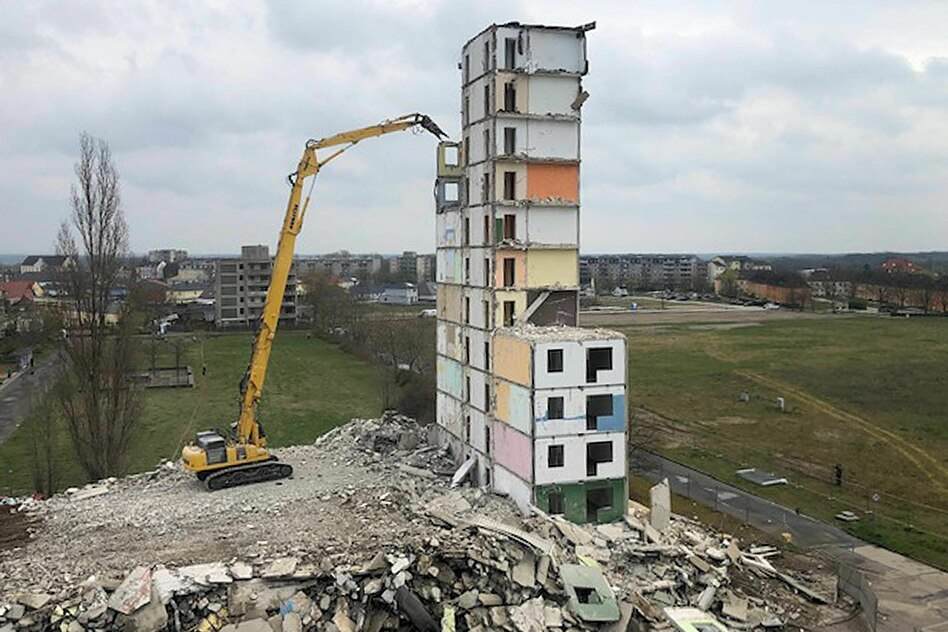
More than 15 percent of the apartments in Eisenhüttenstadt are empty. This is despite the fact that numerous apartments have been demolished in the past. For Maren Kern, board member of the Association of Berlin-Brandenburg Housing Companies BBU, this is just the tip of the iceberg. “We have demographically difficult regions in Brandenburg,” she said at the BBU’s annual Brandenburg press conference on Tuesday.
In fact, vacancies are not only growing in Eisenhüttenstadt, which, with 24,000 people, has more than halved its population since reunification. Almost every tenth apartment is now empty in the so-called “further metropolitan area”, i.e. beyond the Berlin suburbs. This is also an alarm signal for Kern. She speaks of a “negative spiral in which population decline, the loss of infrastructure and growing vacancies reinforce each other”.
For a long time it seemed as if the gap between the Berlin area and the regions further away from Berlin was slowly closing. But it is now becoming apparent that population development also varies widely within the districts. In Erkner, which, like Eisenhüttenstadt, belongs to the Oder-Spree district, the vacancy rate is only 1.6 percent.
Vacant housing and housing shortages belong equally to Brandenburg. In the Berlin area, where it has long been difficult to find an apartment, the situation could soon become even worse. Because the number of investments fell for the first time in 2025. This particularly applies to new buildings. There the decline is almost a third at 28.9 percent.
But less investment is also being made in modernization. Here the decline is only 2.2 percent. But many projects are currently being suspended, says Kern in a survey of the 200 member companies, which with 317,000 apartments represent 40 percent of Brandenburg's rental housing stock. “Two thirds of those surveyed are partially deferring energy renovation measures,” says Kern. The age-appropriate conversion of apartments is also affected.
For the housing companies, which are often municipal, the price increases in construction, but also the interest charges, are a particular problem. “Affordability is becoming more and more expensive,” concludes Kern and calls for an increase in housing subsidies. “In order for additional apartments to be created at social rents, the funding must close the financing gap and grow with the construction costs.”
In the regions far from Berlin, politicians must concentrate on stopping the downward spiral. This included “reliable education and health offerings, good transport connections and a diverse range of housing options”.
Kern did not want or could not predict whether the socialization plans in Berlin would affect the surrounding area in Brandenburg. “Of course that will increase the pressure,” is all she said.