
Politics taz
Economy in Greece: A success story, but only for the rich
The Greek government often says that the financial crisis has long been overcome and the economy is booming. But most people don't benefit from it. more...
Deutsch (original) ·Auto-translated to English
Irida Sotiropoulou works every day. Eight hours, seven days a week. The 34-year-old studied architecture at Oxford University and works in a planning office in the chic Plaka district of Athens, directly below the Acropolis. Because she doesn't have enough money to live on, she also works as a tourist guide on the weekends. “If you even want to think about going out to eat, you have to work multiple jobs.” The architect has no hope that anything will change: “I have the feeling that I can’t start a family here.”
Many people in Greece feel the same way as Sotiropoulou. Having multiple jobs is more the rule than the exception. And this has been going on for years, says Sotiropoulou. The German media has long been talking about the Greek financial crisis in the past tense. In August 2022, Greece's tightened budget surveillance by the EU Commission ended and with it the financial crisis officially ended. The national bankruptcy was averted, but the crisis remained.
At the end of 2009, the social democratic Pasok government revealed that Greece's budget deficit was many times larger than what the previous New Democracy government had reported. In order to avert the impending national bankruptcy, EU member states and the International Monetary Fund provided loan packages worth hundreds of billions. However, this involved harsh austerity measures for the Greek population, which were closely monitored by the Troika, consisting of the EU Commission, the European Central Bank (ECB) and the IMF. As a result, public sector pensions and salaries have been radically cut and thousands have been laid off. Unemployment rose to up to 27 percent, and among young people even to over 60. The Greek social system collapsed, hospitals ran out of money and many Greeks lost their health insurance.
In Germany, the Greek financial crisis was accompanied by an inflammatory campaign: “New billions for the greedy Greeks again?” was what the right-wing media said at the time. This was intended to maintain the claim that the Germans had given money to Greece. In fact, the first loan packages from 2010 onwards served to rescue German and French banks in particular that had speculated on Greek government bonds. In 2015, the debate about the financial crisis became heated again when the government led by the left-wing Syriza party - backed by a referendum - refused to implement austerity measures. However, she finally had to give in due to international pressure.
The right-wing New Democracy has been in power again since 2019. “We have put the country on track,” boasted Prime Minister Kyriakos Mitsotakis at the World Economic Forum in Davos in January 2023. He successfully stages the fight out of the financial crisis as his success story. And it is well received by the media in Germany. “Anyone who invests their money in Greek government bonds no longer has to fear that they will never see it again,” wrote Die Zeit solemnly. Because “today the economy is booming,” it was said on ZDF last year.
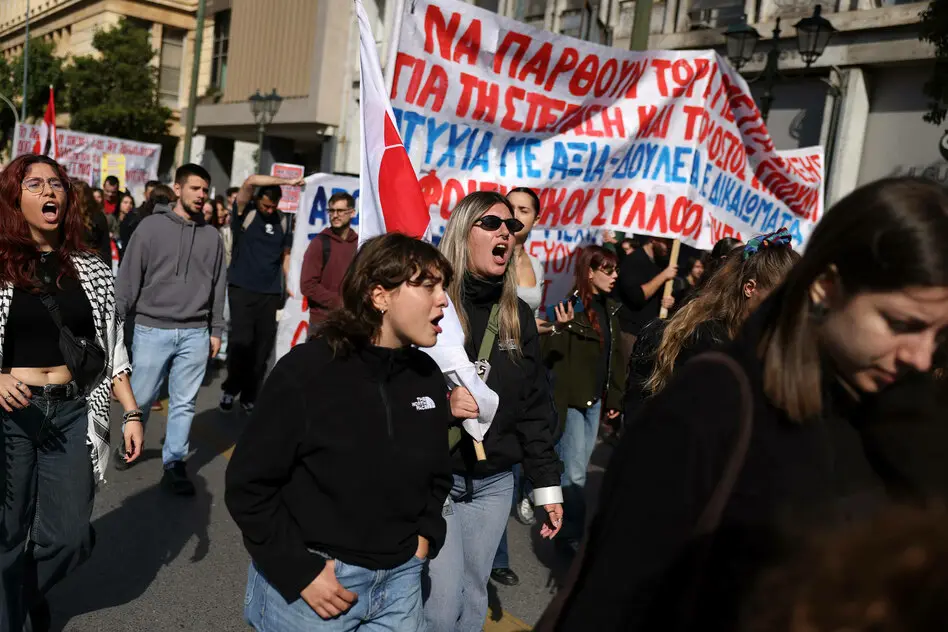
And in fact, Greece's gross domestic product growth has been consistently above the EU average since 2021. But most Greeks don't notice anything about this in everyday life. Hardly any of the money reaches ordinary people. New figures from the EU statistics office Eurostat show that Greece is in second-to-last place among EU countries when it comes to wage levels. Around 18,800 euros gross per year, there is no more. The gap to the European average is 22,700 euros; employees in Greece only earn around 45.3 percent of the EU level.
Ioannis Tsakiris is about to take the final exam of his training as a photographer. The 27-year-old doesn't believe that he can earn a living with a job alone. “As a freelancer, that’s almost impossible.” Even if he got one of the few coveted permanent positions. “With minimum wage, I would have to take a second job,” says Tsakiris. The statutory minimum wage is currently 920 euros gross. When it comes to wages, Greece ranks second to last in the EU and last when it comes to purchasing power. Although people earn less than half the EU average, food prices are above average - as is the inflation rate. According to Eurostat, Greek households also spend the highest proportion of their income on housing costs.
As a result, almost 90 percent of Greeks are barely making ends meet. At the same time, the country will take first place in the EU in corporate profit growth in 2026, according to figures from the EU macroeconomic database Ameco. The money flows primarily into historically high corporate profits and capital gains from large corporations.
The new Eurostat figures are a cause for malice towards the governing party New Democracy. "Did you know that you feel wonderful? No? Then you probably didn't listen properly," mocked the politician Theoni Koufonikolakou (Elas). The success story propagated by Prime Minister Mitsotakis is not being shown for the first time, but it is clearly presented in a completely different light.