
World taz
Winter in the Gaza Strip: In the middle of the night the tents are drowning in the rain
In the ruins of Gaza, where a tent is a luxury, there is no shelter from winter. The new Hamas authorities are doing nothing for the people either. more...
Deutsch (original) ·Auto-translated to English
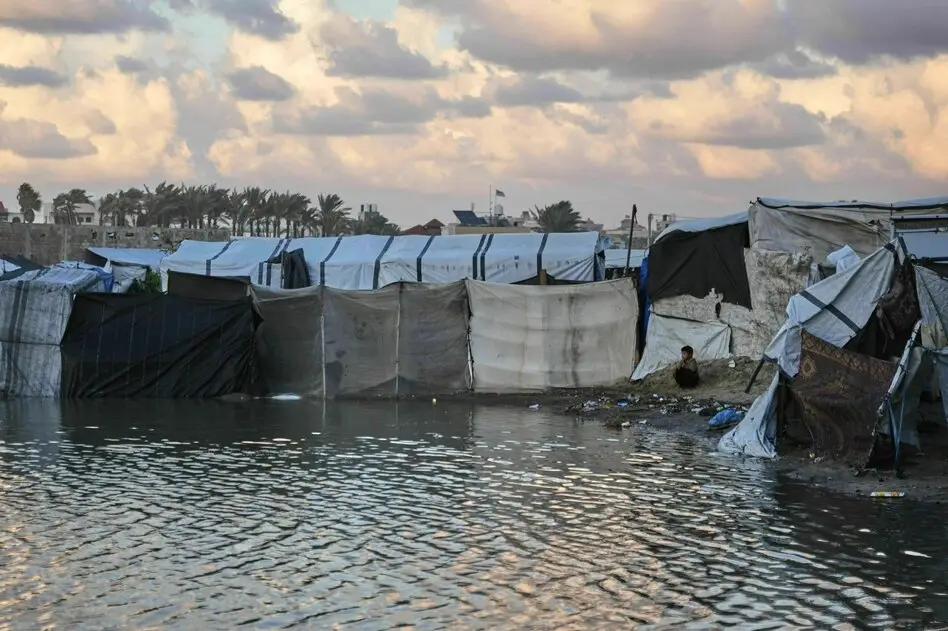
Around 9 p.m. on Friday evening, the sky over Gaza lit up. It starts to storm around 10 p.m. I can't sleep anymore. I hear the displaced people in their tents, just going under. Their fear and their attempts to do anything about the heavy rain. And their insults and curses against Hamas.
Around 11 p.m., Jamal reaches for a shovel. He wants to create a drainage channel around his tent for the rainwater so that it doesn't flood his tent. He says he had repeatedly warned Gaza's city administration for months. The people of Gaza still know from last year what happens when winter and with it the rain comes to the tent cities of the displaced people.
The crackling noise at night is deafening. He uproots three basil bushes that Jamal had planted around his tent. Despite his efforts, torrents of rain and mud over the course of the night flood his tent and the entire belongings of the 80-year-old and his elderly wife.
It no longer makes sense to try to save anything except the tent itself, he says in the morning. “Even my and my wife’s mattresses have sunk and I can’t find my medication anymore.”
In the morning, the Hamas government media office announced that 70,000 tents had been flooded. I think there are more. There are hundreds of thousands of tents in Gaza City alone. In Khan Younis there are even as many. Houses have also collapsed.
All night long I see lights from the cell phones of displaced people trying to save something. Mohammed, a displaced person living in a tent near Deir al-Balah, was woken up by rain in the middle of the night. His tent, in which his wife and toddler also live, is flooded and neighbors rush to help him in vain. He curses the dead Hamas leader Jahja Sinwar and the events of October 7th that he orchestrated.
Jihad, a 40-year-old English teacher who lives in three tents with his wife and five children, is across the street. He runs back and forth for hours, carrying buckets of water. He builds a makeshift shelter from the mud out of flour sacks that are submerged in water and can no longer be used for baking.
For months, the displaced have repeatedly called on local governments to dig simple drainage ditches to protect their tents. But the administration, they say, told them they had too much to do. In fact, the Hamas government had more pressing issues at hand, such as collecting taxes and controlling vegetable prices in the markets.
The Gaza Strip is divided. Israel's military controls over 60 percent of the area and it is largely depopulated. The rest, home to almost the entire population of about two million people, remains under Hamas control. She has been exercising this with a public presence again since the beginning of the so-called ceasefire in October 2025. Their security forces can be seen on the streets, taxes are being collected, and the local administrations are supposed to take care of the distribution of the displaced people in the streets.
As the storm now hits, there are official appeals to the international community: "70,000 tents flooded; citizens are suffering from the devastation of the rains." Official statements lament the world's inaction on behalf of the people of Gaza. But there is also no help, such as a soup distribution, even on Saturday and Sunday.
The widow Fadwa and her two daughters sit alone and silently in their tent in the middle of the street in Nuseirat. At six in the morning she looks for a man who could help her secure her tent. Because their soaked belongings are too heavy to carry. Shivering, she asks shopkeepers and passers-by for winter clothing to protect her children from the bitter cold.
The municipalities are now demanding that tens of thousands of tents be relocated. But they have not yet lifted the fee of up to 1,500 shekels charged per tent in public areas.
Mohammed al-Sayed found no free space except in a cemetery in Gaza. There are four tents: for him and his wife, his three married sons and his grandchildren. He feels anger and pain when he sees his grandchildren playing among the graves. He remembers catching his grandchildren looking at human bones that stray dogs had dug up from fresh graves.
Gaza's city administration, the old man says, came with police the day before the storm to dig a grave right in front of his tent - knowing full well that the cemetery actually had enough space elsewhere. He says this is a ploy to drive him to a place where he has to pay a fee to set up his tent.
Weeks earlier, Hamas had imposed a 10,000-shekel tax on every truckload of food entering the Gaza Strip. The Israeli army then closed the Kerem Abu Salem border crossing and prevented the import of food for a week. Then Hamas lifted the tax so that goods could be imported again.
Munir lives on the street, surrounded by sacks and tattered boxes. He has many questions. "Where do the taxes collected by Hamas go? Why weren't they used to buy tents and distribute them to the residents? Instead, they are available in the markets at exorbitant prices. Four tarpaulins for a tent cost $400. The material goes to Gaza as relief goods - why is it sold in the markets right under Hamas's nose?"
Munir has been living alone since his entire family was killed in northern Gaza. He is actually a computer programmer, but no longer owns a laptop. He only works about twice a month - as a porter when the UN relief agency UNRWA distributes aid packages. He longs for plastic sheeting.