
Politics · taz · · 1h
Windsurfing for refugees on Rügen: Continue surfing when the wind changes
Deutsch (original) · Auto-translated to English
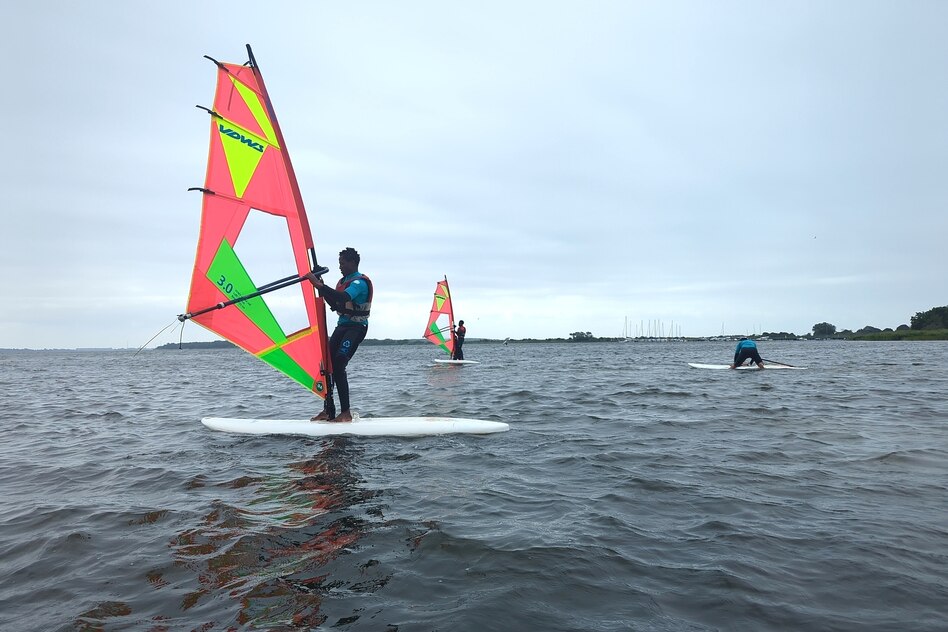
“Ah, help, I’m fallingeee,” shouts Abdul Yasin. Splash! Before he can even extend his hands for a head dive, there is a splash and a splash. The young man lands in the water next to the yellow-red sail with a belly flop. Everyone laughs. Get up, shake, let’s move on! Less than 10 seconds later, the muscular man is back on the surfboard. He grabs the uphaul line, pulls up the sail, catches the wind and sets off.
“It’s great fun,” he says. Abdul is 23 years old, comes from Benin and is a tailor. He has been living in Mecklenburg-Western Pomerania for three years and has recently been able to attend a German course. “Finally,” he says. This summer Saturday he is taking part in a free windsurfing course for refugees. It is organized by the association tow e. V. on the grounds of the “Rügen Pirates”.
The water sports school is located on the Bodden in front of Dranske, the last village on the northwestern tip of Rügen. The tranquil community has recently been allowed to call itself the “Baltic Sea resort”. It has around 35 kilometers of coastline, half of which is along the lagoon waters. On the other side of the headland, when visibility is good, you can see the cliffs of the Danish island of Møn.
“Great, keep it up!” shouts the trainer to Abdul. Her name is Bianca Gottlied and she is 45 years old. She originally comes from Dresden and studied teaching. She is less than 1.60 meters tall and radiates endless energy. Here everyone just calls them Bibi. “Just like Habibi,” she says when introducing herself to the 14 course participants from Ukraine, Afghanistan and Benin – and gets the first laugh.
In general there is a lot of laughter here. And this despite the fact that some things are very sad - for example the experiences the refugees had on their escape, but also in Mecklenburg-Western Pomerania. There the AfD became the strongest force in the 2025 federal election with 37 percent, and in Dranske it even received an absolute majority with 53.3 percent of the votes of the 1,004 eligible voters. Ahead of the state elections on Sunday, the party is at 37 percent, 3 percentage points ahead of the second-placed SPD, according to the latest survey by the elections research group.
If you ask the refugees during a break whether they feel comfortable in the region, they all politely say yes. “We are doing well, we have food and a roof over our heads,” says Ismail gratefully. “But at the beginning it wasn’t easy here… and actually it still isn’t to this day.” If you continue to ask what wasn't easy, they report racist experiences. Just recently, as Ismail emphasizes, the police arrested her on the beach for no reason. According to the Federal Office for Migration and Refugees, less than 10 percent of people from Benin receive asylum. So there is little prospect for Ismail and his acquaintances of staying in Germany.
In addition to the difficult everyday life and the unclear future, the young men from Benin also suffer from the traumatic experiences on the Mediterranean. Many of them, not all, barely made it to Europe alive on rickety inflatable boats. "I like windsurfing. But when there are big waves, it reminds me of crossing the Mediterranean," says Abdul.
Coach Gottlied is of course aware of this. “The other day there was no wind for surfing, so we went on stand-up paddles over to the shipwrecks,” she says. As the water became deeper, one of the participants panicked and shouted: “Oh God, I can’t take it anymore.” Then he turned and raced back to the bank. “It shot off at a high speed and all I could do was pant after it,” she says.
He didn't say why, but Gottlied is sure that the deep water triggered him. In her experience, it is particularly difficult for men in such moments to admit - in front of her as a woman - that they are afraid. "So that it doesn't make him uncomfortable, I said: That was exhausting. Come on, let's chill out on land for a bit, have a smoke together and have a drink," reports the teacher outside of the course.
She sat down under a tree on one of the two meadows in front of the surf school. The surfer knows from her own experience: "It can be an absolute borderline experience when you're out on the water in windy conditions and a gust suddenly knocks you over or you drift away or maybe even have to be towed away by the lifeboat. That can trigger harsh feelings."
Nevertheless, he finds surfing “fantastique,” explains Ismail. Unlike most of the group, he wears a life jacket over his tight wetsuit. "I can not swim." As soon as he puts them on there is laughter. “Maybe you should take the children’s swimming course first,” one of the others teases him. “Ey!” Ismail defends himself and hugs his friend, then the two hug each other. “It looks good on you, you look like a professional,” says trainer Bibi as she walks past.
“Being on the water again can help you process what you’ve experienced,” she is convinced. Be it an escape, be it other traumas. Nevertheless, the educator emphasizes: the whole thing is not designed as therapy. Others are doing this, such as the Refugym project in Greece, with the tow e. V. has already worked together. “Here, our main aim is to share our fascination with water sports and to give people a positive experience.”
The non-profit association tow e. V. was founded in 2019. Florian Krämer, a 50-year-old with medium-long, shaggy hair and a nose piercing, is a member of the board there. Krämer originally comes from Kaiserslautern, where he was a skateboarder. The aim of his club is to bring more diversity to water sports and make them accessible to disadvantaged groups.
The association tow e. V. not only enables refugees to windsurf, the committed people also invite women with breast cancer to dragon boat camps, people with disabilities can paddle here and children from the prefabricated housing estate get extra-affordable swimming lessons. Funding for their projects comes from donations and from various government agencies. “At least if we submit the applications on time,” says Krämer with a grin.
Then cheers come from the water. Ali has just initiated his first turnaround. This is one of the first maneuvers you learn when windsurfing. To do this you have to “luff up”, i.e. tilt the “clew”, the outer corner of the sail, towards the water. Then the bow of the surfboard turns towards the wind. “Yes, yes, continue,” his friend Ramazan cheers him on in German. “Ali is one of the best in the group,” whispers the trainer. “I would suggest that they do training as a trainer themselves.”
Ali is 23 years old, comes from Afghanistan and lives in a refugee accommodation in Bergen, the capital of Rügen. This makes him one of around 1,000 refugees currently living on the island. In Western Pomerania-Rügen there are a total of 5,200 people, as the taz learned from the district's spokeswoman.
Ali managed the maneuver. He pulls the mast towards him, straightens the sail again, puts his feet in an L shape and continues in the other direction. The group claps, he beams. “This incredible joy, this feeling of happiness while surfing, is transmitted to the whole group,” says Gottlied. Her voice also almost cracks with enthusiasm.
As she speaks, one of the other volunteers behind her is screwing a mast base onto a surfboard, a young woman is trimming a sail, and two boys are pushing a catamaran into the water. Then Gottlied talks about another project, with a huge stand-up paddle board that fits 4 people with wheelchairs. “That’s my personal favorite…!” she starts and interrupts herself when the others jokingly raise their index finger. Discrimination is not tolerated here - not even that of projects. “Uh, of course they’re all my favorite projects,” Gottlied corrects himself with a laugh. "But seriously, the wheelchair project is simply unique. There's nothing like it anywhere else in Germany," she enthuses.
A friend of theirs designed the board and the TÜV approved it. "The wheelchairs are fastened with tension straps and the participants wear special self-triggering vests. "They are very narrow and only trigger when they come into contact with water. There is a salt tablet in them and after one or two seconds in the water, it triggers a cartridge that inflates," explains Gottlied. The State Sports Association also supported this project. It is doubtful whether he could still do this under an AfD-led state government, given the anti-inclusion stance of the right-wing extremists.
At a table the size of a stage, a few volunteers are already chopping vegetables for the shared meal later, a few girls are selling self-made bracelets, and others are bending their heads over their learning material for the theory test for their surfing license.
As busy as the “Rügen Pirates” are, the place is secluded and quiet. Only around 1,000 people live in Dranske - significantly more in the summer, when tourism brings jobs, than in the winter. In the past, during GDR times, the place had 4,000 inhabitants and was an important military base for the People's Navy.
Krämer and Co. got to know the spot during a university sports excursion at the end of the 1990s. “We have been leasing the site and running the surf school since 2003,” he says. A three-day basic windsurfing course here normally costs 190 euros, and kitesurfing 280 euros. “Of course you have to earn money somehow,” says Krämer. “But we said from the beginning that our work should not be purely commercial.”
After the surfing lesson, the participants drag their equipment back, peel off their neos and dip them into a large barrel of water to wash them out. When all the caps, watches and sunglasses are back in place, the participants collapse onto a bench. Exhaustion is on their faces.
“Here we sit together, look at the water, eat and talk to each other,” says Krämer. Then the refugees sometimes told us exactly what they had experienced. A boy from Ukraine recently described what it was like when a bomb hit the house next door. And a man from Benin described to Krämer how his boat got into distress on the Mediterranean. “He was rescued at the last moment by a helicopter.”
In order to share something like that, trust is needed, the surf school operator knows. But that happens quickly with water sports. “You think windsurfing is an individual sport, but because we teach in groups and many practice games require cooperation, a feeling of community quickly develops.”
After dinner, Abdul plays a game of football in the surf school's lounge. “I love football,” says Abdul. More than surfing? “Yes,” he admits and adds: “The main thing is to do something.” There are certainly leisure activities on the coast and on the island. But despite a “mobility offensive” by the red-red state government and the expansion of a network of on-call buses like the district’s “VRR-Surfer”, people up here moan about the long distances. If the volunteers from tow e.V. didn't pick up the refugees from their accommodation in their own cars, they would be on the road for hours.
The inadequate public transport is also a problem for locals. One of them is Roman. He is in his early 30s and lives at the entrance to Dranske. “In that yellow block of houses, next to Norma, you know?” On this Friday afternoon during the summer holidays, he made himself comfortable on a self-made bench on the bank. From here he can look over the reeds to his 9 and 12 year old children. They're running across a row of ten surfboards lying in the water and shouting with joy.
The club introduced the children's swimming course in 2003 - after a shock. When they arrived in Dranske, they discovered that many of the children they invited to their surfing courses couldn't swim at all. And this despite the fact that you have the sea right on your doorstep. There are swimming courses on the island, but they are difficult to get to or too expensive, reports Bibi. At tow e. V. the children could come twice a week for 36 euros a year. This is supported by the municipality, in whose representation the “Pro Dranske” alliance with 4 and the AfD with 3 seats are the largest factions.
“This is a great offer,” praises Roman. After all, there is hardly anything else in Dranske. The town has neither a youth club nor a football club. He works as a truck driver and his wife works in the supermarket. He is actually quite happy with life up here.
But at some point while chatting, he suddenly says: “I wouldn’t have any more children today.” Why not? On the one hand, he thinks he is too old, and on the other hand, some social changes bother him. “For example, the whole same-sex thing, this gendering, some people might like that, but I don’t have to have it.” He doesn't yet know what he will choose. He doesn't rule out the possibility that it will be the AfD. He thinks their asylum policy proposals are “good”. Roman doesn't mind that refugees surf alongside his children at the “Rügen Pirates”.
The candidate with whom the AfD is running this Sunday in the Vorpommern-Rügen constituency is called Tommy Thormann. The former official of the now banned Junge Alternative poses unabashedly with the right-wing extremist white power symbol on stickers. In April he threatened raids and bans on political opponents if the AfD took power.
Are the activists afraid of the growing AfD? After all, the right-wing extremists hate everything they stand for: refugees, inclusion, diversity. The committed people appear to be extremely relaxed. “Fear doesn’t help anyone,” says Gottlied. Krämer is also optimistic: “We are now so firmly integrated into the community and I think everyone appreciates what we do here.” He points to the mayor's support. This is from the “Pro Drankse” alliance.
Recently the AfD even invited her personally. “To talk about synergies in the club’s work locally,” reports Krämer. The invitation was politely declined. “We don’t work with individual parties,” explains the club chairman. The surfers' political stance is clear to everyone up here, he says. He doesn't like to name them explicitly. “Everyone can see what we do here. Or hear what the punk bands that perform at our festivals sing.” Everyone is welcome here.
Really, are there no red lines at all? "Yes. Anyone who wears Nazi symbols or shows a Hitler salute will be thrown off the pitch, that's clear." This has happened before, but a long time ago. Although the AfD is getting more and more votes here, Krämer feels that extreme right-wing activities have decreased. Maybe it's because of her work.
Read the full story at the source
Source: taz