
Germany taz
Vienna Academy: How art was managed
An exhibition at the Vienna Academy of Fine Arts attempts to retell the story of the conflict between the academy and the avant-garde. Does that work? more...
Deutsch (original) ·Auto-translated to English
Academism does not have a good reputation in art. Aren't existing rules and bodies of knowledge initially the shackles of individual creation, which produces its rules beyond reproduction? Nevertheless, since the 16th century, the preferred place for this miraculous transformation from external to self-determination has been the academy. It generates knowledge and establishes art as an autonomous sphere. At the same time, she is suspected of channeling the autonomy she has gained back into power.
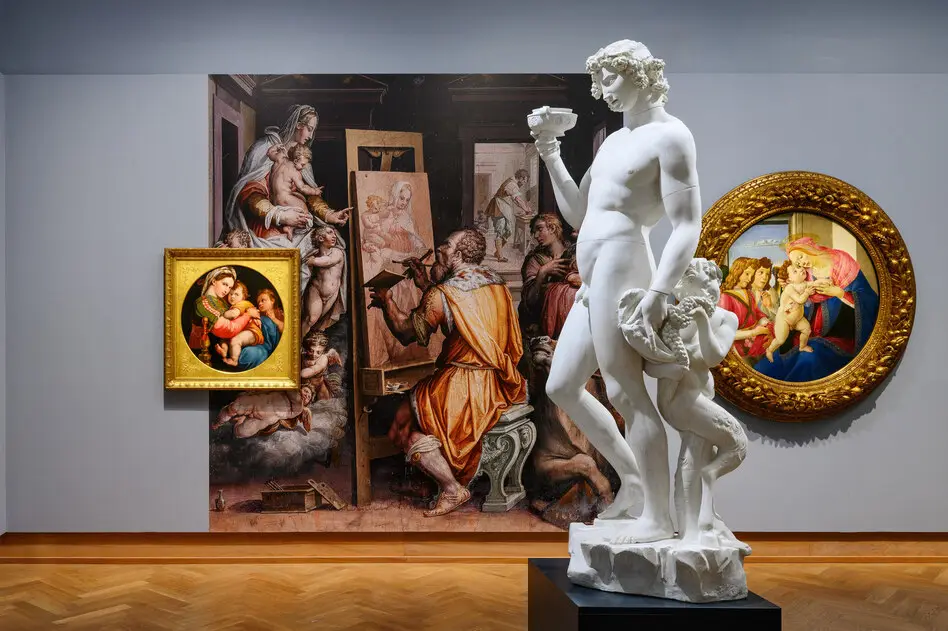
Under the title “The great Michelangelo is dead!” The Vienna Academy recapitulates the history of the institution and its enemies in 15 stages from the early modern period to the present. The show, curated by art historian and cultural theorist Helmut Draxler, includes the exhibiting, knowledge-producing institution itself in the movement of reflection.
300 years after the creation of its statutes, the Academy can contribute a lot from its collection to the change in organization and teaching. Exhibits of obsolete methods such as copies and plaster casts become curatorial assets, ranking equally alongside originals, historical material, commentaries and contemporary works.
"The great Michelangelo is dead! Avant-garde and academicism". Academy of Fine Arts Vienna, Gemäldegalerie, until August 22, 2027
The opposition between the academy and the avant-garde is no longer the endless conflict between old and new, no longer the legacy of historical avant-gardes after their failure and is also something other than the dialectic of the development of the possibilities of expression.
With the exhibition, Draxler relativizes the antagonism without taking the edge off the debate, and chooses the figure of the conflict, which can neither be resolved in synthesis nor resolved according to a generally accepted rule. This dispute constitutes “art as a symbolic category” and shows what is possible with art in its present.
It all begins at Michelangelo's grave around 1564. The Florentines had secretly transported his body from Rome. To follow the “Divine,” ordinary mortals need a teaching to measure the world and an institution to administer this knowledge. Giorgio Vasari, architect, painter and, in his “Vis”, an early representative of art historiography, initiated the Accademia del Disegno. It gives art a theory-based understanding and impact in the emerging absolutist state.
The exploration of the visible gains the potential for independent intellectual creation in the disciplines of painting, sculpture and architecture. Vasari is also responsible for the urban planning program of his Prince Cosimo I. The idea of efficiency is new. According to Vasari, artists from the Academy would hardly reach the level of the masters of the High Renaissance, but they would exceed them several times in the quantity of their production.
Almost a century later, the Paris Academy took the rationalization of the concept of art and its association with the interests of the mercantilist state to the extreme. She establishes competitions, a discursive format with her conferences and the first forms of art criticism. Under the king's auspices, the artist's autonomy is said to embody the monarchical principle.
The new connection to the state gives independence from the former arbitrariness of feudal and ecclesiastical clients as well as from tastes conveyed via the market. Later, at the end of the 18th century, the Vienna Academy was a kind of art authority from drawing lessons to construction.
From now on there will be debate about who consecrates art. In the upswing of bourgeois emancipation, William Hogarth's caricatures mock the English nobility's preference for darkly varnished smooth paintings based on continental models. The turning point of the French Revolution with the temporary abolition of the Paris Academy remained only a short episode. The anti-academic tendencies of Romanticism had a more lasting effect on teaching.
With the return of the Nazarenes and others who had previously absented themselves with a grand gesture, institutional hierarchy is established in a new personalized form in the form of the master class. For the academy opponent Gustave Courbet, the master-student relationship later became a self-contradiction. For him, artistic development is only conceivable as individual self-exploration.
The avant-garde as art only ever succeeds in temporarily interrupting operations. As a movement against the institution of art, in order to overcome the separation between art and everyday life, it fights against the very autonomy whose symbolic surplus it brings into the balance for progress. The term becomes ambiguous; aesthetic, art business and political claims to validity are formed under its umbrella brand, which are by no means progressing in the same direction.
Counterpositions emerge from the academy itself, and new movements successfully expand their curricula. In the exhibition catalog, Sabeth Buchmann traces the impact of the Bauhaus reform pedagogy, which directs the focus from the work to self-reflection in the creative process, right through to the language games of contemporary conceptual art.
In his text about the “Düsseldorf Academy noise” in the 1960s, Hans-Jürgen Hafner points out that the students' protest was not about outdated academicism, but rather targeted prominent representatives of modernity. Some activists return to the academy with recourse to a new figurative painting, such as Jörg Immendorff as a professor.
The concentrate of an academy's history leaves the present with questions about the silent retreat of the state. The interest in representation through art is largely a thing of the past, as is a socio-political reform agenda, in whose wake the field expanded for a long time.
The new indifference, as an efficiency requirement for a lean state, also undermines the funding basis of the academies in the long term. What arguments can still be made against their practice, which is partially removed from the primacy of economics?
Unchained, globalized markets place the speculative object of art indistinguishably alongside other luxury goods. At the end of the history of the avant-garde, does capital unexpectedly fulfill its demand to overcome the separation between art and everyday life? The question of who consecrates art is being asked anew. Functions and institutions of traditional business - criticism, museum, academy - do not become obsolete; they threaten to become decoration in the service of exploitation.