
Germany taz
Water shortage in Brandenburg: The great thirst of corporations
In Baruth, Red Bull wants a factory expansion and Amazon wants a data center. But the groundwater is becoming scarce and the city is bankrupt despite all the industry. more...
Deutsch (original) ·Auto-translated to English
Crack. Once again a machine monster called a harvester has grabbed a tree. It cuts him down, chops off his branches from the trunk, cuts him into pieces. And all in seconds. noise. The next tree is already falling.
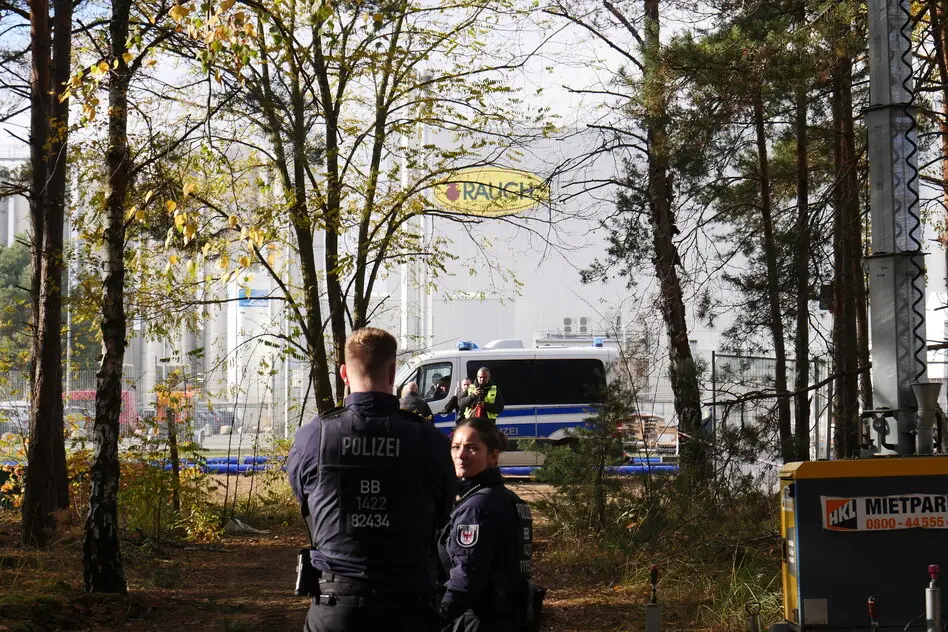
The forest that can be seen disappearing in Baruth, Brandenburg, is to make way for the expansion of a Red Bull factory. Over 400,000 cans are already being filled per hour, plus 100,000 PET bottles. Red Bull is now planning a new can factory and logistics center designed to produce 3.3 billion cans per year - almost a quarter of the approximately 14 billion cans that the group sells annually.
But there is no mention of Red Bull on site. “Smoke” is written on the gigantic, gray factory blocks – the name of a fruit juice brand that has taken over the site together with Red Bull and is responsible for bottling. The whole area is neutrally called the “Baruth Production Campus” – as if Red Bull didn’t want to advertise too much with what was happening here.
No wonder: since research by the taz, little Baruth has been the focus of nationwide attention. The reason for this is always Red Bull. And the groundwater that the company pumps out for its production.
One number is mentioned again and again: 92 percent. Red Bull is allowed to use this proportion of the groundwater that is available to the town, leaving only eight percent for the population. When Red Bull and Rauch bought the Brandenburg company Urstromquelle, which had been producing mineral water since the fall of the Wall, about three years ago, Red Bull also took over their water rights. And they allow 2.5 million cubic meters, i.e. 2.5 billion liters of groundwater, to be pumped out per year. So far, Red Bull says it has skimmed far less. After the factory expansion, the permitted quantity will almost be exhausted.
Environmental associations and the citizens' initiative Resource Alliance Baruth have been sounding the alarm for a long time. For them, Red Bull and Rauch appropriate the region's most valuable treasure: the millennia-old groundwater in the glacial valley, which is said to be of particularly good quality. The problem: In the climate crisis, groundwater levels are falling everywhere. And Brandenburg is one of the driest areas. The resource alliance fears that where water is becoming increasingly scarce, the interests of corporations could be more important than supplying the population.
Opposed to the environmentalists is the municipal water company, Wabau. Last Thursday, its factory manager, Frank Zierath, stated again at the Baruth city council that there were no problems. The city checks every two years how the groundwater levels are changing. And the latest monitoring also shows that these remain stable. “Overuse is not currently expected,” said Zierath at the meeting. And added: “This refutes everything that is regularly claimed by the citizens’ initiative.” Anyone who still doesn't believe that can't be helped.
The fact that it's not that easy can be seen on every corner in Baruth. The church, for example, has large cracks that have only been sparsely covered with some plaster. “A lot of people used to build here on oak pillars in order to build the houses on the swampy ground because there was so much water in the ground,” says Klaus Axenkopf from the citizens' initiative while walking through the town. But now that the water is dwindling, these would rot - and then collapse. “This affects a lot of people who have a house here,” says Axenkopf.
In fact, you can see it, at least at second glance: In Baruth, some houses have a kink. If, for example, one part of the house is on stone and another part is not, the latter will sag, explains Axenkopf. “There are stories from the past that you always had to walk through the garden in rubber boots.” Today the ground would become drier and drier. “But of course, you can’t prove that it’s because of Red Bull,” said Axenkopf.
The defenders of the Red Bull factory point out that there are two groundwater reservoirs beneath Baruth, which are probably separated from each other, at least in the Baruth area - but further up they are certainly connected. Red Bull taps into the lower storage, which is therefore not related to the drying out of the area near the ground. This is said to be due to major developments in the climate crisis - such as the far too low amounts of precipitation - and the draining of agricultural land.
Matthias Rackwitz from the regional nature conservation association (Nabu) is not convinced. “The problem is groundwater recharge,” he explains. After all, almost all of Brandenburg is under groundwater stress and the surface waters in the region are suffering from increasing drying out. “And now Red Bull is taking these huge amounts of water and transporting them all over the world, so that the water is removed from the cycle forever,” says Rackwitz. It is “completely unclear how the lower conductor is supposed to fill up again”.
The lack of transparency also causes mistrust among environmentalists. Because what plant manager Zierath announced in the city council meeting is by no means verifiable. When the citizens' initiative requested access to the monitoring, they only received 26 black pages. Only the fact that these are water levels can be read under the black tables. Rackwitz grumbles: “You wouldn’t have to black out everything if there was nothing to hide.”
Especially since the Resource Alliance and environmental associations have long been surprised by the city of Baruth's extremely corporate-friendly policies. For example, the 8.4 hectares of forest that Red Bull has now had cleared. The B plan for the factory expansion was actually only recently overturned by the Higher Administrative Court because the noise restrictions set there did not meet the requirements of an industrial area where there are actually no noise restrictions allowed.
The city then quickly declared the area a “special area”, not an industrial area - although it is undoubtedly about the establishment of industry. The environmental association Green League describes this as a “label fraud” – and has therefore submitted another urgent application. So nothing has been decided yet. However, the Higher Administrative Court rejected an interim order that would have stopped the clearing until a decision was made. With a reason that reminds Petra Liesenfeld of the construction of the Tesla factory in Grünheide.
The court argues: Yes, the development plan for the factory expansion has not yet been decided. But Red Bull could still clear the forest as a precaution, since clearing the forest is not an irreversible measure. Eventually a new forest could be planted. Even if, of course, it takes decades for a new forest to grow. This procedure, says Liesenfeld, is familiar from the Tesla factory: “Before the approvals are there, so many facts are already created that there is no going back,” she says.
If you ask Red Bull, all of this is done in the interest of the environment. A glossy website explains how many fewer trucks have to go to Baruth per day if the cans are manufactured locally: there are currently 500 a day, with the can factory there would be 380, and if there was also a railway siding there would be 320 trucks a day. And the cleared forest would be replaced, in sixfold quantities. The areas should be in the surrounding area of Baruth.
But what does Baruth get out of it? As you walk through the city, you notice that quite a few houses and shops in the small town, which winds around a main street and includes many small settlements in the surrounding area, are empty. Just outside the town center is a huge industrial area where not only Red Bull resides, but also various wood processing and laminate production companies: Binderholz, Claasen, Pfleiderer. Just outside there is also a huge gas compression plant that forms a pipeline junction.
“With all this industry, the place should actually be flourishing,” laughs Petra Liesenfeld. “There should be swimming pools and daycare centers everywhere here, and the health center should be fully expanded.” And in fact, because of high trade tax revenue, Baruth had to pay the so-called Brandenburg rich tax - a levy for particularly financially strong municipalities. But things have changed in recent years. In the spring, Baruth had to impose a budget freeze - and not for the first time. Apparently the city is bankrupt. How can that be?
The reason is not easy to find out. Anyone who could shed light on the matter would be the city of Baruth itself, especially the new non-party mayor Jenny Hahn. But people in the town hall are apparently overwhelmed by all the media attention that the place is currently receiving - and are blocking all press inquiries.
In October 2023, however, the local newspaper Märkische Allgemeine reported that the financial problems had something to do with a demand for repayment of 16 million euros in trade tax. It is not known which companies these come from. According to taz information, it could be the Brandenburger Urstromquelle, the previous owner of the factory, which now belongs to Red Bull and Rauch.
And then, according to the local newspaper, it is probably the case that Red Bull and Rauch - unlike Urstromquelle - hardly pay any trade tax because they have their large investments written off for tax purposes. “For us, this means that millions in trade taxes will be lost for the foreseeable future,” the newspaper quoted then mayor Peter Ilk (independent). Nobody currently knows when Red Bull and Rauch can be expected to pay trade taxes again.
A report from spring this year about the current budget freeze also cited the “restructuring” at Red Bull and Rauch as the reason for the lack of trade taxes. Red Bull told the taz: They pay taxes “according to the tax and legal requirements”. No tax refunds have been requested.
This all makes environmentalists angry. And not just because in the end nothing stays in place. But also because it has not been known for years how much Red Bull actually pays for the extraction of groundwater. Ask the State is currently trying to sue out the details of the water contract. Red Bull told the taz that it would pay an “appropriate fee set by the city council”. As a guide: In principle, companies in Brandenburg pay between 10 and 11.5 cents for the extraction of groundwater for 1,000 liters of groundwater.
In this uncertain situation, the next major project is already knocking on the town hall door: Amazon's subsidiary Amazon Web Services (AWS) also wants to fell trees in the forest around Baruth. And even more than Red Bull: The tech group wants to build a new data center on 62 hectares - around 86 football fields - and part of the planning is in the water protection area. The project is part of a billion-dollar investment by Amazon, which wants to build an independent cloud infrastructure in Europe based on EU regulations.
At the city council meeting, where Frank Zierath from the water company explained why everything was on track, three company representatives also appeared to present the project. They emphasize how important the “community” is to Amazon, how Amazon intends to put its “heart and blood” into the place. “We go to kindergartens and schools and show: What is AI, what advantages does it bring?” says one person at the presentation.
This is a big concern for environmentalists. Data centers are also known for their enormous water consumption for cooling: According to a recently published study, their water consumption across Germany is likely to rise to 27 billion liters per year, which is roughly equivalent to the consumption of 580,000 people in the same period. Amazon now claims that it wants to use a system without water cooling. Environmentalists fear that water will be used by summer at the latest - simply because it is cheaper. At least for the corporations.