
Germany taz
“Waiting for a Bus” at the Berliner Ensemble: Here are the last voices from the East
The successful series “Waiting on a Bus” is coming to the Berliner Ensemble with two new episodes after a five-year break. Is that fun? more...
Deutsch (original) ·Auto-translated to English
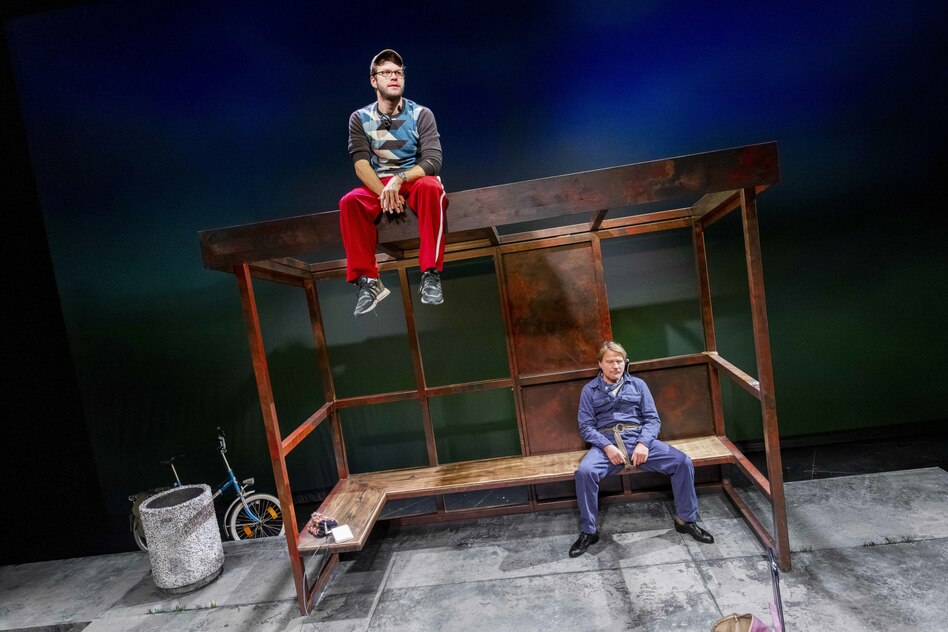
In the middle of the pandemic, a TV series came out that was quite popular with many. It was called “Waiting for the Bus,” and basically not much else happened. Two men, both unemployed since the fall of communism, were sitting in a bus stop in Brandenburg, killing time. They philosophized about life, confessed their love for the bus driver and sometimes they even danced with each other because one of them used to do that in the district league.
The series was a mixture of “Dittsche” and “Braunschlag” because it combined the associative of a Hamburg snack bar chat with Austrian bizarreness. It was heartwarming, funny and bitter and came from the playwright and screenwriter Oliver Bukowski. Born in Cottbus and thus himself socialized in the East, he gave the East German man, who is usually classified somewhere between a loser and an angry citizen, a human face.
The critics at the time were not sparing with words of praise, and the first of the two seasons produced by RBB earned her a nomination for the German Television Prize. Now, after a five-year break, two completely new episodes based on the TV series have premiered in the Berliner Ensemble. They were written by Bukowski himself and his screenwriter colleague Hannahaccio. One wonders what this is all about: Are the two of them planning a TV comeback? Or do you want to let the two originals have their say again, now that the AfD is sticking to the East like shit?
In the BE's new building there is a bus stop made of rusted sheet metal. Next to it is a GDR street lamp. There is also an apple tree with real fruit and authentic floor tiles between which grass grows like in real life. It takes a moment to get used to the fact that Hannes and Ralle are not played by the usual cast. Peter Moltzen and Gabriel Schneider still do it well. They even manage the dialect quite well, even though they weren't originally from Berlin or Brandenburg. One can only imagine how intensively they must have rehearsed this with director Max Hopp.
In the first episode, which lasts just under an hour, the two men want to produce a podcast: everyone is talking about them, now they want to have their say. The slapstick works. The two of them get excited and forget that they've been on the air for a long time. The exchange of blows is also funny: “I have something to lose” – “What then?” or her gallows humor: “Hello Bello, here are the last voices from the East.” Because the local press is gone and they, who are explicitly not Nazis, feel left alone.
Their discussions revolve around censorship and cancel culture and how that might not be the same as the Stasi in mother's floor lamp. Hannes (Moltzen), who is a walking quote slinger, quotes C. G. Jung and Marx, Ralle (Schneider) regularly gets upset about it. In the further course it is about whether people are good or bad and why leftists always have to tear each other apart while rightists demonstrate unity.
Unfortunately, a lot of what Ralle and Hannes are discussing has been heard many times before, so the gain in knowledge is not that enormous. It is also disturbing that the political discourse does not flow bit by bit into everyday dialogue, as was the case in the series, but rather takes up a lot of space and therefore seems constructed. Here they obviously wanted to make a political contribution and not let the characters be characters.
The second episode is better. In it, Ralle, who is waiting in vain for his son, a successful non-fiction author and Easter explainer, and Hannes talk about missed opportunities, loneliness and shame. This sometimes scratches the cliché, but is also touching as long as the two don't grab the microphone and rap. But there is one sparkling moment, namely when Moltzen's character talks about how she feels. “I’m someone too!” he calls out to the audience. That sums it up.