
Germany · taz · · 59m
Election campaign in Gambia: The “chosen one” and the perpetrators of the Jammeh dictatorship
Deutsch (original) · Auto-translated to English
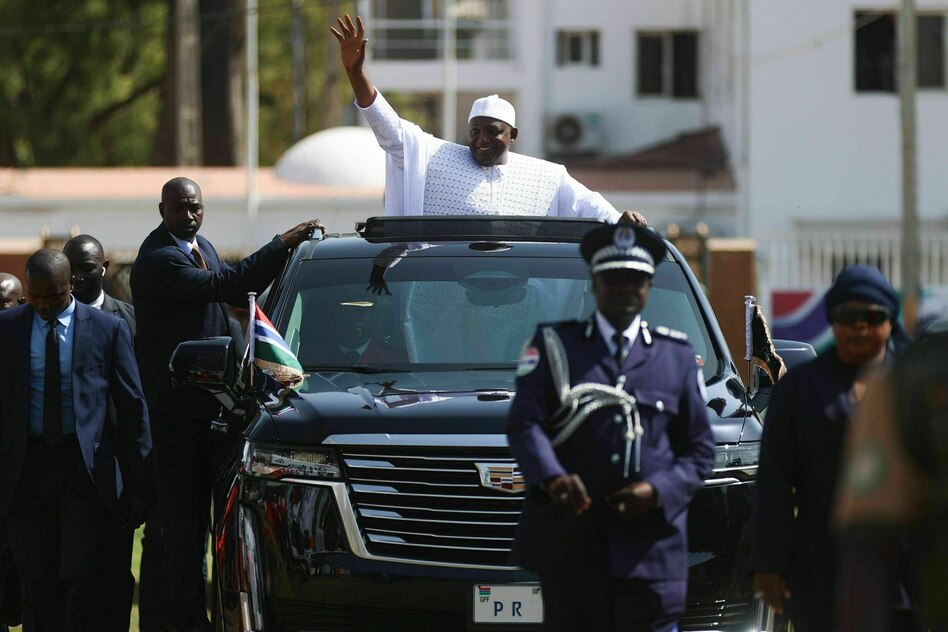
Dressed all in white, hand raised in greeting, President Adama Barrow's face waves down from the roof of a multi-story apartment building at one of the central intersections of Gambia's capital, Banjul. The election poster is gigantic, as is the lettering: “The Chosen One,” emblazoned in large letters next to the president’s face.
The staging of Barrow waving, especially from an open car, has something pontifical about it. Barrow is Muslim, as are around 95 percent of the Gambia's population. However, divine assistance – regardless of denomination – should be welcome by December at the latest. Then Gambia will elect a new president.
While the opposition is fragmented and is only laboriously exploring its political alliances, Barrow has long since entered the election campaign. It is the third time that the politician from the National People's Party (NPP) is running for office as head of state. He is supported, among others, by the APRC, the party of former dictator Yahya Jammeh.
In December 2016, Barrow surprisingly won against Jammeh. Its 22-year reign of terror was marked by serious human rights violations, including enforced disappearances, sexual violence, extrajudicial killings and arbitrary detentions. After his election defeat, Jammeh fled into exile in Equatorial Guinea in January 2017, where he still lives today.
For a good five years, from 2017 to 2021, a Truth, Reconciliation and Reparation Commission (TRRC) worked on the crimes of the Jammeh era. But almost ten years after his fall, the ex-dictator has still not been brought to justice - partly because Equatorial Guinea is refusing to extradite him. The appointment of the British lawyer Martin Hackett as special prosecutor for Gambia's special tribunal in May 2026 has set another ball rolling, but overall the investigation is progressing slowly, while the patience of the affected families is being strained.
"The perpetrators are aging, some of them have already died. This means that they will never face justice. This is very painful for the victims who are waiting for answers. But Gambia must first build the appropriate structures," says Sirra Ndow. Things are progressing, albeit slowly, says the country director of the African Network against Extrajudicial Killings and Enforced Abductions (Aneked): “There is probably not a single family in Gambia that is not affected in some way by the crimes committed under Jammeh.”
To ensure that the atrocities of the past are not forgotten, Aeneked runs a museum. The Memory House is located on an unpaved side road from Serrekunda, just a short drive from Banjul. "Our aim is to present the victims' perspective. What happened during Jammeh's rule should be recognized and recorded. Also for future generations, so that something like this can never happen again," explains Ndow as she leads through the memorial site.
Behind a display case, securely locked and neatly lined up, lie a taekwondo belt, an ID card and a hat. They are the possessions of people who were killed. “Following generations should also learn that they have a right to truth and information,” she says.
There are countless photos lined up on the wall behind her. Every single picture shows a missing person and their personal stories. "22 years is a long time. The effects of the Jammeh regime are still felt today," she says. One is the obvious consequences, for example people who were tortured and who needed ongoing medical care. The other is the systems and structures, such as the judiciary, the education system and the security sector, which are still characterized by the autocratic legislation of the Jammeh era.
The Gambian human rights activist Madi Jobarteh sees it similarly: "Since 2017, public spaces have become much safer - for journalists, for civil society and also for political actors. But even ten years after the end of the dictatorship, our government is still at a crossroads."
As founder of the Edward Francis Small Center for Rights and Justice (EFSCRJ), he advocates for human rights, equality and accountability. "The atrocities of the past may have ended and infrastructure has improved across the country. But this is not reflected in higher living standards or better opportunities for people," says Jobarteh. The country is still riddled with corruption and the people are plagued by poverty.
"Barrow has also brought many of the former regime's important colleagues back into office. Take, for example, the President of our National Assembly, Fabakary Tombong Jatta, or Muhammad B. S. Jallow, the Vice President," criticizes Jobarteh. Men who also held top political positions under Jammeh and supported the continued existence of the regime, including its human rights crimes. “What I read from this is no interest in real transitional justice,” says Jobarteh.
It can also be observed how the tactics of the former regime are still firmly anchored today: “Let’s take, for example, this culture of eternally maintaining power,” Jobarteh gives an example. Barrow's announcement of his third candidacy had caused dissatisfaction.
In 2016, he actually took office with the promise to only run once and to introduce term limits as a lesson from Jammeh's long and brutal rule. There is no longer any talk of a limit; instead, Barrow sees himself as best suited to lead the West African coastal country for another five years - and possibly beyond.
Political culture is only one side of the heritage. “During the dictatorship, the security forces were used specifically against the population and misused as a repressive tool,” explains the human rights activist. Since 2017, a security sector reform has been intended to transform these into constitutional and accountable institutions.
"Yes, of course. There is progress: the military no longer tortures arbitrarily. But the police continue to be used against their own population. Especially when they are criticized," says Jobarteh, referring to anti-corruption protests in July 2025 that were brutally crushed. The methods are direct legacies of the dictatorship.
And yet: To this day, the ex-dictator still has a small but persistent pool of supporters. “Welcome to Fono Region,” a sign greets drivers on the only connecting road that winds its length through the country from west to east. Just behind the sign, green flags begin to decorate the side of the road, it is the color of Jammeh's APCR party.
The region where Jammeh was born, especially his birthplace Kanilai, remains a place of staunch supporters even after the end of the dictatorship. “Gambia is sinking, only Jammeh can save us,” reads graffiti on a corrugated iron hut in Kanilai.
The small village only houses a few hundred people. And yet it once had its own bank branch and a huge hotel with tennis courts and a pool. The hotel is still operational, albeit limited.
“There used to be something going on here every day,” says the manager. Jammeh regularly invited his guests to lavish celebrations in his private residence right next door, with a view of his own crocodile pool in the garden. Today the residence is cordoned off and guarded by the military. The hotel is sometimes still booked for conferences, otherwise it has become quiet in the village.
A mosque, around which there is still rusty scaffolding and whose floor plan suggests enormous dimensions, is evidence of the surprising end of Jammeh's reign. The Fono region had been greatly developed and promoted by Jammeh, so that the population in the region of his birth was able to enjoy good electricity and water supplies as well as tarred roads from an early age.
Today this is no longer the case, the road towards Kanilai is riddled with holes like Swiss cheese and hasn't seen a fresh layer of tar for a long time.
For analyst Sait Matty Jaw, Jammeh is now little more than the rusted scaffolding of the never-finished mosque: a marginal figure whose star has long since faded. What is much more important is what direction President Adama Barrow takes in 2027.
Read the full story at the source →
Source: taz