
World taz
Elections in Israel: Extremely high voter turnout in Israel
As of 10 a.m., 1.2 million people have already cast their votes. Meanwhile, Netanyahu is accusing Arab voters of fraud – not for the first time. more...
Deutsch (original) ·Auto-translated to English
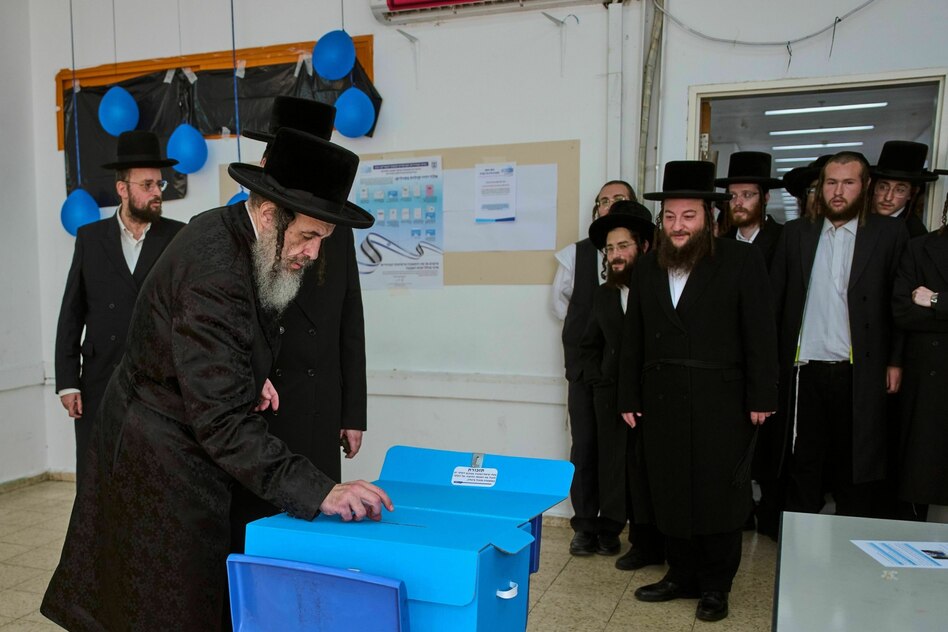
Israel is electing a new parliament today. For the first time since the Hamas attack on October 7, 2023 and the subsequent war in Gaza. For Prime Minister Benjamin Netanyahu it is about maintaining power, for the country it is about making a political decision. Surveys indicate a close race between the right-wing religious government camp and the opposition led by Gadi Eisenkot. Who can govern in the future and what does the election mean for the region? And what are the people saying at the polls? The most important developments, results and reactions in the taz live ticker.
"Although Netanyahu's Likud party wins the most votes, the governing bloc itself loses massively. The Arab parties win significantly." This live ticker ends with the election report from Middle East editor Lisa Schneider. You can find further coverage of the election here and directly on taz.de from tomorrow morning.
Neither Netanyahu's camp nor the camp of his political rivals - each with several parties - achieved an absolute majority, according to post-election polls. This confirms the expectations of most analysts. However, it is not yet possible to predict whether there will be coalition negotiations, a minority government or new elections.
The numbers will still move a little: the votes of hundreds of thousands of Israeli soldiers and reservists will not be counted regularly until Wednesday. This group of voters is said to have strong support for right-wing parties.
Preliminary final results are expected on Thursday. The official results are due to be published eight days after the election. Only then does President Izchak Herzog instruct the candidate who is given the best chance of winning a majority to form a government. (taz/dpa)
There is currently no clear winner in the parliamentary elections in Israel. Neither Prime Minister Benjamin Netanyahu nor his main challenger Gadi Eisenkot can expect a clear majority in the 120-seat Knesset, according to voter surveys carried out by major television channels. According to forecasts, Prime Minister Benjamin Netanyahu's right-wing conservative Likud party is the strongest force. The second strongest party would be the centrist Jashar party of ex-military chief Gadi Eisenkot. His bloc is in the post-election polls with 52 seats, just ahead of Netanyahu's governing alliance with 50 seats. The remaining 18 seats went to Arab parties: the Joint List, which consists of the Hadash, Ta'al and Balad parties. And the Ra’am who could now be important when forming a government. (dpa/rtr/taz, updated)
The polling stations will close in a few minutes. The first forecasts based on post-election surveys, the so-called “exit polls”, are then published. A final result is not expected until Thursday. (taz)
In a fateful election today, Israelis are voting for one of 36 parties. Lisa Schneider, Ulrich Gutmair and Tamar Ziff asked six of them about their hopes and fears. (taz)
8 p.m.: Voter turnout already at 74.3 percent
The polling stations in Israel are still open for one hour. And according to the electoral authority, 74.3 percent of those eligible to vote have already cast their vote. This means that turnout is already higher than in 2022. In the last Knesset election, 70.6 percent of those eligible to vote voted. Only in 1988 had more people found their way to the polls at this time. (taz, haaretz)
7:43 p.m.: Election Commission rejects Likud application
The Central Election Commission in Israel has rejected a request from Prime Minister Benjamin Netanyahu's Likud party to extend the opening hours of polling stations. The high voter turnout in all parts of society shows a strong democratic commitment, the electoral commission said on Tuesday. No need was identified to extend voting beyond 10 p.m. (local time, 9 p.m. CET).
Prime Minister Benjamin Netanyahu's Likud party has requested an extension to the opening hours of polling stations in Israel's parliamentary elections. “We have submitted a request to extend the times for voting,” the conservative party said on Tuesday on the Telegram online service. The Netanyahu party also tried to mobilize its voters: “Only vote for Likud,” she wrote on Telegram.
The Jashar party of center-right opposition politician Gadi Eisenkot “decidedly” opposed extended polling station opening hours. “No extraordinary incident has occurred that would justify granting this request,” said the party of Netanyahu’s most likely challenger. The motion aims to “prepare the ground for accusations intended to question the integrity of the election.”
The polling stations actually close at 10 p.m. (local time, 9 p.m. CET), after which the first projections are expected.
Voter turnout in some of the largest cities and towns that overwhelmingly supported Prime Minister Benjamin Netanyahu in 2022 is below the national average, according to data released by the Central Election Committee, Israeli daily Ha'aretz reports. For example, in the northern city of Kiryat Shmona, in Beer Sheva in the south of the country and in Bat Yam, a suburb of Tel Aviv.
Netanyahu is obviously getting cold feet (again) and is requesting an extension to the opening hours of the polling stations. “We have submitted a request to extend the times for voting,” the Likud said on the Telegram online service on Tuesday. Gadi Eisenkot's Yashar party, however, rejected the Likud's request. The party said in a statement:
"The request aims to pave the way for claims questioning the integrity of the election and follows on from the lies that Netanyahu has been spreading since this morning. No extraordinary event has occurred that would justify approval." (jp, afp)
According to the Central Election Commission, nationwide voter turnout was 55.7% at 4 p.m. - the highest ever recorded at that time. No relevant data were collected before the 1973 election. (haaretz, jp)
Likud banners read: "Don't let them rig the elections. Did you vote? Tell us." This spreads the conspiracy theory of election fraud by opposition groups and violates the principle of electoral secrecy. This is the first election in which poll workers are prohibited from counting the number of votes for a particular party and passing them on to party representatives during the election. (tz)
Walking down Masada Street in Haifa, you hear almost no Hebrew, only Russian and Arabic, and you pass many trendy cafes and bars where young people drink beer. Interestingly, unlike the Merkaz Hacarmel district, there are Likud stands and signs here. Ultra-Orthodox Jews, secular Russians and Arab men and women – with and without hijabs – enter the building to cast their votes. The Likud stand is right next to the Arab-leaning United List stand, where activists distribute leaflets for the “socialist struggle.” A Democratic activist says she was surprised at how many wanted to vote for her party. (tz)
According to surveys, neither the government nor the Zionist opposition has the 61 mandates needed to form a government. What coalition options are there? Middle East editor Lisa Schneider reports on the five scenarios for forming a government
A young man from Ramallah writes to the taz: He doesn't know exactly which parties in Israel are actually running in the election this Tuesday. However, he is sure of one thing: “I wish that Netanyahu doesn’t win again.” (lks)
Rain and stormy weather in parts of the country are making it difficult for Israelis to cast their votes. The weather service said on Tuesday afternoon that thunderstorms were developing in several areas in the south and center of the country. There is a risk of flash floods. The police reported several road closures in the south. (ap)
A group of young Democratic activists at a bus stop in Haifa have just finished their shift. You spent the morning motivating people to vote. They appear hopeful.
Conversation with a voter: Yuval is a doctor and works in Haifa. He sympathizes with the left, but voted for Gadi Eisenkot. “Gadi must become prime minister,” he says. "Yair Golan is good, but he should rather become security minister and clean up the settlers in the West Bank. The position has to be held by someone strong." (tz)
According to reports in the Israeli newspaper Ha'aretz, the Civil Election Guard, an organization that deploys more than 20,000 election observers at polling stations across the country, observed a series of disruptions in ultra-Orthodox communities: ballot papers from the Haredi Public party were stolen.
The newly founded “Haredi Public” party wants to offer a more moderate alternative to the established ultra-Orthodox parties “United Torah Judaism” and “Shas” and is also putting women on its list. According to the latest polls, the party will not make it past the 3.25 percent hurdle.
The disruptions are said to have occurred in 20 different polling stations, including in Jerusalem and Bnei Brak. Stacks of the party's ballot papers were removed from the voting booths or hidden under those of other parties. (haaretz, jp)
Unlike many polling stations in the country, there is almost nothing going on at one of the polling stations in the center of Jaffa. An older woman with a colorful headscarf leaves the building; A security guard yawns next to her. On the fence in front of the school there are posters from the Joint List, but also posters from the Likud, warning against a coalition between the Arab parties and the opposition parties such as Eisenkot. (lks)
According to its own information, the central election commission recorded the highest turnout in the parliamentary elections in Israel since 1973. By 1 p.m. CET, 44.7 percent of those eligible to vote had already cast their vote. (dpa)
A young woman in her thirties from Ajami, south of central Tel Aviv, says she wanted to go to her polling station at 7:30 a.m. - but it was still closed. It was supposed to open at 7 a.m. “Israel,” she jokes. She hasn't cast her vote yet; the lines are now too long for her. She wants to try again in the evening.
In view of the high voter turnout and long queues, the Central Election Commission announced that all polling stations would remain open until 10 p.m. Normally, polling stations in smaller towns are only open until 8 p.m. (lks, jp)
Netanyahu continues to stir up sentiment against Arab parties and voters. He tweets on
The tweet is reminiscent of a Facebook post by Netanyahu from 2015. Also on election day, he wrote about “Arab voters” who are “going to the polling stations in droves”: “Left-wing organizations are taking them there on buses.” The post caused an uproar and brought him accusations of racism. After the elections, Netanyahu apologized. (jp)
A man was arrested during a campaign tour by Democratic Party leader Yair Golan in Tel Aviv. According to reports in the newspaper Ha'aretz, he was carrying a knife and had approached Golan in a threatening manner.
Police had previously raised Golan's threat level to four out of six. On Monday, the Shin Bet security service took responsibility for its personal protection after a protracted legal battle. (Ha'aretz, jp)
There are reports of a shortage of Arabic-language ballots at polling stations in several mixed-population or Arab-majority cities in the north, including Jerusalem. Meanwhile, three Bedouins from the Negev were arrested on suspicion of bribery, according to Israeli daily Ha'aretz. Envelopes containing money and ballot papers for the Ra'am Party were said to have been found with them. The three were taken in for questioning. The Likud and right-wing parties regularly accuse Arab parties of fraud in elections. Ha'aretz also reported that Eisenkot's Yashar party and the smaller Amcha Israel party had contacted the electoral commission, claiming ballots had disappeared or were otherwise manipulated. These reports have not yet been confirmed. (tz)
I cast my vote at Merkaz Hacarmel in Haifa, where older Ashkenazim (Jews from Europe) and Russians as well as a few young families mix. This area of Haifa is consistently liberal and rather secular. In front of the polling station there are stands for Yashar (Gadi Eisenkot's party), Beyachad (Bennett's party) and the Democrats under Yair Golan. No stands from even more right-wing or religious groups.
People in the queues say they have never waited so long to vote and that the queues are incredibly long everywhere. We've been waiting for about an hour now, and similar reports are coming from friends in other cities. (tz)
The first numbers indicate a high voter turnout. According to the Central Election Commission, voter turnout at 10 a.m. was over 16 percent, which, according to media reports, was the highest it had been in 45 years. (jp)
In the center of liberal Tel Aviv in front of a café. Four women of obviously Moroccan origin: “If Bibi loses, it will soon look like it does in France with the Arabs who rule everything.”
Thousands of Israelis have rushed home from abroad in recent days to take part in the fateful election. Because you have to be in the country to be able to vote in Israel. “Did Joel come from Berlin?” one asks. "No. That's good, he would vote for one of the Arab parties anyway." (mm)
Election day in Israel begins with an unusual calm for a weekday. The streets are still empty at eight in the morning, and for once the city buses in Tel Aviv arrive on time. It is also quite empty at the train stations. Because Election Day is a public holiday in Israel; many offices remain closed.
Later that morning in Jaffa, activists from the Standing Together movement shouted into a megaphone in Arabic: Go vote! Activists from the Arab Joint List are sitting in a café, busy talking on the phone. A car drives along the street, draped with flags from the other Arab electoral list, Ra'am.
Further north, in the hip center of Tel Aviv, flags from various parties hang on the balconies, and party members walk through the streets and distribute flyers. (lks)
The first parliamentary election since the Hamas attack has begun in Israel. The country's polling stations opened on Tuesday morning at 7 a.m. (local time, 6 a.m. CET). The vote is considered a choice about Israel's future direction. The opposition has a good chance of replacing the incumbent government of Prime Minister Benjamin Netanyahu. However, a close race is expected. The first projections are expected after the polling stations close at 10 p.m. (local time, 9 p.m. CET).
Around 7.3 million eligible voters are called upon to cast their votes. More than half a million young people are registered as first-time voters. According to surveys, the majority of them identify with the center-right spectrum or the right-wing political camp. It is also estimated that tens of thousands of Israelis traveled from abroad to take part in this important election. (afp)