
Germany taz
Lots of presence at “Open Mike” in Berlin: Vertical identity creation
A new generation of writers introduces themselves at the Berlin “Open Mike”. In a gym atmosphere you try to describe the present. more...
Deutsch (original) ·Auto-translated to English
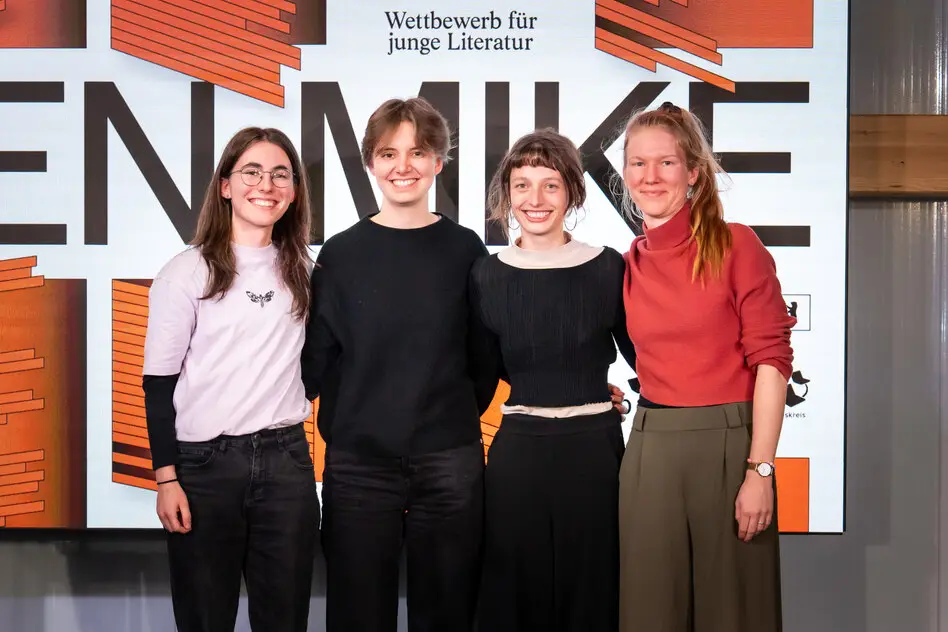
There has perhaps never been so much daylight at an Open Mike. But not that much street noise either. It's a bit tragic that it's a small multifunctional hall where young writers under the age of 36 came together at the weekend for the 34th time to read their texts.
It is well known that things are currently not going well with cultural financing in Berlin. The Open Mike is also fighting for its survival. After years in the home port of Neukölln and a stopover in Wedding's Silent Green last year, this year's edition now took place in the pop-up annex of the ZLB's America Memorial Library, which is squeezed between the main building and Blücherstrasse.
The organizers emphasized several times how vital this place is for the survival of this year's competition. A lot has been said about the deplorable funding gaps in Berlin's culture, when one realizes that one of the most important German-language young literary competitions has to take place in an emergency building, which itself only exists because politicians have not found a solution for the overcrowded ZLB for years. As nice as the solidarity of the beleaguered Berlin cultural scene is with one another, it would also be nice if the texts could be read again in the future in a place that doesn't look so much like a gymnasium.
Nevertheless, the idea of organizing the competition together with the ZLB is a good one - this way library visitors can also listen to the young literature of the twelve finalists, whose thematic range was wide.
Alina Sauernheimer and Lotti Player brought language games to the stage with “Entkränzung” and “Report in 7”. Florian Kranz, who was already a finalist in 2023, tackled the digital chaos that surrounds us in the form of his anagram poem cycle “Manic Machine”: “Select all the pictures with traffic lights.”
The jury, consisting of Daniel Falb, Martina Hefter, Ruth Klinkenberg and Sasha Marianna Salzmann, chose three winners. Among others, they honored Charlotte Obenau for her prose. "Valerie. A Chronology" is a mysterious text that reflects on variations of an entire life in variations of the name "Valerie" using curved sentences.
The jury was also impressed by Bente Schwichtenberg's short story "6A02", in which Schwichtenberg links autism and trans identity with a trip into space. Schwichtenberg's text is perhaps the most introspective text in this year's edition.
It is refreshing that the introspection that characterized previous Open Mike years was now found in fewer texts. There wasn't a really convincing short story this year, but there were promising excerpts from novels. The Serbian-born Boban Ristić draped a blue thirst-quenching tetrapak on the table in keeping with the genre and then read excerpts from his novel project “The Life of Goran Gorki”. In it, drug-selling teenagers stumble through Vienna, looking for a big breakthrough in the German rap scene. The authenticity of Ristić's delivery extends to the perfectly softly rolled "r" of the word "brother", which is omnipresent in the text.
Marie Hahn recited her outstanding poem “glueck_unter” just as perfectly. Hahn, who comes from the Erzgebirge, goes underground and digs up current references to German industrial culture. Hahn takes the old mining vocabulary, arranges it in meter, describes the pride of the miners without romanticizing the hard work - and is also able to decipher the cultural heritage rooted in it: "the shaft as a vertical foundation of identity." "glückauf glückan, I'll take you out - to fine mining tonight / there we can crawl, sipping acidic mine water / wasting away with us fish serving up pure nerve poison.”
Hahn rightly won not only the jury's poetry prize, but also the audience prize, which she shares with Ina-Lena Dinse, who read an excerpt from a novel that contains a powerful coming-of-age story about two friends who are struggling with their male friends and the future, which could also work well as a film.
Given the hardships that young people face (housing, climate, educational cuts), it is nevertheless noticeable that the participants' texts largely refrain from explicit criticism of the present; rather try to find new ways of describing the present.
Traces of technology and digital criticism were most noticeable in the competition. In addition to Florian Kranz's machine anagrams, Miriam Suad Bühler's prose text "Blood, Orange" at least skewers the algorithmic brutalization: "I hadn't listened to Suzanne and instead scrolled through Reels for hours in the evening. Someone with cancer needed more money for his GoFundMe page, a school friend was in the Bahamas, a child's head had been bombed off in Gaza. Oh, the internet was great."