
Germany taz
Defense of literary criticism: For disrupting business operations
Why literary criticism? Because literature is about something. Literature that believes it no longer needs criticism has already given up. more...
Deutsch (original) ·Auto-translated to English
There has always been a specific vehemence in German literary criticism, which can be explained by its historical beginnings. In the 18th century, writers were concerned with creating a German literary language. The small absolutist courts were a considerable hurdle for the developing bourgeoisie.
Under these circumstances, writers naturally also worked as literary critics; Gotthold Ephraim Lessing, for example, was at least as well-known as a critic as he was as a playwright. Literary criticism was understood as a separate literary genre. Because it was about something. They didn't spare themselves. Lessing judged a poem by his famous contemporary Friedrich Gottlieb Klopstock: "It's like all of Mr. Klopstock's songs are; so full of emotion that you often feel nothing at all."
It was about the whole thing. Aesthetic disputes often took the place of political ones, because the German bourgeoisie in the 18th and then in the 19th century had nothing to determine and nothing to say. But even more so about art. People liked to be fundamental. One of Ludwig Börne's most beautiful sentences is: "Since I felt, I have hated Goethe, since I thought, I know why!"
In the 19th century, literary criticism was no longer only carried out by writers. A new caste developed that acted more academically, even as a senior teacher.
In doing so, she hid her subjective foundations behind an objective style and built on the theoretical fields that were currently in the air. In the 19th century, these were the fatherland, religion and family, and university lecturers routinely reduced the sometimes impetuous effervescence of literature to their level.
These critics have long been forgotten, but their attitude endures to this day. Except that the forms of discourse are no longer called “Fatherland” and so on, but rather are determined by the current debate parameters.
However, well into the 20th century, literature and criticism often played on the same keyboard. Walter Benjamin read Marcel Proust and wrote: "In the last century there was an inn 'Au Temps perdu' in Grenoble - I don't know if there still is today. In Proust too we are guests who enter a threshold under the swaying sign behind which eternity and intoxication await us."
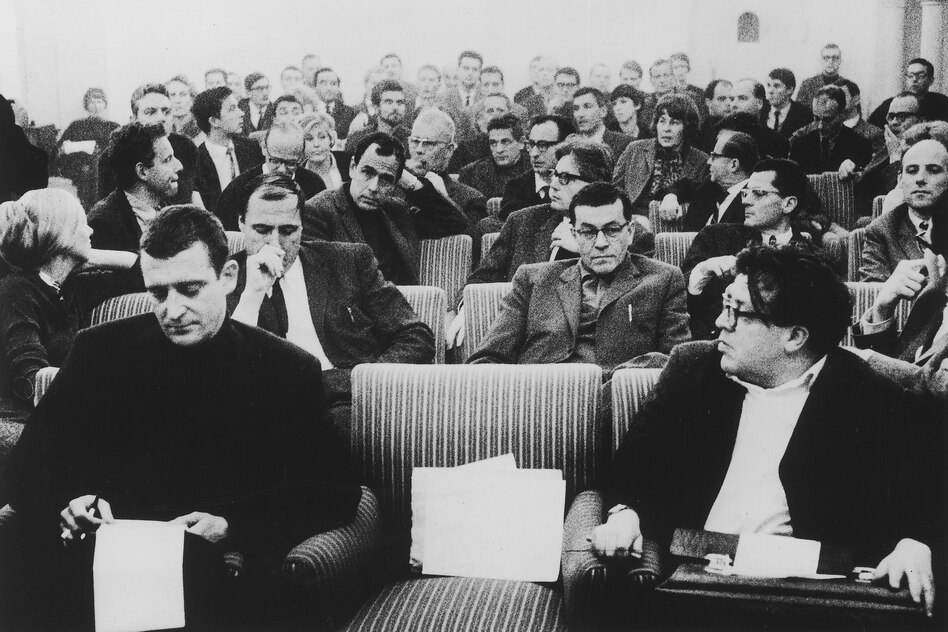
This brings us to our very own literary territory: intoxication and eternity. The collapse of civilization caused by the Nazi regime was also evident in the narrower field of culture. After 1945, the task arose of building on a critical practice that had been completely driven out. In the early days of Group 47, it functioned as a means of overcoming the influences of the Nazi era in the form of speech and counter-speech.
Basically, the situation was similar to that in the age of Lessing and the Enlightenment: one had to be clear about what a new contemporary literature could actually look like. And this gave the critic enormous importance. It was about something. The emblematic lines that Günter Eich highlighted in his radio play “Dreams” in 1951, which deals with the repression of the Nazi era: “Be sand, not the oil in the gears of the world!”
It is striking that this sounds rather strange to today's ears, recognizable from yesterday. Because West German literature gradually grew into a prosperous, affluent society. In 1979, Hans Magnus Enzensberger, who was always first in line, invented the ironic and playful section “Journal of Luxury and Fashion” for his magazine Transatlantik. It was important to savor the new, diverse possibilities of consumption and individualization. The cultural criticism celebrated in most feature sections was quickly considered outdated. It was equated with the buzzword “cultural pessimism,” which had become fashionable.
The pop culture turnaround of those years was initially perceived as a liberation, with good reasons; what counted was the enjoyment of the present. Newly founded zeitgeist magazines like Tempo or Wiener summed up this feeling, replaced the model of bad-tempered hippies and stood for coolness.
However, some pop exegetes pointed out early on that pop culture has two poles: on the one hand there is rebellion and on the other hand there is the ecstatic affirmation of the existing. And the market combines both. It is striking that in the mid-1990s, the suffering of a Swiss millionaire's son because of his Barbour jacket was able to identify with an entire generation.
Pop and magazine journalism quickly developed its own momentum. The stars of the new media scene were the all-knowing reporter and the columnist who absolutes his self and perceives the world through his highly polished mirror. This primary media narcissism has prevailed across the board.
In the mid-1980s, Baden-Württemberg Prime Minister Lothar Späth was the first to define culture as a “soft location factor” for the economy. That had consequences. Within a few years, a diverse infrastructure was created with government funding and subsidies, prizes and scholarships, workshops, networks and festivals. Since then, contemporary German literature has been very spoiled. Professionalization is growing faster than substance. And the writer is no longer dependent only on reviews, he can market himself.
In the 1990s, when contemporary euphoria was at its peak, new buzzwords emerged. They were called “larmoyant” or “murmurous” and were directed against everything that was not present and clear enough - too much in the in-between, too floating, too little translatable into the current media feeling. The word “low-threshold” became the new mantra of cultural officials.
It is always hastily confused with “democratic”. What became the enemy of a new class of media and communication experts was what was supposedly aloof, too presupposed, what was difficult to understand - in other words, what was decidedly literary.
In 2015, the internet magazine Pearl Taucher conducted a survey on literary criticism. According to the findings, the gestures of the art judge and gatekeeper no longer correspond to the circumstances. The role of the traditional literary critic is now taken on by cultural managers, literary agents, presenters and other media celebrities. They are the lubricants of the company - a far cry from Günter Eich's sand in the gears.
Criticism – this is a disruption to the operational process. Core sentences from Amazon reviews such as: I “enjoyed reading it” or it was “terribly exciting” are considered much more accurate. It is striking that in political journalism people warn against populist simplifications - but in cultural journalism, for many bloggers and BookTokkers, populism is something like the basis of business.
Since time immemorial, thoughtful minds have complained that far more poetry is written than read. Today this applies to many internet activists: two-minute short videos on the sofa, emotional and confident. The medium is the message. But anyone who is only interested in the present does not understand the present.
There are outstanding contemporary authors who do not want to fall behind what William Faulkner, Ingeborg Bachmann or Uwe Johnson developed in order to find aesthetic forms for a contemporary consciousness. They naturally have a harder time when literary populism becomes stronger. And the time of written, differentiated literary criticism on which such authors depend is over - say the media experts or what the editors-in-chief and program directors think so.
Empirical data about the “audience” seems to confirm this. But the “audience” per se does not exist; it is primarily an ideological construct. Statistics don't get you very far in literature and literary criticism. It is completely wrong to try to capture them using the means of consumer research. Anyone who enjoys distinguishing a Bordeaux from a Burgundy will no longer be satisfied with Liebfraumilch. And a literature that believes it no longer needs criticism has already given up. Then in the end it is no longer about anything.
Literature as art can provoke. She ventures into empty spaces, into the ambiguous and uncanny. It evades concepts and creates a form of knowledge that is surprising and illuminating in an unknown way. This includes rhythm and form, and language as a translation of previously unperceived images.
Literature thrives on the fact that an initial lack of understanding can be productive, and the same applies to literary criticism. Sentences like: “I don’t understand that” or: “I don’t feel taken care of,” which are often used as a matter of course as an argument, deny the most beautiful experiences you can have.
As is well known, Marcel Proust was also a great literary critic, and at the end of his great novel about lost time he speaks of the “deceptive character of supposedly realistic art”. It is “mendacious” because it gives “what we feel an expression” that in no way corresponds to the feelings, “but which after a short time we take to be reality.”
Proust stands for the fact that literary criticism has nothing to do with a mean review system, with thumbs up and thumbs down. A true critic doesn't just write reviews. He is an essayist who measures the shimmering zone that emanates from art and moves into its space.
This text is an edited and shortened version of the acceptance speech that the author gave when he was awarded the Johann Heinrich Merck Prize for Literary Criticism by the German Academy for Language and Poetry in Darmstadt on October 24th.