
Germany · taz · · 3h
Socialization: “The unions must dare to do more Marx”
Deutsch (original) · Auto-translated to English
taz: Mr. Krebs, there has been a new fuel discount in Germany for a few days. Petrol and diesel are cheaper again. Does this help against the ongoing economic crisis?
Tom Krebs: No. This federal government is incapable of making a convincing crisis policy. You simply lack a sensible concept.
Cancer: He comes too late and is not right either. The energy companies are currently ripping off consumers and making insane profits. The state must intervene much more strongly in the market and control prices. But the Union and large parts of the SPD suffer from naive faith in the market. This makes them unable to question certain things and to pursue an effective crisis policy with a comprehensive energy price brake.
taz: You advised Olaf Scholz when he was finance minister. As Chancellor, did he make a better crisis policy with his traffic lights?
Krebs: The traffic light also made economic policy mistakes, but in retrospect it was much better than Friedrich Merz's black-red coalition. The traffic light coalition agreement was good, Olaf Scholz was very pragmatic, and Robert Habeck had good ideas for a strategic industrial policy.
is a professor of macroeconomics at the University of Mannheim and a member of the Minimum Wage Commission. His new book “Capital and Crisis” was published by oekom in September 2026.
taz: But then there was FDP leader Christian Lindner as finance minister.
Krebs: Yes, it increasingly influenced traffic light policy during the energy crisis. That's why Olaf Scholz had to realize that neoliberalism and social democracy are incompatible and fired Christian Lindner.
taz: Since the Left's election victory in Berlin, half of the Federal Republic has been discussing the socialization of large real estate companies. They say that's not enough. In addition to living space, you also want to socialize the power grids and parts of the steel industry. Why?
Krebs: This is the only way we can overcome the triple crisis the country is in and save democracy.
Krebs: We are currently experiencing the worst economic crisis in post-war history. Economic output has barely grown since 2020. If growth had instead been the same as in previous years, gross domestic product would be 11 percent higher today. This corresponds to a loss of income for an average household of 12,000 euros per year. At the same time, rising energy prices and job cuts in industry are unsettling people. And hanging over all of this is the climate crisis. All of this is campaign ammunition for the AfD.
This text first appeared in wochentaz, our weekly newspaper from the left!
Every week, wochentaz is about the world as it is – and as it could be. A left-wing weekly newspaper with a voice, attitude and the special taz view of the world. New every Saturday at the kiosk and of course by subscription.
taz: Friedrich Merz has only been chancellor since 2025. Then the fault for the misery also lies with the traffic lights.
Krebs: The traffic light was ultimately overwhelmed by the energy crisis. It took her too long to respond to rising gas prices. Initially, she even wanted to impose an additional burden on consumers with a gas levy. The AfD benefited massively from this. Robert Habeck's heating law was added later. In his first draft, which was rightly criticized, he did not focus enough on subsidies and tenant protection. Both led to approval ratings for the AfD doubling from 10 to 20 percent during the traffic light coalition.
taz: Socialization like you are calling for sounds like socialism to many people. To what extent were you thinking about Karl Marx when you wrote your recently published book Capital and Crisis?
Krebs: Marx analyzed the structural contradictions and crisis tendencies of capitalism very well on an abstract level. Given the structural problems that the economy currently has, it is not enough to simply use government money to stimulate demand. If the entire economy is privatized, then it is just a redistribution from bottom to top. But I don't want socialism either. Instead, I advocate a planned market economy.
taz: Chancellor Merz wants us all to work longer. The industrial lobby too. All of this is intended to reduce wage levels and lead Germany out of the crisis. This also sounds a lot like Karl Marx, whose main thesis was the theory of surplus value, according to which all profits are created through the exploitation of labor. Did Merz and Co. secretly attend a “Capital* reading course?”
Krebs: If Marx were alive today, he could very well explain the behavior of business associations. He described unleashed capitalism very well. It is in the interests of companies that their employees work for as long as possible for as little money as possible. But an economic model based on the exploitation of cheap labor is not stable in the long term.
taz: And the nationalization of entire sectors of the economy makes the system more stable?
Cancer: If an economy is to be stable and resilient, basic goods must be provided by non-profit companies. Ultimately, private companies always have a purpose: they should generate the highest possible return for their owners. And that can contradict the needs of society, as we see with the housing crisis. A rent control or a cap will not be enough to create enough affordable housing again in cities like Berlin. This requires more public housing companies.
taz: But what speaks for the socialization of the power grids?
Krebs: That's the high network fees. You can't have low electricity prices and a privatized grid at the same time. We have the highest electricity prices in the EU, and in recent years the prices in this country have been around 35 percent above the EU average.
taz: Why do private network operators make electricity prices more expensive?
Krebs: Network operators are regulated monopolists who can ultimately determine the price despite regulation. They also have owners like the financial company BlackRock, who demand double-digit returns on their invested capital. We all pay this with our electricity bills. And in the future these will be even higher. Because our electricity networks are predominantly in private hands, the planned network expansion will result in additional costs of up to 100 billion euros.
taz: It's not just private companies that can provide poor service at high prices. Deutsche Bahn is 100 percent publicly owned.
Krebs: Deutsche Bahn's problems began when they wanted to privatize it. Back then it was destroyed. We are still feeling the consequences today. Switzerland shows that things can be different. The railway there is also in public hands. But Switzerland has invested in its railway system.
taz: You write that, in addition to the areas of public services, the steel industry also belongs to the public sector. Why?
Krebs: The steel industry is currently in a massive crisis because it is suffering from global overcapacity and the green transformation is pending. At the same time, it is important that it is preserved in Germany. Steel is an important raw material for many other industries. There are also already positive examples in the steel industry: in Salzgitter, where the state of Lower Saxony is involved, and in Saarland, where the steelworks are in the hands of a foundation, the transformation is going much better than elsewhere.
taz: Massive resistance is forming against the left's socialization plans. Your plans go even further. Do you think they have a realistic chance of being implemented?
Krebs: Admittedly not with this federal government. I also have little hope for the parties at the federal level. Especially not in the Greens and SPD.
Krebs: Ultimately it's about securing good jobs, living conditions and democracy. This is what the trade union movement has always stood for. That's why she has always called for more public companies.
taz: Conflicts with the business lobby seem to be inevitable.
Krebs: The unions must dare to do more with Marx and become more combative again. The social partnership that has existed for decades is currently being dismantled by large corporations such as Volkswagen, ThyssenKrupp and BASF.
taz: With Yasemin Fahimi, there is a woman at the head of the DGB who was once SPD general secretary. Aren't the unions too closely aligned with the Social Democrats for such radical demands?
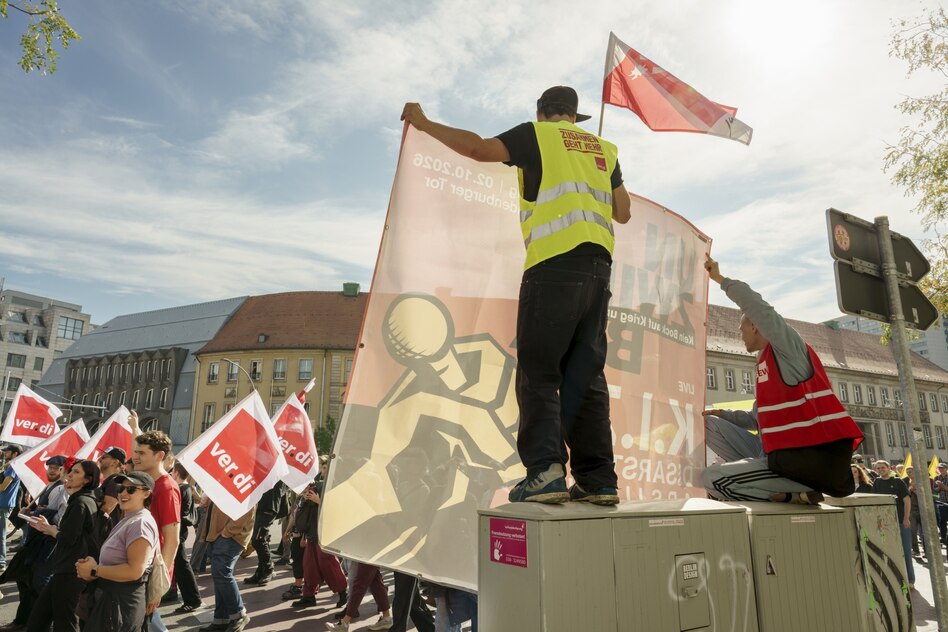
Krebs: The DGB must become more political again and move from the defensive to the offensive. The fact that he is mobilizing against the planned social cuts, as he did on September 26th, shows that he can also take to the streets against a government with SPD participation.
Read the full story at the source
Source: taz