
Germany taz
Venue bUm in Berlin: Google’s rebellious heirs
Crochet courses, co-working and one of the last refuges of the Palestinian solidarity scene: the venue bUm has to close at the end of the year. more...
Deutsch (original) ·Auto-translated to English
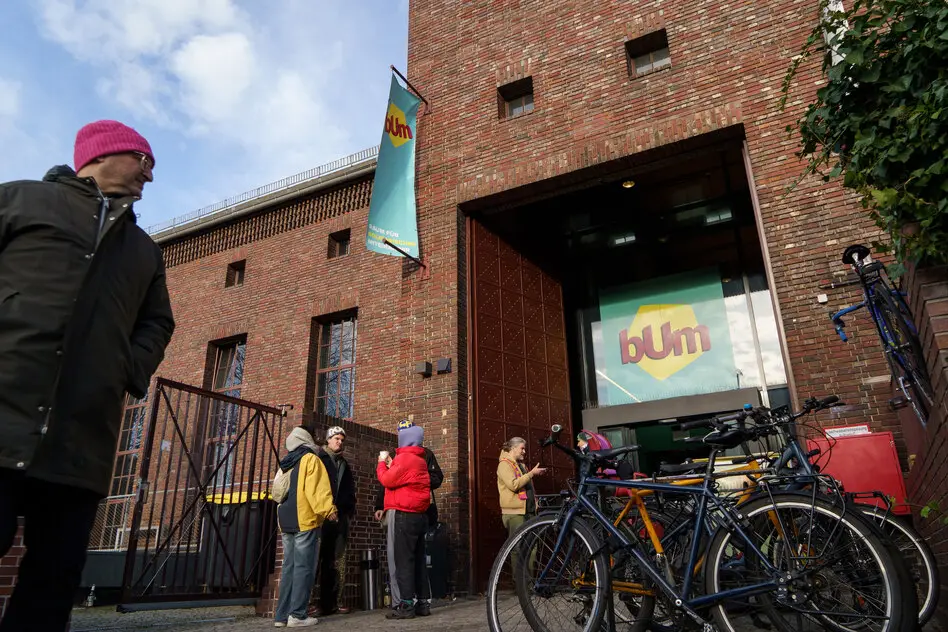
On a gray Wednesday morning, bUm managing director Eva Mörchen leads a tour through the converted basement of the former substation on Ohlauer Straße. In a large meeting room, a group of mostly older people is packing up their seat cushions. “This is our weekly meditation course,” says Mörchen. It was there from the beginning, and later one of the participants founded the crochet group. “These are also projects against loneliness, without us calling them that,” says Mörchen.
Mörchen leads the taz up a small steel staircase through the old machine hall of the substation. Today the event room offers space for 200 people, the stage and technology are already there. On the wall hangs a poster for the event that will take place here this weekend: “Zündfunke. Congress for socialism from below”.
The bUm is an unlikely place. In a listed brick building directly on the Landwehr Canal, a property like this is a dream for every investor: attractive architecture, centrally located in one of the hippest neighborhoods in Berlin, extensively renovated. Over the past seven years, a place has emerged here, freed from the pressure of profit, anchored in neighborhood culture, which not only offers free rooms for crochet courses, but also stages for anti-capitalist and Palestinian solidarity congresses.
Now the bUm has to be out by the end of the year. How could this come about?
Mörchen switches on the light on a small digital control panel. The ceiling of the machine hall is so high that there is still space above the hall for a container with meeting rooms and offices that is suspended there - the bUm box. “Google expanded everything,” says Mörchen, “we didn’t have to do much anymore.”
In 2016, Google announced that it wanted to build a tech campus at this location in Kreuzberg. Resistance arose against the project from the neighborhood and Berlin civil society, which culminated in a brief occupation of the substation.
Shortly before the opening, however, the company, which was still concerned about its image, withdrew and left the rented space to civil society. Initially via the “Betterplace” donation platform – the abbreviation bUm actually stands for “Betterplace substation”. Eventually the donation platform also withdrew and the small team led by Eva Mörchen took over the management of the space.
Google did not interfere in bUm's affairs, but paid the rent over the years. But the rental agreement expires at the end of the year. The US tech company does not want to extend it.
Back down in the basement, past soundproof meeting boxes and a tea kitchen, about a dozen people are sitting intently in front of their PCs. “We have around 200 members who work here,” says Mörchen.
A place here costs less than 100 euros a month, which is around a third of what is charged for comparable co-working offers. For many of the users, it is the only option if they do not want to work at home.
This also includes Annamaria Olsson and Silke Georgia from the Stories from the Beauty Parlor association. The two women are sitting at a white work table, hunched over the screen of a laptop. “We do fundraising for feminist projects,” explains Olssen. Women’s work is systematically underfunded worldwide, and only 1 to 2 percent of charitable donations go to feminist projects, explains Olssen.
“Unfortunately, we are one of them,” says Olssen. The association is very small and run by volunteers; expensive offices or commercial co-working spaces cannot be afforded. “The alternative is isolation in the home office,” says Olssen. In the past few months she has learned to appreciate the community in bUm, especially the informal exchange with other clubs and projects.
“It’s a shame that we’ll all have to leave soon,” says Mörchen. A large protest was planned for the handover of the keys to Google on December 17th. “We thought we would somehow manage to save the bUm.”
Mörchen explains that they tried to approach the owner, an international real estate company. The bUm developed a new concept in which a public interest-oriented operation could have been cross-financed through commercial use. A rent of 20,000 euros per month would have been offered, but the owner would not even have responded with a counter-proposal. “There was neither a concrete number nor a constructive conversation,” reports Mörchen.
The owner is keeping quiet about what comes next. The company left inquiries to the taz unanswered. The company also did not comment on the bUm, says Mörchen. “We had the impression that vacancies would be more worthwhile for them.” In the neighboring areas not managed by bUm, many offices are empty.
There is little reason for hope. In an open letter that the bUm plans to send this Monday, the bUm calls on the owner to at least be transparent about it and to prevent future vacancies.
They received many expressions of solidarity from the parties and district politics, but no serious attempt was made to save the bUm, says Mörchen. "In the end it's a question of political priorities. One could have been creative."
In response to a taz request, the Friedrichshain-Kreuzberg district office said that, with the support of external experts in public interest-oriented real estate developments, they had examined how the property could be acquired by the state or a sponsor. “However, the owners’ price expectations made such an acquisition appear unfeasible,” said a spokeswoman from the district office.
There are many reasons why bUm, in contrast to other left-wing projects, runs relatively quietly. One of them is probably that in recent years the bUm has developed into a retreat for the Palestinian solidarity scene, which is being excluded from more and more locations in Berlin.
The bUm came into the focus of reporting when the Neukölln Left organized a neighborhood festival in 2025 in solidarity with Palestine. The local association invited the controversial Palestine activist Ibrahim Ibrahim, who, as a representative of the United Palestinian National Committee (VPNK), is accused of being close to Hamas.
“Neukölln's Left party celebrated with supporters of a terrorist organization” was the headline in the Tagesspiegel. The CDU MP Timur Husein asked in an inquiry about public financing of the bUms. The taz also spoke of the event space as a “stage for those who understand terrorism”.
The bUm responded to the allegations in a statement at the time: “Precisely because voices of Palestinian solidarity in Berlin are massively affected by racism, repression and exclusion, we believe it is necessary to open up spaces for these groups in which mourning, dialogue, negotiation and diverse positions remain possible.”
Basically, bUm only rents out the rooms and does not interfere with the program. “We have so many people in the house, we can’t do an attitude test for everyone,” says Mörchen.
As soon as a topic is justified from the bUm's point of view, it can take place in the house. However, they do not want to take part in contact guilt logic, says Mörchen. It is important that the house rules are adhered to at the events. This also includes a ban on glorification of violence and racist and anti-Semitic statements. A bUm awareness team is present at all events and, among other things, ensures compliance with the house rules.
Even with the socialist Zundfünke Congress at the weekend, the bUm remains true to this attitude. Left-wing MP Vanessa Emde, who fell into disgrace because of her uncompromising anti-Zionist stance, and Ramsis Kilani, who was already kicked out of the party for the same reasons, appear there. The organizers of the taz have refused press accreditation.
Ironically, it is also the independence from government funding made possible by Google that allows bUm to afford not to buckle in the face of media and political pressure.
With the so-called “BDS resolution” of 2019, the federal government is calling on municipalities and public institutions to deny associations and actors public spaces and funding if they are close to the non-violent boycott movement “Boycott Divest Sanction”. According to the decision, even questioning Israel's “right to national defense” is anti-Semitic, as are calls for a boycott.
In practice, it may be sufficient if an organization is close to the BDS campaign or supports its content. The Oyoun in Neukölln, which was financed by public money, had to close after the anti-Zionist Jewish Voice for a Just Peace in the Middle East held an event there. In February 2025, the TU canceled an event with the UN special rapporteur Francesca Albanese, which could then take place in the bUm.
“In general, the question is who gets access to spaces in the city,” says Mörchen. This applies to the Palestine solidarity movement as well as the clubs working here and the meditation course. Even if the bUm can no longer be saved, Mörchen hopes for political solutions that can secure spaces for the common good in the long term in the future. “Structures that have grown for seven years should be above the right to be vacant,” says Mörchen.