
World taz
USA before the midterms: Forever Trump?
When Donald Trump became US President for the first time, Samuel Cosmano and others explained to the taz why they voted for him. How do you see his politics today? more...
Deutsch (original) ·Auto-translated to English
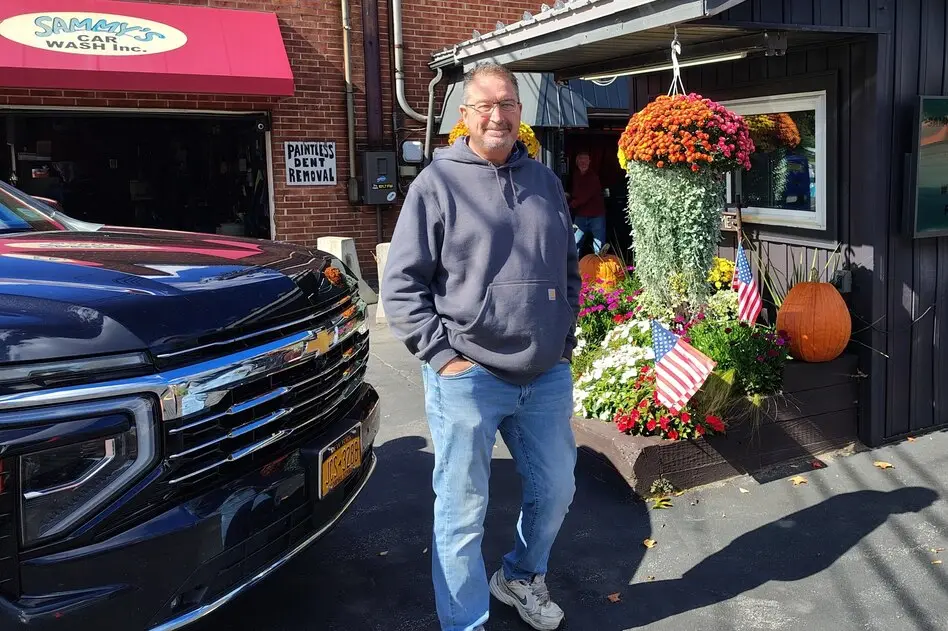
S amuel Cosmano is happy. “Isn’t he embarrassing?” He grins. “Isn’t he really very embarrassing?” The grin gets wider. “He’s not a great speaker, he’s not a politician.” Art break. “And I like that.”
A taz report from the summer of 2017 begins with these words. Donald Trump ruled the USA for the first time at the time, and Samuel Cosmano, a cheerful 51-year-old with brown curls, was satisfied. He lived with his family in East Aurora, a small, wealthy town near Buffalo, New York. Here he ran a Car and Dog Wash, a laundromat for cars and dogs. At the time, he and his local friends thought the president was a clever businessman who first made maximum demands and then negotiated something better. They saw his rudeness as a clever tactic.
Today, nine years and one and a half Trump terms later, Samuel Cosmano sounds a little more reserved. On a Thursday afternoon in early October, he was sitting in a restaurant in East Aurora to talk to the taz about the US president. The 60-year-old's hair is mottled gray and cut short. He chose the table right next to the entrance so he can greet everyone he knows, and there are many. “Good to see you.” Firm handshakes, roaring voices that sound a little like the engines of the pickup trucks outside the door. Behind the wooden counter, baseball flickers across a screen.
"Trump has an idiosyncratic personality. He is very direct, and yes, that may come across as tactless," says Samuel Cosmano today. “Sometimes when I hear him talk, it makes me uncomfortable too.” The fact that Trump wants to rename Lake Ontario, just an hour north on the border with Canada, “Lake America” is one such example. Cosmano grimaces. “That’s silly.” Then he gets serious and says emphatically: "I still believe that Trump is smart. He is street smart. And he makes a difference."
Now Trump is undoubtedly making a big difference. Among other things, he raised and lowered tariffs, deported hundreds of thousands of people, attacked Iran and fell out with nearby Canada. What Samuel Cosmano says about it?
The first paragraph of this text comes from a report by the late colleague Bettina Gaus. Before Trump's first presidency in 2016, she traveled across the United States, including to New York state, and spoke to many who wanted to vote for him. It was also because of these conversations that she was convinced early on that Trump would win against Hillary Clinton.
In the summer of 2017, she returned to East Aurora and Buffalo to hear how Trump as president was being received by those who voted for him. She talked to Samuel Cosmano and his friends. With Mary Stang-Cooke, who was a long-time city councilor for the Republicans at the local level. And with Jen Griesbaum, who works for a Democratic politician and still voted for Trump.
We analyze the US midterm elections on November 3rd: What does the result mean for US politics, the Democrats, Donald Trump and the 2028 presidential election?
Register here or watch live in the stream.
The midterms, the important interim elections, are coming up in the USA next week. What do those Trump voters from back then think about the US President and his policies today? Have their hopes been fulfilled or are they disappointed?
In the midterms, the entire House of Representatives and a third of the seats in the Senate will be re-elected. Typically, the incumbent president's party performs worse in the midterm elections. Added to this is Donald Trump's unpopularity: in a recent survey, only 31 percent said they were satisfied with his work, fewer than ever in both terms of office. Above all, the high prices and the Iran war are costing him support among Republicans. If Trump loses even one of the two chambers of Congress, his power would be contained. With a majority in the House of Representatives, Democrats could block laws and the budget and even initiate new impeachment proceedings. If you believe them, the midterms are about nothing less than saving American democracy.
East Aurora lies between forested hills, almost 600 kilometers northwest of New York. The leaves turn yellow and orange-red at the beginning of October. Around 6,000 people live in the pretty little town. There are restaurants, an art and book store, a cinema and an organic supermarket. The toy manufacturer Fisher-Price is based in East Aurora. The household income in 2024 was $103,000, above the average in the USA. American flags and pictures of soldiers who served in various wars hang from the street lamps on Main Street. Squirrels scurry across the meadows and deer can often be seen between the houses.
A peaceful-looking place. But of course the polarization that is omnipresent in the USA is also noticeable here. The state of New York traditionally votes Democratic, which is mainly due to the large cities, especially New York. In small East Aurora, the Democrats are the mayor, but the conservative country is right next door. Here, too, families and friends have fallen out because of Trump. Some people prefer not to talk about politics at all anymore. Too much conflict, too tiring.
Samuel Cosmano lives with his family just outside on a small farm with a horse stable. He still runs the Car and Dog Wash. In 2017, he said he might want to open a second car wash. “My wife talked me out of it again, too much stress,” he said in the restaurant on Thursday afternoon. The children were still small back then and business was going so well. Over the years they were able to renovate their house and build a pool in the garden. The son is now working and the daughter is studying. Both still live at home.
“Your colleague asked at the time whether I didn’t think Trump had a mental problem,” says Samuel Cosmano, referring to the president. He wants to say something more about that. "Yes, Trump has a big ego, but the liberal media doesn't cover him fairly either. Or when was the last time you heard something positive about him?"
He hasn't watched traditional news channels like CNN for years. “You report biasedly.” Cosmano now informs himself about what he calls “independent media” on the Internet. Every morning he listens to “The President’s Daily Brief,” the podcast of a former CIA officer who often appears on Fox News. He likes Joe Rogan, who supported Trump before the 2024 election and then distanced himself again. “You get both sides.” Sometimes he also listens to “Investigate Earth Conspiracy,” says Cosmano with a smug smile. “It’s a conspiracy channel, but it’s funny.” He doesn’t take it “totally seriously.”
This article was made possible through the financial support of the Forschungsfonds Ausland e. V. You can support the research fund through a donation or membership.
Has he become more political in the past ten years? “I still have the same beliefs,” he replies. He is against high taxes and a strong state. He sees himself as a conservative, independent businessman, “in the middle of the road” – in the middle of society.
An older, blonde woman comes in. “Hi Sammy,” she greets him, “you look good.” “I lost 27 pounds, really sexy, right?” “Yes, you are!” Both laugh.
If you ask Cosmano what he, as a businessman, says about Trump's trade war with Canada, which is putting a strain on companies in both countries, he waves it off. “Canada has imposed high tariffs before.” The country imports Chinese goods, slaps a Made in Canada label on them and exports them to the United States. This is damaging the American economy, and that annoys him. He speaks poorly of Canada in general because of what he calls “mass migration.” “The Canadian government is betraying its people,” he says. He has Canadian friends who feel the same way. "One is thinking about emigrating to the USA. He can't stand it there anymore."
In fact, Canada protects its own market for dairy products with high tariffs. This is where the anger in the debate is directed, and the tariffs are only levied above a quota that US companies have not yet exhausted. In the past, free trade agreements regulated largely duty-free transport of goods between Canada, the USA and Mexico. What Cosmano alludes to with the word “mass migration”: As of 2021, the proportion of migrants increased from 3 to 7.5 percent of Canada’s total population. The country organizes its immigration using a points system. Because so many people came, the Canadian government reduced the quotas, but recently promised more immigration again.
Samuel Cosmano, on the other hand, wants “closed borders”. This is also why he will vote for Trump's Republicans again in the midterm elections, he says. Does he see himself as part of the MAGA movement – Make America Great Again? Cosmano leans forward across the table and lowers his voice. There is a stigma attached to MAGA, he says. "It just means: Make America great again. Of course I'm for it. I don't see how you could not be for it."
Samuel Cosmano now has to go pick up a friend from California at the airport. Back in 2017, he talked about him, a former classmate with whom he sometimes clashed politically. Most recently, they argued in a chat group about whether Elon Musk gave the Hitler salute at Trump's inauguration or not, says Cosmano. “He can’t tell me what to think.” When he wrote that, the friend left the chat group. “But now he needs someone to pick him up from the airport,” he says cheerfully. "And you know what? I'll bring a few beers and I bet we'll have a good time."
We agree to continue the conversation by visiting the car wash. The Buffalo Bills, the local football team, also play on Sunday. They have only won so far this season. Cosmano suggests watching the game at his farm.
Opinion research differentiates between different groups among Republicans. There are the MAGA Republicans who continue to stick with Trump. But there are also those who do not see themselves primarily as supporters of the president, but rather as conservative and Republican. They make up about half of the Republican electorate, writes pollster Kristen Soltis Anderson. She calls them the “normal” Republicans. Dissatisfaction with Trump's policies is growing among them. How the midterms turn out depends largely on how you decide.
Samuel Cosmano would probably not be included in this group. Maybe Mary Stang-Cooke.
The temperatures fell overnight and a fresh wind was blowing on Grand Island, an island in the Niagara northwest of Buffalo. Nevertheless, Mary Stang-Cooke wears short jeans and sandals. We'll meet in a public building near the highway. Stang-Cooke finds it funny that the interview begins with the question of whether she is cold. “No!” she shouts and throws her head back, laughing. The 67-year-old was up late the evening before because she was canning dill beans. You can't tell, she's full of energy.
Mary Stang-Cooke sat for 22 years for the Republicans on the city council of Grand Island, a community with around 22,000 residents. She took early retirement in 2015. Although retirement is the wrong word. She cared for her father, then her mother. She helped her stepson, who opened a restaurant. She reads from the Bible once a month during church services and accompanies families through bereavement. “I have ten grandchildren and one great-granddaughter.” She pauses briefly and counts. “No, nine grandchildren and one wonderful great-granddaughter.”
She is grateful that the political conditions were different during her time on the city council, without social media, “not so toxic”. Sometimes the Republicans had the majority in Grand Island, sometimes the Democrats. “In order to achieve something, we had to negotiate compromises,” she says. She is saddened by the fact that Democrats and Republicans in Washington have been blocking each other for years. Stang-Cooke believes: “If you can’t talk to each other, you’re done.” She speaks very clearly. One can imagine that she was a tough but fair negotiator.
Mary Stang-Cooke doesn't want to defend the president's verbal outbursts. “I’m at a loss for words.” Regarding the allegations that he and those around him used insider knowledge for stock market transactions, she says: "Yes, and that's not good."
But what concerns Mary Stang-Cooke above all is the integrity of the American electoral system. "It's a huge mess. It's hard to know the truth. Something's not right," she says. She believes that many ballot papers from the 2020 election were forged. When asked if there is evidence of this, she says: “It depends who you ask.”
Trump has repeatedly claimed that the 2020 election was “stolen” from him. There were a lot of checks. “None of these investigations uncovered the widespread voter fraud alleged by Mr. Trump to have influenced the election results,” writes the New York Times. Republicans in charge also told Trump that he was wrong about his claim. Nevertheless, he stuck to it, and many in his party with him.
That has consequences. The most visible was certainly the storming of the Capitol on January 6, 2021. She was “shocked and dismayed” when she saw the images, says Mary Stang-Cooke. She criticizes the processing of the events back then as opaque.
The discussion about the 2020 election also has a long-term impact. A poll this year found that 63 percent of Republican voters believe the election was “stolen.” Additionally, 82 percent of Republican voters said they believe there is widespread fraudulent voting by non-citizens in U.S. elections.
Now the elections in the USA are certainly not without errors. There is no population register. Anyone who wants to vote must first register. These lists need to be constantly updated - which doesn't always happen. In 2012, a study by the liberal think tank Pew Research Center found that nearly two million deceased people were listed on voter rolls nationwide. Mary Stang-Cooke looks after the home of a recently deceased friend. His absentee ballot came in the mail last week. “I could easily vote for him and no one would notice.” She says she has access to the list of registered Republicans in the election committee. “Even people who have moved away still stand there for years.”
There is great uncertainty, and not just among Trump supporters. A majority of Democrats also want all voters to present an official photo ID. This would not be as easy to implement in the USA as it is in Germany: almost one in ten Americans does not have proof of citizenship. Such a requirement would exclude these people, including many black people, from voting.
With his “Save America Act”, Trump wants to reform the electoral system, centralize it and make postal voting more difficult. The Democrats fear that the lists will be manipulated, and his own people also have objections. Trump has not yet gotten the law through Congress. The Supreme Court stopped a decree restricting postal voting in September.
“I want to be able to trust the electoral system again,” says Mary Stang-Cooke. She has the impression that Trump - unlike the Democrats - is tackling the problem. "He'll be gone in two years. But I hope the Republicans continue to address the issue," she says. She will vote for the party again in the midterms.
The dispute over the 2020 election continues to polarize American society to this day. History shows “that extreme polarization can be deadly for democracies,” write Steven Levitsky and Daniel Ziblatt, professors of government at Harvard, in their book “How Democracies Die.” Their main thesis is that democracies do not necessarily collapse with a coup or revolution, but rather in many small steps.
Levitsky and Ziblatt published the book in 2018 and it became a classic. Reading it today, it seems like a script for much of what has happened in the United States since then.
This text first appeared in wochentaz, our weekly newspaper from the left!
Every week, wochentaz is about the world as it is – and as it could be. A left-wing weekly newspaper with a voice, attitude and the special taz view of the world. New every Saturday at the kiosk and of course by subscription.
Samuel Cosmano comes around the corner of the car wash with empty plastic canisters. The sun is shining. It's good for business, he says, people want to see their cars shine. This afternoon, several SUVs are lining up in front of the entrance to the elongated brick building. One employee sprays the cars with water, another directs the drivers into their lane. The cars automatically slide through the car wash, are soaped, scrubbed and blow-dried.
For $32 a month, you can drive your car through the car wash as many times as you want. The subscription ensures Cosmano a fixed income, everything else is on top. For example, the Dog Wash: In the simple room on the other side of the building, a $10 machine spits out the soap you want, you walk your dog up a ramp and then wash it in a large metal tub.
Samuel Cosmano says the car wash business has been going very well for a long time. “But now it’s stagnating.” That's not surprising: the average price for a gallon of gasoline in the US is now over $4. At the beginning of the year it cost just $2.68. If you have to skimp on filling up the tank, you save having to wash your car.
Which brings us to the Iran War. During his election campaign, Trump promised not to start expensive wars abroad. Then why the attack at the end of February? “He wants to prevent Iran from getting nuclear weapons, and that's right,” says Cosmano, but he doesn't sound enthusiastic. He does not see the fact that Trump said a year ago that the USA had completely destroyed Iran's nuclear facilities as a contradiction. “Someone may have misinformed him.”
Cosmano also doesn't believe that gasoline is so expensive just because of the Iran war and the blocked Strait of Hormuz. "The oil companies are intentionally keeping the price high in order to make money. And they want to hurt Trump before the midterms." Then he takes off. There is a lot that we don't know. America is threatened “by the globalists,” he says, and Trump is only defending American sovereignty.
In conspiracy stories, “globalists” are used to describe a type of elite that acts in secret and wants to establish a “new world order.” In right-wing extremist circles, “Globalist” is considered a code word for Jews. Trump has also repeatedly called for a fight “against the globalists”.
Apparently Cosmano doesn't just listen to the conspiracy podcast for fun. That's why he's not a marginal figure. As in the bar, Samuel Cosmano is constantly greeted at the car wash. He used to coach local children in football and now helps with the volunteer fire department. I've been told twice these days that he's the "secret mayor" of East Aurora. That's what his friends say, it's an exaggeration. But it shows how well connected he is. And he is not alone with his views either. In one study, 4 out of 5 Americans agreed with at least one conspiracy ideology statement. Today, such content reaches a lot of people very quickly via social media, including those in the middle of the road.
Shortly afterwards something surprising happens. After lunch at a Mexican restaurant - there are tacos and frozen margaritas - we sit on a bench on the main street. When Samuel Cosmano heard that, as a journalist in Germany, I had also dealt with politicians, but that I did not believe in the existence of an elite that was secretly pulling all the strings, he said: “I’m glad to hear that.” No buts. He almost seems relieved for the moment.
Jen and Chris Griesbaum park their electric car in front of a Polish restaurant. Inside, they pick a table in the corner so we can talk in peace. They often have breakfast here on Saturdays, potato pancakes with sour cream and bacon.
Jen Griesbaum manages a law firm whose lawyer is not only her best friend, but also a politician, she represents the Democrats in the district. Although Jen Griesbaum and her husband are “die-hard Republicans,” as Bettina Gaus wrote in 2017, Jen Griesbaum organizes her friend’s political campaign. “If I lived in your constituency, I would definitely vote for you.” Jen Griesbaum speaks quickly and precisely and you think: If anyone has made a U-turn, maybe it's her.
Jen Griesbaum has a lot to complain about about Trump. That he attacked Iran “even though Iran posed no threat.” She criticized Trump's lack of impulse control back in 2017. While the waitress refills the coffee, she complains: "He's a bully. He thinks he can do whatever he wants, the others have to clean up after him. Typical billionaire behavior."
Jen Griesbaum, on the other hand, likes the fact that Trump wants to further arm the military in order to ensure the country's security in "unsettled times," as he says.
And also his restrictive migration policy. “President Biden opened the borders and let everyone in,” adds Chris Griesbaum, with the fear of a loss of control also ringing in. He is more conservative than she is. But they share this position that migration must be limited. "I'm not against immigration. We're all descended from immigrants," says Jen Griesbaum. "We need people who want to work, whether it's picking grapes or developing artificial intelligence. People who will make the country a better and more diverse place." However, immigration must be legal and a comprehensive reform is necessary. “What I don’t want is immigration into the social systems.”
At the start of Trump's term, fewer migrants were apprehended at the border with Mexico than in decades, an analysis by the Pew Research Center found. The decline is attributed to an agreement with Mexico that Joe Biden was still negotiating, as well as tightening measures by the Democrats. And Trump's restrictive migration policy, at the border and inside. In public perception, the falling numbers are primarily attributed to him. Trump is taking brutal action against migrants in the USA. It is estimated that 980,000 people have been deported so far during his second term in office, including those caught at the border. That's more than under the Biden administration, but less than under Bill Clinton in the early 2000s.
Jen Griesbaum thinks it's right that criminal foreigners are identified and taken out of the country. However, she does not agree at all with the actions of the ICE authority. She considers the raids on private homes and offices to be “wrong and reckless.” They are generally directed against “non-whites”. “They spread fear and terror among the population.” There are more effective methods to deal with the situation.
For Jen Griesbaum, Trump is just the lesser evil. When Bill Clinton was up for election, she voted for him, she says. But there is currently no such alternative among the Democrats. Like her husband, she will continue to vote Republican - at least for now. "I love America. Basically, I'm disappointed that our current politicians are supposed to be the best we have."
Although she does think one politician is great, Secretary of State Marco Rubio. If she had her way, he would inherit Trump, not J.D. Vance. Marco Rubio has more experience and he is more balanced. “Maybe, as the child of Cuban immigrants, he could even solve the immigration problems.”
Not only Jen Griesbaum, but also Samuel Cosmano and Mary Stang-Cooke cite Trump's migration policy as an important reason why they repeatedly voted for him. Now the USA was created in the first place through immigration; every one of them is descended from immigrants. So where does this strong defense come from?
Political scientists Steven Levitsky and Daniel Ziblatt attribute this to political and demographic shifts. During the 20th century, the two major parties were ideologically broader for a long time: the Democrats were elected not only by liberals, but also by conservative white southerners. The Republicans, on the other hand, included conservatives, but also liberals from the northwest. There were overlaps in content.
That changed with the civil rights movement, which reached its peak in the mid-1960s. The Democrats became the party of civil rights, liberals elected them, black people, and later also migrants from Latin America and Asia. The Republicans, on the other hand, rallied white conservatives and evangelical Christians. The parties are divided by origin and religion, the two authors write, “two highly polarizing issues that fuel more intolerance and hostility than traditional political issues such as taxes.”
In 2024, more than half of Latino males voted for Trump. But it remains to be seen how sustainable this will be; many are already expressing their disappointment.
In 1950, non-whites made up only 10 percent of the American population, in 2014 it was 38 percent, and according to demographers' calculations, the majority of Americans will probably be non-white by 2044, Levitsky and Ziblatt explain. “The enormous hostility that has become a feature of the American right is due in large part to the loss of majority status and the struggle against this collapse.”
With Samuel Cosmano it sounds like this: “If we are flooded with immigrants, it threatens our Western way of life.”
On Sunday, East Aurora will wear blue. Shirts, baseball caps, socks: everything for the Buffalo Bills football team. Instead of greeting each other, you say: “Go Bills!” It's against the New England Patriots, an important rival. Stacey Cosmano, Samuel's wife, is also wearing a blue Bills shirt. While the game is already running, the two show their farm. There are four racing cars in bright colors in the workshop. Samuel Cosmano used to race, but today his son works on the car. Two horses are running back and forth in the stable. A newborn kitten recently tumbled out of the hay, says Samuel Cosmano. It is gray and only has three legs. They named it Lieutenant Dan, after Forrest Gump's disabled comrade.
Lieutenant Dan is asleep on the sofa inside, the hustle and bustle doesn't bother him. In the middle of the living room, a television hangs above a homemade bar. Blue and white figures with broad shoulders and helmets wedge themselves together on the lawn.
The friend from California left again. It was nice, says Samuel Cosmano. They simply didn't talk about politics at all. Another friend is now joining us, a criminal defense lawyer; he also spoke to Bettina Gaus at the time. He comes straight from a shooting competition. He has a new weapon, a Krieghoff made in Germany, and therefore can't believe that shooting isn't common in Germany. Here already. Samuel Cosmano points to a black cabinet on the wall. He says there are 13 weapons in the safe. Stacey Cosmano explains, “There are also family heirlooms.”
And as the Bills head into halftime with a narrow lead, we'll talk politics again. It's not that Samuel Cosmano and his friend don't also criticize Trump's policies. The changing tariffs, the approach to the Greenland question, the Epstein Files. But other things are more important to them, such as the fact that Trump “closed the border.” That for him America comes first and that he will defend the country against China and Canada and whatever powers. Cosmano says: "I think we are on the right track. We should stay the course."
When the Bills play again, Cosmano's friend says he, too, will vote Republican in the midterms. Like all the interviewees in this research.
In the spring, Daniel Ziblatt told Spiegel: "The United States has become more of an authoritarian regime in the past few months than I ever expected. There has never been such a broad attack on democracy in the history of the United States."
Don't Cosmano and his friend, but also Mary Stang-Cooke and the Griesbaums, see that? What if Trump tries to kick journalists out of the White House? When he criticizes rulings by supreme judges?
Samuel Cosmano says: "The media says Trump is undermining democracy. But he just wants legal elections."
Mary Stang-Cooke answers the question by saying that she can see that. "But Trump can't do anything, the constitution prevents that. Let him rage."
When asked the question, Chris Griesbaum thinks of Zohran Mamdani, the mayor of New York, he warns about his “communism”.
Jen Griesbaum is convinced: “If democracy were really threatened, there would be massive unrest and a big fight.” She's not worried about that.
Maybe it's like this: When your own people undermine democratic norms, you don't think it's bad, but rather necessary to defend against your political opponent - who you think doesn't follow the rules. If you believe, for example, that the 2020 elections were fraudulent, then that was the big democratic break. Everything else is not worth mentioning in comparison.
Several times these days, Cosmano says: “The media determines the narrative, and the narrative determines the outrage.” Which he is right about.
The Democrats can still do better in the midterms. Because that doesn't mean that many Republicans suddenly have to vote for the hated Democrats. If only some of the “normal” Republicans stay at home out of dissatisfaction, i.e. simply do nothing instead of voting, that could be enough for a blue victory in the House of Representatives.
Things are now getting hectic in the Cosmanos' living room. The game only runs for a few minutes. “Come on, Josh,” calls Stacey Cosmano. She claps. "There! Well thrown!" A blue player pushes the ball to the ground in the farthest section of the field. touchdown, 6 points. “Incredible,” says Samuel Cosmano and pours more beer. The Bills are ahead 26:21.
Quarterback Josh Allen is the Bills' star. “He's super talented, but also unpredictable,” explains Stacey Cosmano. "When he's good, he's really good. But when he's bad, he's really bad." “Like Trump,” says Samuel Cosmano and laughs.
The Patriots score a touchdown. Josh Allen misses one last chance. “No, no, no, no, no,” whines Stacey Cosmano. Time is up. Final score 26:29 for the Patriots.