
Germany · taz · · 2h
US singer Ty Segall: Love is like a hospital
Deutsch (original) · Auto-translated to English
Chromating has the practical effect of protecting metal from corrosion and the beautifying effect of making the material reflect shimmeringly. US actor James Dean in his role as Jim Stark in the classic film “Rebel Without a Cause” in a chrome-plated Mercury Eight Club Coupé built in 1949 quickly comes to mind and a decade in which galvanic chrome-plating of bumpers on classic cars is mandatory and the bodies, shining with opulence, become important backdrops in rock 'n' roll.
The 1950s are the time in which rebellion became a rebellious gesture. And sounds come to life that tickle ordinary ears. Ty Segall's garagish punk work is demonstrably not based in the 1950s, but rather in the rough and catchy sounds of the 1960s and 1970s. And yet his album title “Chrome” evokes exactly these Stone Age associations with the old petrol pumps.
Undoubtedly, Segall represents an opulence in the repertoire that is unconditionally handmade. On many of his albums he plays the drums, guitar and bass entirely himself, records analogue and confirms in the interview that the title is not about dazzling superficialities, but "more about the reflection on a surface created by man, but not cars".
This is expressed brilliantly in the opening song “Hospital”, in which it says in a sugary, sticky way: “She's like a hospital to me / I cry like a waiting room for her / Breathe like a crash or just before”, arranged with guitars that are not at all whimsical, but rather twangy, unpolished and over-pitched and catchy synthesizers - and the 90s are there too.
Segall creates his own decade by weaving together the energetic rhythms and loving vocal harmonies that often only work as either/or and turning them into something wildly sweaty. Excellently articulated in the song “Play Cowboys”; and this despite the fact that Segall “cannot be enthusiastic about a western hero at all”. Layers upon layers of guitars play on top of each other, next to each other, one after the other.
The fuzz is back. (Note: Parallel to the release, a reinterpreted 12" of the Twins classic "Lovefuzz(z)" was also released, which was already sold out in advance.) With all the many layers that can also be found in the musician's paintings, as you can discover on his homepage, the question arises: what was there, what is left?
None of that, "this album was actually supposed to be recorded live with my band, I wanted to spontaneously capture how we sound - there's only one overdub in the songs! On other albums I like to 'throw all the paint at the wall' and see what sticks - but not here," explains Segall.
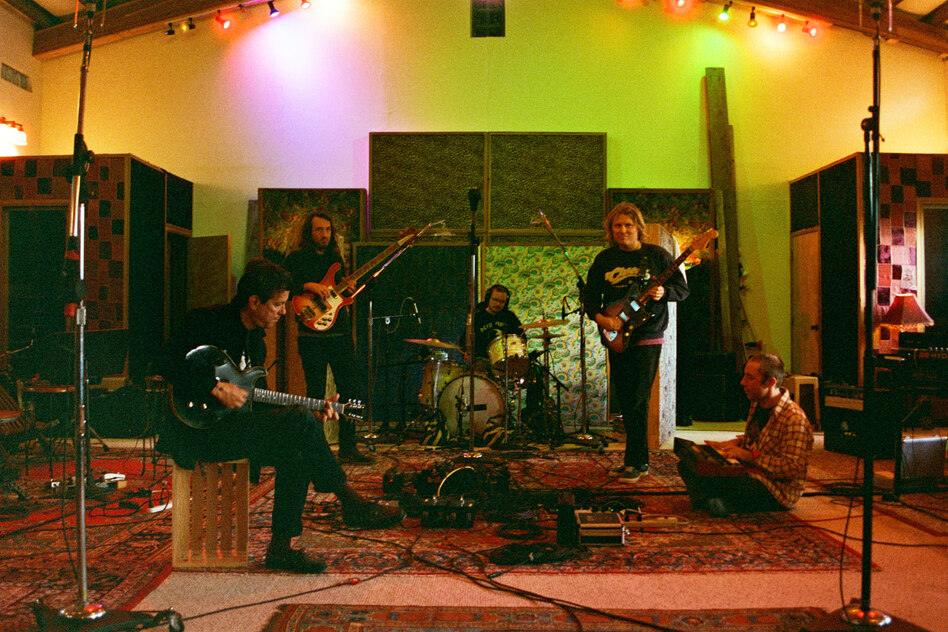
“Chrome” overcomes the first compositional hurdles in a jam session with drummer Evan Burrows, further sessions follow with wife Denée Segall and Matt Yoka, the songs are then finalized with artists who have worked alongside Segall for years and who have already provided a nuanced note in a wide variety of projects such as The Freedom Band, The C. I. A. and Reverse Shark Attack: Ben Boye (keyboard), Mikal Cronin (bass) and Emmett Kelly (guitar).
The nine tracks were created as a collaboration in a “humanoid rock'n'roll factory”, as praised by the US magazine Stereogum, and the subtle deviations in the otherwise straightforward Segall sound can be understood as marginal. "The intention is important, of course, but I tend not to worry about the original idea as long as the end result sounds cool. Sometimes a new idea, a new thought or a different intention arises in the middle of the creative process. But often I stick to strict guidelines - like the one that 'Chrome' should be a live album."
Ty Segall: “Chrome” (Drag City/Rough Trade); live: September 14th Berlin, Kreuzberg Festival Hall, September 15th Hamburg, Knust, 16.9. Cologne, building 9
It's almost a shame that the heavy and dense instrumentalization takes up the foreground, because the composition of his lyrics may seem like nonsense at first, but it's definitely worth a second reading. “Separation” is a garish interpretation of Sylvia Plath’s “The Bell Jar,” which is about an increasing sense of isolation that leads to depression.
“Living in a ball of glass / Looking through it, it’s not right / Get it away from me / Taking my everything / Touch it, feel it, in the outside.” The feeling of a suffocating emotional life is completely hermetically sealed in “Glas”: “You’re never leaving me / You’ll never fly away.”
“Chrome” is an album that escapes decomposition by adapting the environment of sincere music, the work ends with the title track and the lines “When I died / I was alive / I was alive / When I died”. Ty Segall knows what he's doing.
Read the full story at the source →
Source: taz