
World · taz · · 2h
US President Donald Trump in Ireland: “Trump is keeping our village alive”
Deutsch (original) · Auto-translated to English
Suddenly Tony points up: “Air Force One,” he calls, “doing a lap over the golf course before flying on to Shannon.” At the western Irish airport on Saturday afternoon, US President Donald Trump boarded his Marine One helicopter, which took him to the Trump International Golf Links in Doonbeg, where the Irish Open was taking place until Sunday.
“Trump is a blessing for Doonbeg and the whole area here on the West Coast,” says Tony, sitting on a stool outside Tubridy’s Bar, drinking a Guinness. He comes from the not-too-distant city of Galway and is on holiday in Doonbeg. "The golf course has prevented the economic decline that has plagued so many rural areas. I wanted to see how the place was preparing for the US President."
Doonbeg has around 270 residents. In the summer, when the holiday homes fill up, the number rises to 1,000. The village has been dressed up for the distinguished visit. The paint manufacturer Fleetwood donated paint to give the houses along the main street a new coat of paint. An excited report of a football game is playing on the local radio from the loudspeakers along the main street. And the golf tournament is shown live on a large screen in the parking lot of the community hall.
“You won’t hear a bad word about Trump from the locals,” says Maeve. She and her mother Suzie have made themselves comfortable on the low wall in front of their house and are watching the hustle and bustle on the street where police officers are checking the cars. “We have four pubs, two restaurants and a number of guesthouses in Doonbeg,” says Maeve. “Without Trump none of this would exist.”
Around 340 full- or part-time employees are employed at the golf resort. Joe Russell, the managing director, estimates that the resort contributes around €11 million annually to the local economy through direct labor costs, suppliers and services. “If a factory with more than 300 employees were to close, it would make the headlines,” says Suzie. "Trump is our factory. He is the largest employer around. We don't agree with everything he does in the world, but he keeps our village alive."
The close relationship between Doonbeg and the golf course began long before Trump. The facility was designed by locals. They purchased a 1,600-square-meter strip of sand dune shoreline about four miles outside the village and set about building a golf course to attract wealthy Americans. The golf course opened in 2002, followed by the opening of the clubhouse in 2006. Locals paid affordable membership fees, while foreign members were supposed to bring the necessary money into the coffers. But the plant ran into financial difficulties, leading to internal disputes that ended in court in 2013 and ultimately led to the sale of the company.
Trump purchased the property in 2014 for €15 million, a bargain price, adding it to the 15 golf resorts he owned at the time. His arrival caused great relief in Doonbeg. At that time, almost 250 people worked at the golf resort during peak season. Trump promised to invest money in the golf course and he kept his word. At the time, it was not foreseeable that the new owner would soon be the most powerful man in the world.
The outrage over Trump and his resort only arose during his first presidential campaign ten years ago. It came from outside and has since increased in proportion to his repulsive behavior. This is nothing new for the villagers. They have been living with the collateral damage to their reputation for a decade. In the public eye, Doonbeg has sold his soul.
However, there are no signs that Trump's behavior in office is hurting business. So far this year, Doonbeg has gained more than 40 new members, bringing the total to 1,300. About half of them do not live in Ireland. The admission fee for members from abroad is $30,000. But in the last year and a half, the square has been vandalized twice by pro-Palestinian demonstrators. Last June, Sean Corcoran, an environmental artist, and two friends carved the 106-meter-wide message “Free Palestine” into Doughmore Beach, right next to the golf course.
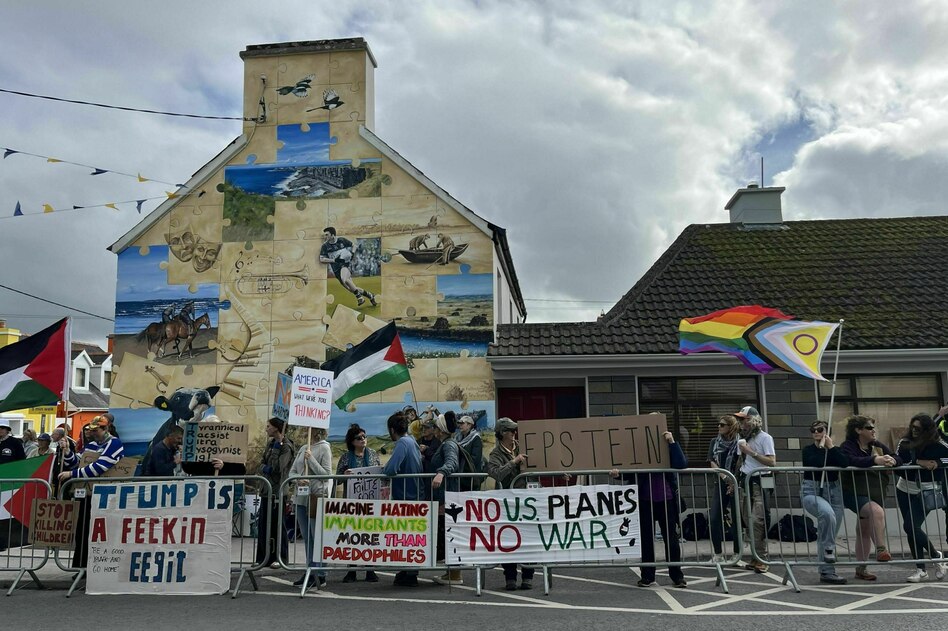
Protests against Trump were limited over the weekend. Around 25 people with anti-Trump posters have gathered in front of the corner house, whose gable wall has been decorated with a painting by the German artist Marcus Vallböhmer, who has been living in Doonbeg since 2023, telling the history of the place in the form of puzzle pieces. “Trump may be good for the village, but he is not good for the world,” said a young woman who did not want to reveal her name. "Why did they give him the Irish Open so he can make even more money? Why are our politicians so submissive? They are afraid of his whims."
This fear is entirely justified. It is in Ireland's economic interest to keep Trump happy, as the country depends on tax revenue from US multinationals. In the 40 years between 1982 and 2022, export sales of U.S. companies based in Ireland increased from $2.8 billion to $443 billion. U.S. corporate assets in Ireland are more than double those in China and South Korea combined.
Conversely, four cents of every dollar that the US federal government borrows from other countries comes from little Ireland. As of November last year, Irish companies - investment funds, pension funds, insurance companies, corporations - held $340 billion worth of US government bonds. Germany holds $110 billion.
The political part of Trump's visit passed without major incidents, which is not always guaranteed when meeting the unpredictable US president. Sure, thousands demonstrated in Dublin and Shannon - for Palestine, against the Iran War, against pedophilia, racism, misogyny, transphobia, corruption, climate destruction and against the use of Shannon Airport for the US military on the way to the Middle East. There are many issues that Trump is responsible for.
He himself said he didn't see any demonstrations at all. As well as? He was driven from Dublin Airport directly along closed roads to Phoenix Park, the largest city park in Europe. There is not only Farmleigh House, where the Irish government receives its guests, but also the residence of the Irish President and the US Ambassador. This meant that Trump was able to quickly get through the political part of his visit before continuing on to the golf tournament.
Socialist feminist President Catherine Connolly stressed in a carefully worded statement that she had expressed to Trump "the firm position of the Irish people that the normalization of war and genocide will never be accepted." The meeting lasted barely a quarter of an hour. It was a little longer at Farmleigh House and things got uncomfortable for Irish Prime Minister Micheál Martin.
When asked by a journalist how he felt about Irish unification, Trump replied: "I would love to see Ireland unified, that would be a really cool thing. It's going to happen anyway, so you might as well do it now." And Martin is “the right man to take things forward.” So far, however, he has shown little enthusiasm for this matter. Trump's 34-minute speech in the marquee of US Ambassador Edward Walsh's residence was the usual mix of humor, boasting, self-deception and outright lies. He gave the Irish a kind of praise: "I'll tell you what: you're some of the cruelest bastards, but if you want to be nice, there's no one nicer."
Everyone got what they wanted on this visit. The Irish Prime Minister and his government maintained friendly relations with the Trump administration - which, according to Trump, "have never been better than they are now." President Connolly was able to present her views on peace. And Trump was able to promote his resort, watch some golf and present the winner's trophy to Irishman Shane Lowry.
Read the full story at the source →
Source: taz