
Germany taz
Environmental Destruction in Argentina: The Sand, the Gas and the Corruption
Fracking is booming in Argentina, also because of the high demand from Germany. An entire ecosystem is devastated. An attempt at resistance. more...
Deutsch (original) ·Auto-translated to English
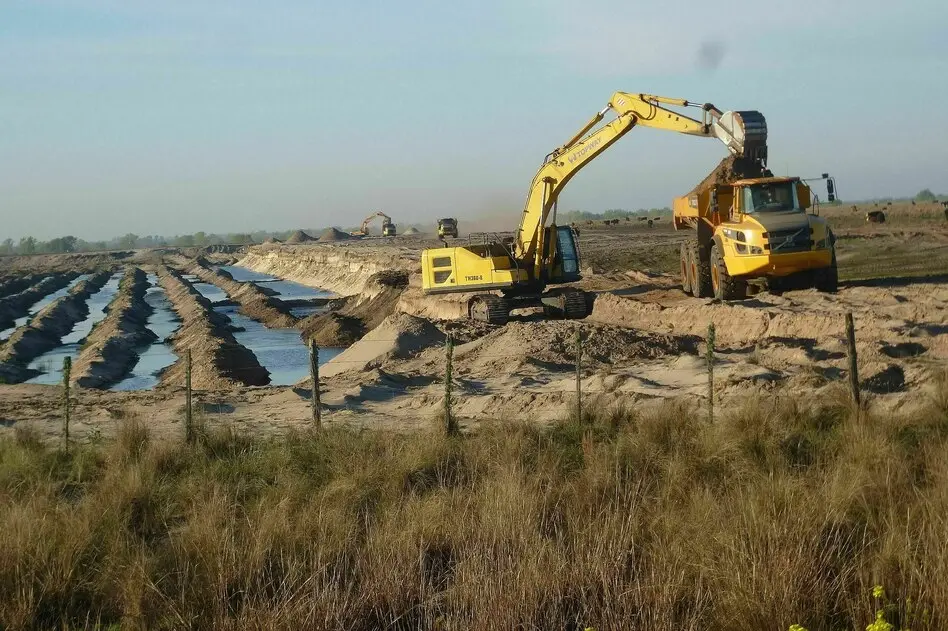
What remains when the excavators leave Entre Ríos are deep pits. Carlos Cadoppi stops his pickup truck on the side of the RP45 provincial road. They are up to eight meters deep. “Only three are allowed,” he says. The trained agronomist points through the open side window to the fields on the right and left. Brown and black cattle graze on some of them. In one, a yellow backhoe shovels through the soil and loads it onto a transporter. The next one is slowly approaching. As soon as the transporters are full, they drive to a washing plant where quartz sand is washed out of the soil mix.
Cadoppi continues to Ibicuy. The small town in Argentina's Entre Ríos province is literally built on sand. The Guaraní called the region “Yvyku'i”. The indigenous word means “ground earth” or simply sand. “Sand has always been mined here,” says Cadoppi. For a long time this happened on a manageable scale, especially for the production of glass and ceramics.
But since fracking has been booming in Vaca Muerta, in Patagonia, around 1,300 kilometers away, sand mining in the region around Ibicuy has also been booming. Vaca Muerta is a 36,000 square kilometer geological shale formation in Patagonia that lies at a depth of around 3,000 meters. Fracking is a hydraulic process for extracting oil and gas from shale rock. Cracks are created in the rock and a mixture of water, chemicals and sand is injected into them under high pressure to keep them open.
This article was made possible through the financial support of the Forschungsfonds Ausland e. V. You can support the research fund through a donation or membership.
Between 6,000 and 15,000 tons of sand are required for one drilling process. Sand grains that are small, firm and round are particularly suitable. Small so they can easily penetrate the broken rock. Firm so that the rock doesn't crush them. Round so that oil and gas can flow through the spaces between the grains and be pumped upwards. All of this is quartz sand. And the best quartz sand is in and around Ibicuy.
From 2027, two million tons of liquid gas from Vaca Muerta are to be delivered to Germany every year. The corresponding contract has been signed and is being euphorically celebrated by the industry as a showcase project. The fact that – in addition to the many environmental risks associated with fracking – a rare ecosystem is also being devastated has so far received no public attention.
The area around Ibicuy is a mosaic part of the Paraná Delta. 4,500 years ago the sea penetrated there, far inland. Everything that was above sea level at the time were islands with sandy beaches. "As the sea retreated, the river advanced. Together they created different environmental conditions that determine the ecological diversity of the delta today," says Rubén Quintano. He is a biologist and president of Fundación Humedales, the Argentine partner of Wetlands International. Around Ibicuy, “a unique dune landscape emerged in the middle of a wetland, with characteristics that made you feel like you were by the sea,” he says.
Today there is hardly anything left of it. "Sand mining is an irreversible process. Once mined, the landscape will never be the same again." Science calls such a landscape a relict landscape, which, once destroyed, cannot be restored. “The former dune landscape is becoming a mining landscape,” says Quintano.
Agronomist Carlos Cadoppi has been fighting against sand mining since 2017. At that time, a sandworks had washed the sand in a stream that bordered his fields, thus blocking the inflow. "The stream was blocked and dried up. And then they started taking water from the groundwater. The same water that is used as drinking water," complains Cadoppi. It was not possible to communicate with the company.
Cadoppi not only filed a lawsuit, but also recognized the negative consequences of the sand boom. Hardly anyone else resists this. Corruption and the friendly economy are topics in Entre Ríos that are usually only discussed behind closed doors. But in Ricardo Luciano he found a comrade-in-arms. “The topic immediately grabbed me,” says the lawyer. “Here, an entire ecosystem is being transported away on trucks under questionable conditions.” In this way, taxes are evaded on a large scale.
Each sand factory must submit an affidavit stating the amount of sand loaded by the 10th of each month. A tax will be charged on the specified quantity. The Entre Ríos tax authority and the Mining Secretariat declared at the end of 2025 that they had collected the equivalent of around 18.3 million euros for the stated 1.5 million tons of sand. But if you add up how much sand from the region has officially arrived in Vaca Muerta, you get “a delivery volume of 4 million tons,” he says. Around 25 million euros more in taxes would have had to be paid. Together with Cadoppi, he filed a criminal complaint for tax evasion.
Nobody knows how much sand actually leaves Ibicuy. There are no official scales anywhere where the loading weight of the trucks could be measured and documented. Estimates of how many trucks commute between the fracking area in Patagonia and the 12 sand mining companies near Ibicuy also vary.
There is talk of at least 400 to 1,500 trucks every day. Every truck must carry a freight consignment note. But it is applied for and issued digitally. If it is not checked along the way, there is no evidence that it was actually used for the respective load. The note can then be reused for the next load.
On the site of the “El Mangrullo” sand pit, the conveyor belts rattle incessantly. There's a roar from the sand washing plant. 24 hours a day, floodlit at night, seven days a week. The state oil and gas company YPF is fracking on a large scale in Vaca Muerta and operates the largest sand works in the region. Natalia Mosquera waits in front of the entrance with her truck. Four to six hours pass by waiting and loading, she says. The queue is around 30 trucks long. It rarely gets shorter. “If you’re full, you go, if you come empty, you get in line.” The journey to Patagonia takes around 24 hours, including breaks. She goes on this tour several times a week. The condition of the roads is a nightmare. It is actually never checked.
Carlos Cadoppi already criticized the lack of controls in an open letter to the region's governor, Rogelio Frigerio, to whom he is ironically related: "It is obvious that the officials of your government have not fulfilled their specific control tasks. One cannot help but assume that corruption is rampant in our country." Nothing has changed in the situation. Calls for the establishment of public truck scales have also so far failed to materialize.
Attorney Luciano talks about another court case he initiated. “The provincial water law requires any company that uses large amounts of groundwater to conduct hydrogeological surveys.” The aim is to determine the relationship between water requirements and delivery capacities. Because these investigations were not carried out, he sued for enforcement. And won. But although the provincial Supreme Court upheld the sentence in September 2022, it “has not been enforced to this day,” he says.
The water tower towers over the crouched houses in Ibicuy - a large tank on stilts and the widely visible landmark of the town's drinking water cooperative. It has existed for over 50 years and supplies the city's more than 2,000 households. The water comes from three wells 55 meters deep. “Depending on the season, the daily requirement fluctuates between 900,000 and 1.3 million liters,” says Félix Echenique, president of the cooperative.
This text first appeared in wochentaz, our weekly newspaper from the left!
Every week, wochentaz is about the world as it is – and as it could be. A left-wing weekly newspaper with a voice, attitude and the special taz view of the world. New every Saturday at the kiosk and of course by subscription.
You won't find the typical drinking water treatment basins here. “Our water was so pure that all it required was sand filtration, the addition of chlorine, and then up into the tower,” he says. That is the past. Since intensive sand mining began, iron and manganese levels have increased significantly. "Historically, the iron and manganese content in raw water was 0.12 milligrams per liter. Today the values are 1.20 milligrams per liter," he says.
An increased iron content affects the taste and clouds the water. Elevated manganese levels, on the other hand, can affect the nervous system. In order to reduce the burden, the cooperative had to invest in modern filter systems. So far, these have been sufficient, says Echenique. But while they previously had to clean the filters about once a week, today this is necessary almost every day. The mass that wobbles in the tub next to the filter system is brown-black.
The sand works' pumps are monstrous. The sand works used as much water in one hour as households in Ibicuy use in a day. And because there are more and more of them, the underground flow speed increases, which means that the water dissolves more substances such as iron and manganese from the rock. Instead of groundwater, the mining companies should use water from the river, he demands. “The river is a thousand meters wide and at least thirty meters deep.” After washing the sand, the water used could first be cleaned in collecting basins.
In his office, Echenique points to an old photo on the wall. “As kids, we used to run up and down the dunes to get to the river.” The dunes disappeared before the boom, but over a period of 50 years. "Today they say there is still sand for 100 years. They want to mine it in 10 years."
When that happens, companies leave with their profits while local people have to pay for the ecological consequences. The prospects are as bleak as the iron-rich water that is already coming out of the wells. Agronomist Carlos Cadoppi simply calls what is happening for the fracking boom in Vaca Muerta in Ibicuy “an ecocide.”