
Germany taz
Ulm 5 process: behind glass, without a pen
The Stuttgart regional court has been negotiating against “Ulm 5” for six months. An end is not in sight until February. more...
Deutsch (original) ·Auto-translated to English
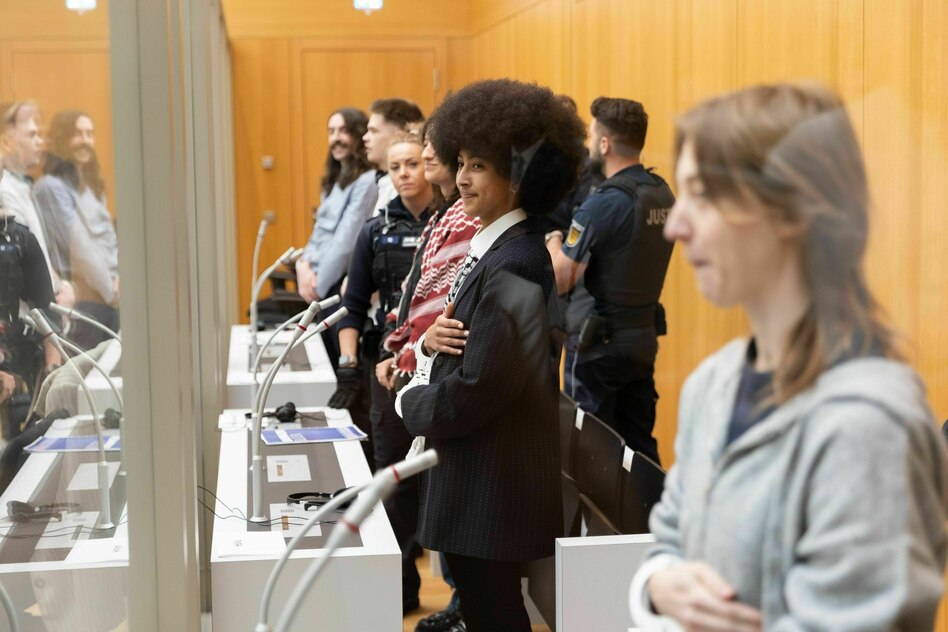
The 27th day of the trial begins with a joke: “Should I formulate it myself this time?” asks the presiding judge Kathrin Lauchstädt, because the defense has not agreed on who will make the applications today. Since the end of April, five activists who are accused of sabotaging the Ulm branch of the Israeli arms company Elbit Systems have had to answer before the Stuttgart regional court. It is also being examined whether “Palestine Action Germany” is a criminal organization. Negotiations will take place in the high-security building in Stuttgart-Stammheim.
At the beginning of each day of the trial, the defense makes the same motions - which are rejected each time with the same wording, namely with the note that "reference is made in full to the statements made so far".
The audience is not permitted to take notes because the chamber considers carrying pens to be a security risk. Even specially developed pens that buckle under pressure cannot address the court's concerns. A verbatim protocol will not be prepared. In addition, the defendants sit behind a glass pane in the Stammheim hearing room, separated from their lawyers, and are presented in handcuffs. The defense's ritualized motions, day after day, aim to change that.
The controversial seating arrangement was even discussed in the EU Parliament, where defender Anna Busl spoke in October at the invitation of Irish MPs. EU Justice Commissioner Michael McGrath had already commented on the case in September. In his answer, he emphasized that the implementation of constitutional procedures is the responsibility of the Member States. However, he expressly points out that suspected or accused persons may not be “presented as guilty” through physical restraint in the courtroom or in public. Exceptions can only be justified by case-specific reasons, such as serious safety concerns.
However, the district court does not justify handcuffs and glass as an acute threat. Judge Lauchstädt explained that it is due to the available space; there is no other hearing room that is large enough for everyone involved in the proceedings, including the eleven lawyers and the five defendants. However, the defense asked the president of the regional court. According to his information, there are six halls that are large enough. Not all of them are in the Stammheim high-security building.
In this respect, every day of the hearing reference is made to a questionable justification. The court also refuses to allow the defense to have its own record because there is no corresponding claim. When the defense demands that a detail be included in the court minutes, the presiding judge explains: “I decide what goes into the minutes.”
The dispute over these questions took up entire days of negotiations at the beginning of the proceedings. It has now become routine and has shrunk to just a few minutes. But despite this time saving, the process is progressing slowly. The verdict was originally scheduled for July. Further days of negotiations are now scheduled until the end of February 2027.
So far, it has mainly been police officers who have been questioned as witnesses. The course of events has been undisputed since the start of the proceedings: there are videos of all five defendants confessing their crimes, and they did not deny the crime in their opening statements.
The most recent days of the hearing dealt with the question of whether the court wanted to hear defense experts. So far it has rejected all of them and has not yet heard from any of the witnesses named by the defense. The court said that whether Elbit's military equipment enabled a violation of international law in Gaza to be "legally irrelevant" when determining the sentence.
The 27th day of the trial was devoted almost exclusively to one event: the accused V. K. was transferred from the Schwäbisch Gmünd JVA to the Stammheim JVA without her lawyers finding out about it. Judge Lauchstädt had approved the transfer with a handwritten note. However, this was not yet in the files for the continuation of the process.
While the court denied there was an “outstanding public interest” in the proceedings, around 1,000 people demonstrated on Stuttgart's Schlossplatz last weekend for the defendants' release. The five have now been in custody for almost 14 months. Seven members of the Bundestag from the Left have announced that they will be observing the trial on the next day of the hearing on Friday.