
Housing taz
Dead homeless people in Hamburg: The red-green Senate will filter the numbers in the future
In the future, Hamburg will only count dead homeless people in public spaces. People who die in clinics or aid facilities are excluded from the statistics. more...
Deutsch (original) ·Auto-translated to English
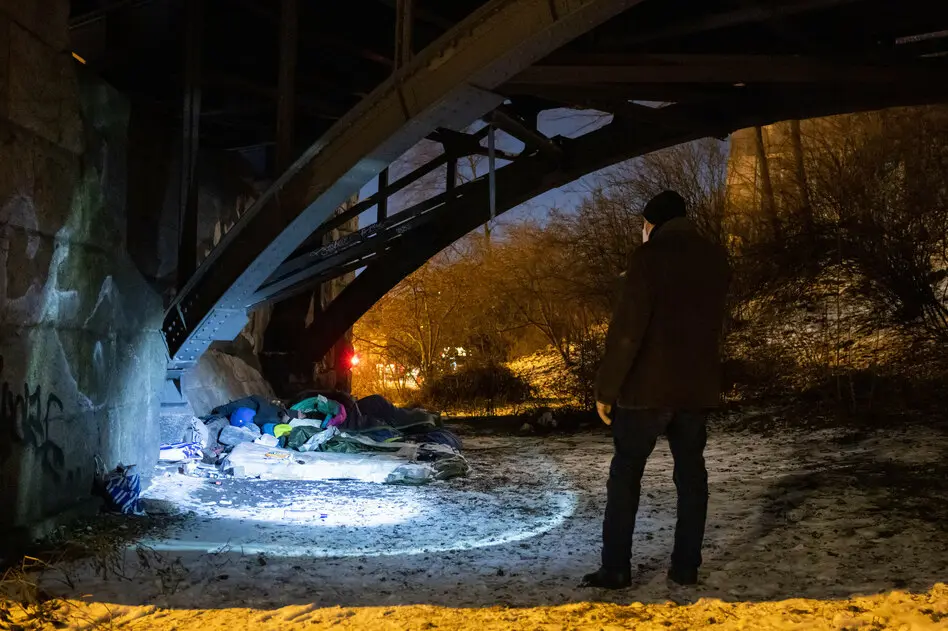
Hamburg's Social Senator Melanie Schlotzhauer (SPD) got into a lot of trouble for the stricter rules in the winter emergency program. Because in future everyone seeking help there will have to reveal their identity after the third night, even the Jusos and some Greens fear that homeless people will be deterred and that there will be more deaths. But in the future, corresponding figures will only be published by the Social Senator.
Schlotzhauer presented this as an improvement in the NDR “Hamburg Journal”. “We have reliable figures for the first time,” she said. The previous figures were drawn from different sources. But they were above all politically explosive numbers.
According to the police and public prosecutor's office in Hamburg, 15 people without a permanent address died in the period from January 1st to 23rd alone. And that put a lot of pressure on the senator responsible for the winter emergency program. Even when temperatures were below zero, people had to go out into the cold during the day. And 117 EU foreigners without any entitlement to social benefits were referred to a “warming room” without beds.
When the winter was over, Schlotzhauer announced to the Social Committee that there would be “standardized reporting”. Only your authority can provide information. This new survey can now be found on their homepage and will be updated monthly throughout the winter. But it is a filtered counting method. Of the 15 deaths from January, four died in a hospital and four in an emergency shelter. According to the new “definition”, they no longer count.
Social authority spokesman Wolfgang Arnhold said that only those dead who were found in public spaces without a fixed address and who were transferred to forensic medicine by the public prosecutor's office are now regularly recorded. The aim is to determine how many of them had not taken advantage of accommodation in the assistance system and were therefore exposed to the risks of the street. “This explicitly does not involve a complete recording of all deaths of homeless people,” writes Arnhold.
There is criticism of this counting method, for example from Jörn Sturm, the managing director of the magazine Hinz&Kunzt. It cannot be the case that someone who is picked up by an ambulance when they are terminally ill and then dies in the hospital is not counted as a deceased homeless person, he told NDR.
Confronted with this criticism in the "Hamburg Journal", Senator Schlotzhauer said: "That's the way it is. These are the new statistics proposed by the Institute for Forensic Medicine." But of course there will continue to be written questions from MPs. Hospital numbers would then also be published if they recorded them.
Left-wing MP Olga Fritzsche says: "I think this new counting method is nonsense. I don't see any improvement here." But she will take the senator at her word and ask for these numbers again. For example, in May 2022, the former Left MP Stephanie Rose asked the Hamburg Senate how many people without a permanent address died in Hamburg's hospitals in the winter of 2021 and received the precise answer that they statically recorded 11 such deaths.
In October, the CDU social politician Andreas Grutzeck asked the same question for the year 2026 so far. But this time the Senate is stubborn. In response, he only gives the small numbers collected according to his new definition and leaves out those who died in clinics.
When asked whether this answer will now become common practice, Arnhold explains: “It cannot be predicted across the board.” There is no complete data base for such deaths in hospitals because hospitals are not obliged to do so.
But the press offices of other authorities now also strictly refer the issue of dead homeless people to the social authorities. So it will be difficult to get anything other than their numbers. Andreas Grutzeck is not satisfied with the answer. “Given the fact that the authorities say we can make inquiries, that’s a mockery,” he says. “It is up to the social welfare authorities to obtain these figures through the Institute of Forensic Medicine and release them.”
Olga Fritzsche also says she does not understand why the Senate no longer wants to provide the previously published data.
Your left-wing faction wants to request at the next town hall meeting that the obligation to give names and seek advice after three days be lifted. She finds support from the Jusos. “If the social authority attaches basic frostbite protection to conditions such as mandatory social counseling, then it endangers human lives,” warns its chairwoman Janne Roehsler.
Kathrin Warnecke, a Green parliamentary representative, even spoke out against compulsory counseling. People could avoid the winter emergency program out of fear, she said on Instagram.
The authority that came under criticism announced on Thursday that there had already been a referral from the winter emergency program to the warming room if there was no cooperation. The employees would continue to take the situation of those affected into account in the future. People who first need to gain trust can be given more time. Referrals are made “not automatically, but after consideration in each individual case,” writes spokesman Arnhold. “Protection from the cold is guaranteed.”