
Germany taz
Death of Lisa T.: The feed is full and the mind is empty
The case of the dead girl Lisa T. shocks the country - and goes viral. What does it do to young people when they consume such content? more...
Deutsch (original) ·Auto-translated to English
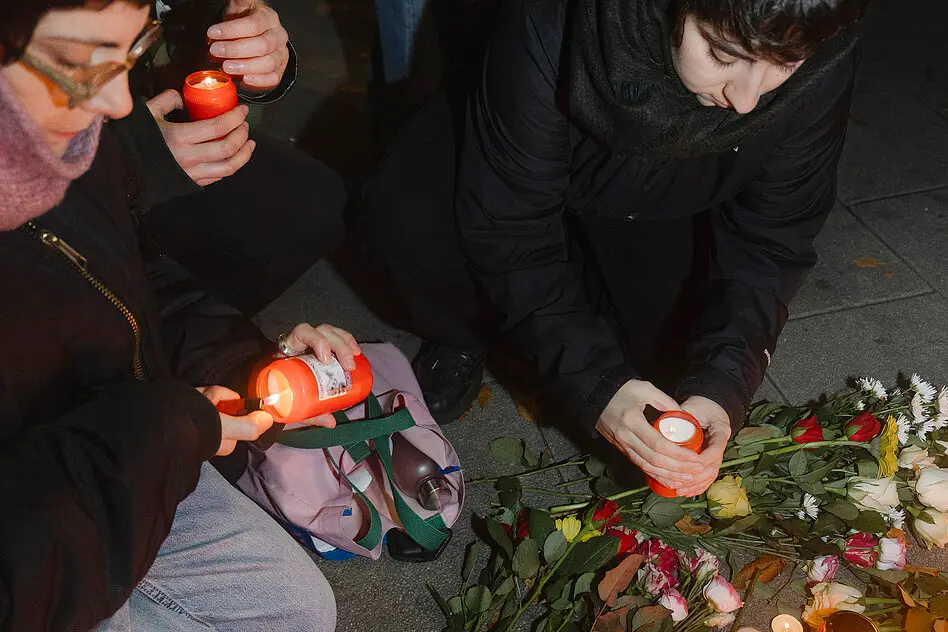
Minutes before the actual minute of silence, people are silent. It's Tuesday evening, dark and cold. A few dozen heavily bundled figures crowd around a public water dispenser on the forecourt of Berlin's Lichtenberg S-Bahn station. They light candles and place them next to the framed photo leaning against the dispenser. They lay roses, silently, in memory of the girl in the photo.
The girl's name is Lisa. Her disappearance and later death have filled newscasts, feeds and timelines over the past week and a half. Lisa, 13 years old, left the house in Berlin-Marzahn on Tuesday, November 3rd, around 7:15 a.m. to go to school. But she never got there. The missing person report went viral. A large-scale search was unsuccessful. Five days later she was found: dead, in an uninhabited single-family home in Brandenburg. Next to her was a 22-year-old man with serious gunshot wounds.
From here something starts to happen. An avalanche of reporting. On television, on news sites - and especially on social media: Instagram, YouTube, Tiktok. Every new movement in the case, every detail, every rumor is posted and reposted in a new post. That the suspect had previously been investigated on suspicion of purchasing and possessing child pornographic content, that on the day of her disappearance, a car was said to have been parked in front of the family home in Brandenburg for hours with its hazard lights on, that neighbors had heard cries for help, but no one did anything.
This text first appeared in wochentaz, our weekly newspaper from the left!
Every week, wochentaz is about the world as it is – and as it could be. A left-wing weekly newspaper with a voice, attitude and the special taz view of the world. New every Saturday at the kiosk and of course by subscription.
The flow of content does not stop, the case is translated into a general threat narrative: an influencer posts a warning about an alleged “pedophile rampage”. Momfluencers are alarmed, warning the parent bubble in Reels not to let their children out of their sight.
What explains the enormous attention – and how does it affect our perception of violence? And what does it do to young people when a crime not only appears in the news, but is repeatedly re-staged, emotionalized, commented on and sometimes speculatively embellished in thousands of reels and clips?
On Wednesday morning, high fog hangs over the city and envelopes the upper floors of Berlin's rows of houses. The taz speaks to two students who are currently on their way to school. Have you heard from Lisa T., the missing girl? Yes, a friend had sent them a post on Tiktok. What did her Tiktok feed look like in the days following the news of her death? Everything is full of Lisa. One student says that at times it became too much for her and she put her cell phone away. For example, when a video showed an alleged phantom image and an alleged photo of the alleged perpetrator.
A look at Tiktok shows how quickly the trap door to the rabbit hole opens. Anyone who finishes watching a clip about Lisa's case will immediately see the next one. Search suggestions lead to additional video collections. Many contributions are accompanied by dramatic music, the cuts are quick, the commenting voices are excited. The boundaries between news, commentary and entertainment are blurred here. An Ofcom study observed that children viewed news content from Tiktok creators as credible, sometimes without checking. The German #UseTheNews study also found that many young people lack knowledge about how professional journalism works.
At the beginning of the avalanche, however, there was a message. It was picked up by media companies, reporters were sent out, and a video journalist accompanied the police search operation live. The case is attracting attention nationwide and on all channels. At the same time, two suspected femicides have been committed since Lisa's disappearance, in Hamburg and Baden-Württemberg. There has so far been no media response of this magnitude. Why is that?
A call to media researcher Thomas Hestermann from Macromedia University. He has been studying how the media reports on violent crime for 20 years. His findings: Homicides dominate, the victim side speaks out more often than the suspect, and child victims are greatly overrepresented. Since the 2000s, the fight for circulation, ratings and clicks has become tougher. This leads to greater emotionalization. This creates a certain view of victims of violence, says Hestermann. “The focus is on an idealized victim who is worthy of a society’s sympathy.” In the US discourse there is talk of the “worthy victim”: This victim is female, young, most likely a child. The more innocent, the better. Like Lisa.
Together with the pressure of the attention economy, Hestermann sees this as a problem: if the media relies primarily on strong emotions and clicks, the journalistic classification risks being lost. The idealization of individual victims as particularly “valuable” can also create a distorted, unambiguous image of violence - here the perpetrator, there the victim, black and white. Editors should pay particular attention to this.
On Tiktok, content creators generally do not work with editorial teams that set journalistic and ethical standards for them. They sit alone at home with their cell phones and film themselves or edit video snippets that they find on the Internet. It is emotionalized and staged in a continuous loop.
The two students talk about their fears on their way to school. Yes, she has gotten stronger since the incident with Lisa. They are happy that they always go to school together and then go home together afterwards. Her mother, one says, gave her a key fob in case of an emergency a few days ago. She pulls her key out of her jacket pocket; a black plastic part dangles from it with a short cord hanging from it. If she pulls on it, an alarm will go off.
The fear has become real, although statistically it is extremely unlikely that a kidnapping like Lisa's would happen again in such a short time. Although, on the other hand, it is much more likely that the daughter will be hit by a car on the way to the bus stop. What role does social media play in causing anxiety?
A call to André Ilcin. He is a clinical psychologist and works with children and young people in Berlin. The extent to which violent videos are harmful also depends on how often young people are exposed to them. Repeated confrontation can increase the feeling of being at the mercy of violence and losing control. “If this is repeated over days, the environment can eventually be perceived as unpredictable and dangerous.” Another reaction is to become numb to violence.
A vicious circle could also arise, says Ilcin: “I’m afraid, but I still actively expose myself to what scares me.” By searching for more information, young people tried to reduce insecurity and regain a sense of control - and in the process they found themselves confronted with the same stressful content over and over again.
If you swipe through the clips of Lisa's murder on Tiktok, some videos and accounts particularly stand out. They are content creators, mostly young, who often speak into the camera. They superimpose their own image over excerpts from television reports or any other images. Their videos are tagged with hashtags like #truecrime or #crimetok. They report what they have learned from the media, sometimes citing the sources. They often raise questions, make assumptions and speculate. “It sounds like Lisa definitely lived a little longer,” says Sarah Kolumna in her video.
True crime formats are booming among children and young people. One of the schoolgirls also says she regularly listens to true crime podcasts to distract herself. In a small study with young people, the Voluntary Self-Control Television (FSF) examined what fascinates them about such formats and what frightens them. What is important is not only that the stories actually happened, but also their perceived relevance to reality. Real-life cases, such as those involving child victims, could be experienced particularly intensively.
But not everything is bad about it, says Claudia Mikat, managing director of the FSF and expert on youth media protection. True crime can educate young people about crimes and sharpen their knowledge of dangers. What is crucial is how drastically the crimes are depicted and how original material is used - for example whether victims can be identified. A classic crime drama, in which a case is solved at the end and justice is achieved, could also help young people.
While professional true crime productions are subject to editorial and legal standards, virtually anyone can distribute content about real crimes on Tiktok - without journalistic training, editorial control or consideration for the personal rights of those affected.
You can see the consequences of unregulation in the exploitation of Lisa's case in true crime videos: In most cases, her photo is not pixelated. The case cannot follow a crime dramaturgy for the time being, as the alleged perpetrator died in the intensive care unit and the investigation is likely to take months. However, a true crime content creator posted seven videos about Lisa's case in three days. The most clicked has 710 thousand views.
What to do? The expert Claudia Mikat appeals for more media education: "We should talk about the way media is made: What is a factual message and what is a designed, gimmicky representation? Children must learn to recognize this and also see through mechanisms of manipulation."
The memorial event for Lisa at the Lichtenberg S-Bahn station is over after two hours. The candles, the roses, a few made posters and the picture frame are left behind at the water dispenser. Three teenagers - two girls and a boy - walk past, stop and look down at Lisa's picture. Have you heard about the case? Yes, on Tiktok. How do you feel when you think about it? Sad, angry, empty? Empty. When asked if they also watched true crime formats, one of the girls nodded. And how does she find them? She laughs and says, “They’ll find me.”