
World taz
Play about Bataclan attack: horror out of the blue
Laurent Gaudé's play “Paris After” is about the attacks on the Bataclan. The German premiere in Göttingen makes the horror palpable. more...
Deutsch (original) ·Auto-translated to English
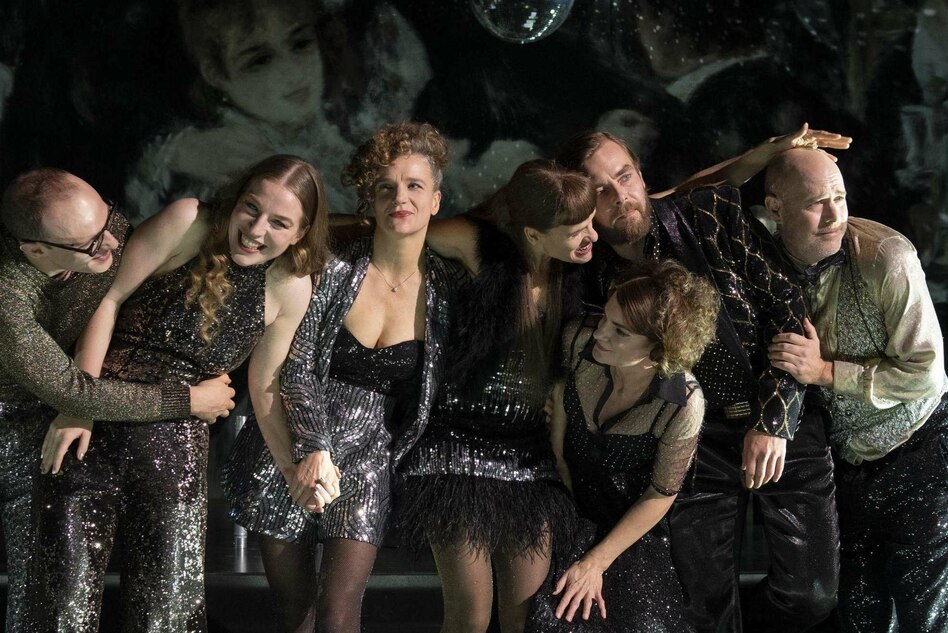
The costumes glitter in competition with the disco ball. Excited, carefree, almost cocky people throw themselves into Friday evening fun. In jittery, teen-like excitement, one woman longs for her first kiss with her new friend, another wants to forget the argument with her husband on a dance floor and twin sisters want to celebrate their 30th birthday. Friends meet friends, sing, drink, have fun with each other. There is a relaxed atmosphere of a sensual celebration of life enjoyed in an open, pluralistic way.
For the German-language premiere of Laurent Gaudé's "Paris Afterwards", the stage of the Deutsches Theater Göttingen is closed off at the back by the oversized projection of Pierre-Auguste Renoir's painting "Bal du moulin de la Galette" (1876). It shows a sun-drenched crowd dancing and having a happy get-together in a garden bar. Pure savoir vivre.
Two representations that some radicalized Muslims see as manifestations of what they hate so much that they counteract it with the barbarity of fanaticism. On November 13, 2015, IS supporters murdered more than 130 people in the café and restaurant streets of the 10th and 11th arrondissements in Paris and in the Bataclan concert hall. Hundreds were injured.
The international football match between France and Germany in the Stade de France was also attacked with explosives. Not a coincidence, not fate, but a coordinated act of Islamist terror, as they say on stage. It revealed the vulnerability of public security and society.
Laurent Gaudé summarized the events in his piece. He does not rely on the authenticity of statements made by those directly and indirectly affected: for his fictional documentary theater, the author researched the facts and came up with characters who put spotlights on typical behavior.
The actors switch quickly through various role sketches. As those who don't survive the evening, they describe the horror out of the blue, the inability to understand that they are dying. But the author allows them to reach out again from the afterlife with their last words of love. Despite all the tragic force, this is formulated in a sober, poetic style.
Appropriately, director Schirin Khodadadian illuminates the facets of disbelief with empathetic clarity. The murderous violence is only hinted at in the characters' reactions; the audience has to imagine the war-like events themselves. This only intensifies the horror. In addition, the color soon escapes from the Renoir painting and the contours become blurred.
A reference to the now growing fear among Parisians of constant threat with the consequences of a lasting disruption of the familiar present and the desolation of the attitude to life depicted. A migrant comments on the first TV images of the horror: “This sets us back ten years.” Multicultural coexistence is perdu.
The seven-member ensemble is a choir of introspective individual voices that only come together in song, but have to deal with the collective trauma as a community. Everyone takes a deep look into their emotional chaos. The perpetrators remain consistently faceless. In addition to victims, eyewitnesses, relatives of the dead and survivors also have their say with their pain, shame and sadness and the question of what meaning there is in escaping.
After the experiences of the attacks, everyone seems alienated from themselves. Even the so-called heroes. A 20-year-old firefighter, totally overwhelmed, holds the hand of a seriously injured woman who dies during his perseverance speech. Equally impressive is the inner conflict of a police officer who has to ignore the wounded people screaming for help because he has to storm the concert hall and shoot the perpetrators who are holed up with hostages. This will stay with him for the rest of his life.
“Paris After” by Laurent Gaudé, German by Margret Millischer, Deutsches Theater Göttingen, directed by Schirin Khodadadian, again on November 3rd, 14th, 20th and 27th as well as December 16th and 29th, each at 7:45 p.m
A similar situation occurs to a doctor who, with desperate professionalism, has to triage quickly in order to save as many lives as possible. Even the crime scene cleaner has to face the total confusion of the consequences of the massacre.
When the players can no longer bear the suffering, they sing songs that are joyful for life. Or indulge in vitally blazing flashbacks to life in Paris before the attacks with fog and glittering lights. Sometimes people quote calendar sayings out of sheer helplessness. And at the end we rave again about kissing and the happiness of being carefree. So that the audience is not paralyzed, but can at least leave the theater with a spark of hope.
This evening will probably leave no one cold. Precisely because it can also be understood as an example of the suddenness of death. Rarely does a dramatic concept work out as convincingly as it does in this production. Without any compromises: a great evening at the theater.