
Germany taz
Symbol of the anti-nuclear movement: always contested
The fact that Brokdorf is known nationwide is due to the nuclear power plant – and the controversy surrounding it. The first major demonstration took place there 50 years ago. more...
Deutsch (original) ·Auto-translated to English
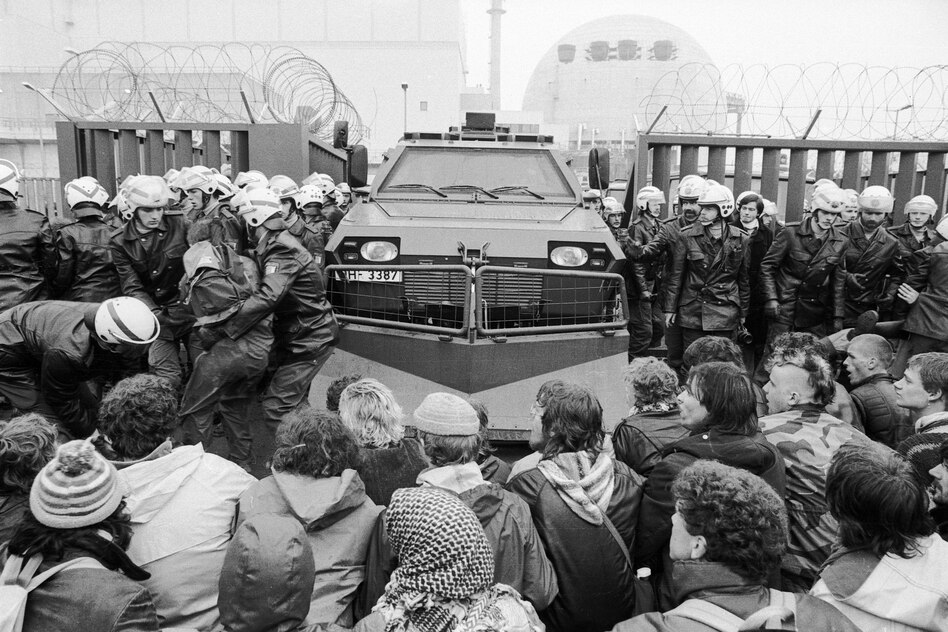
Where 50 years ago there was a construction site converted by the police into a fortress, complete with a moat and sharp-edged NATO wire fence, the now shut down Brokdorf nuclear power plant stands. It went offline forever on January 1, 2022, and dismantling has been underway for two years. So far this has mainly happened inside the power plant, so the visual changes to the outside facilities have been limited.
The reactor dome is light gray and, together with the approximately 150 meter high exhaust air chimney, it characterizes the silhouette. Next to it, all in white, is the massive engine house. A new addition is the so-called transport preparation hall - the interim storage facility in which the fuel elements removed from the reactor, packed in castors, are to be stored until a final storage facility is available for the highly radioactive waste. A fence runs around the 12 hectare company premises.
We came on foot. From Wewelsfleth, which is five kilometers away, across the Elbe dike. The same path as on October 31, 1976, when we were in Brokdorf for the first time.
Brokdorf is the most hotly contested and symbolic German nuclear power plant. On October 30, 1976, around 6,000 people demonstrated against the start of construction in a cloak-and-dagger campaign, and several hundred occupied the construction site. At dawn, police drove the occupiers from the square with dogs, clubs and tear gas. “The police acted with unbelievable brutality,” said the NDR news at the time. The demo was the first major protest against Brokdorf; it went down in the annals of the anti-nuclear protest as “Brokdorf 1”.
A day later, 4,000 people protested against the police attacks on the Elbe dike. We had seen the evacuation of the construction site on the TV news the evening before, had no idea about nuclear power and drove to Brokdorf out of curiosity. Many of those who were with us that day probably felt the same way.
Although the police closed off large areas of streets, two weeks later, on November 13th, 30,000 marched through Wilstermarsch to the construction site: “Brokdorf 2”. The attempt to re-occupy failed. Police and border guards defend the area, throwing tear gas canisters into the crowd from low-flying helicopters. Hundreds of people are injured.
While the first major anti-nuclear protests in Wyhl, Baden, had a strong regional focus and were primarily aimed at protecting one's own living environment, in Brokdorf the debate over nuclear power reached a more fundamental level: it developed into a rebellion against the capitalist system and against the “nuclear state”. Large parts of the urban and student movement in particular merge the ecological question with the system question.
This text first appeared in wochentaz, our weekly newspaper from the left!
Every week, wochentaz is about the world as it is – and as it could be. A left-wing weekly newspaper with a voice, attitude and the special taz view of the world. New every Saturday at the kiosk and of course by subscription.
At the end of 1976, the Schleswig Administrative Court ordered a construction freeze for Brokdorf; this was later confirmed by the Higher Administrative Court and lasted four years. “Judges’ rulings don’t make nuclear power plants safer,” counters the anti-nuclear movement. Despite unprecedented agitation and the conjuring up of a “Battle of Brokdorf” in the media - the Bild fantasizes about the death of demonstrators calculated by the “chaotics” for propaganda purposes - and despite a ban on gatherings, the largest demonstration against the nuclear power plant to date took place on February 19, 1977. 50,000 people move towards the construction site - and turn back after a rally at the first police barrier. The masses do not follow the Communist League of West Germany (KBW), which calls for the “razing of the fortress”.
In the fighting for Brokdorf, the then strong “K groups” discovered their love for the anti-nuclear movement. They see the new and growing initiatives emerging everywhere as an ideal propaganda and recruiting field. Some hard-core K-groupers, for example from the KBW or the “Group Z” splinter of the Communist League (KB), do not stay in the movement for long, but march straight on into the green and colorful lists that formed at the end of the 1970s - the forerunners of the Greens.
On February 28, 1981, 100,000 people protested in Wilstermarsch against the end of the construction freeze. A huge police force with helicopters and water cannons greets the demonstrators. Hours of clashes ensue, with numerous people injured and arrested.
A few days later, Stern published a photo: It shows three nuclear power opponents beating up a police officer who had fallen into the ditch. The public prosecutor's office investigates attempted murder, two men are arrested and sentenced to prison.
The legal dispute over the ban on demonstrations culminated in the Brokdorf decision of the Federal Constitutional Court in May 1985. In its ruling, the court made far-reaching statements about the importance of freedom of assembly, it developed terms such as urgent assembly and spontaneous assembly and expressly emphasized that bureaucracy and protest do not mix well and that it “has always been considered a sign of the freedom, independence and maturity of self-confident citizens to gather with others unhindered and without special permission”.
Tens of thousands made their way to Brokdorf again on June 7, 1986. Just a week before, reactor number 4 exploded in the Ukrainian Chernobyl nuclear power plant, and a radioactive cloud spread across half of Europe. The demonstration is broken up by the police. The Hamburg convoy - eight kilometers long, more than 10,000 people - was attacked by the officers on the way out. They break the windows of more than a hundred vehicles, slash the tires, break open the trunks or push the cars completely into the ditch. Many photos show that the street near Kleve resembled a scrapyard back then.
On October 7, 1986, the Brokdorf nuclear power plant finally went into operation, the first in Europe since Chernobyl. Brokdorf of all places!
It is, at least perceived, one of the worst defeats of the anti-nuclear movement. Some activists resign, come to terms with the power plant, turn to other political issues or withdraw into their private lives.
Others, like meteorologist Karsten Hinrichsen, continue to resist. The now 83-year-old had already joined the group of plaintiffs as scientific advisor that forced the four-year construction halt in court in 1976. Hinrichsen, who lives in the village of Brokdorf in a pretty little house right on the dike, sued himself after it was put into operation, went through all the courts - and after 13 years finally lost at the Schleswig Higher Administrative Court.
Nevertheless, Hinrichsen continued. He organizes vigils and, after the Fukushima nuclear disaster in Japan in 2011, he co-founded the “Brokdorf Akut” action group. This will organize vigils and rallies until the nuclear power plant is finally shut down at the end of 2021. In September 2025, Hinrichsen handed over several boxes with leaflets, protocols and other documents from the decades-long history of protests to the “German Atomic Heritage Archive” in Braunschweig.
When we got back to Wewelsfleth, it was dark. Only in the northwest, where the nuclear power plant is illuminated by floodlights, does it still shine behind the dike. The nuclear power plant remains shut down forever, but the story isn't over yet. Conflicts arise primarily over the whereabouts of hundreds of tons of construction rubble and residues, which are considered to be uncontaminated or only slightly contaminated and end up in landfills after so-called clearance measurements. Because no landfill wanted to accept the scrap voluntarily, the state of Schleswig-Holstein allocated the material from Brokdorf to a dump near Harrislee near the Danish border.
The operator PreussenElektra is planning to build Europe's largest battery storage facility for wind power on the nuclear power plant's premises. It is intended to temporarily store excess wind energy in order to stabilize the power grid during periods of calm or overload and to prevent wind turbines from being switched off.