
Germany taz
Job cuts at Tamedia: Man-made journalism in crisis
The Swiss media group Tamedia is laying off scores of journalists and is relying more and more on AI. This is criticized internally and externally. more...
Deutsch (original) ·Auto-translated to English
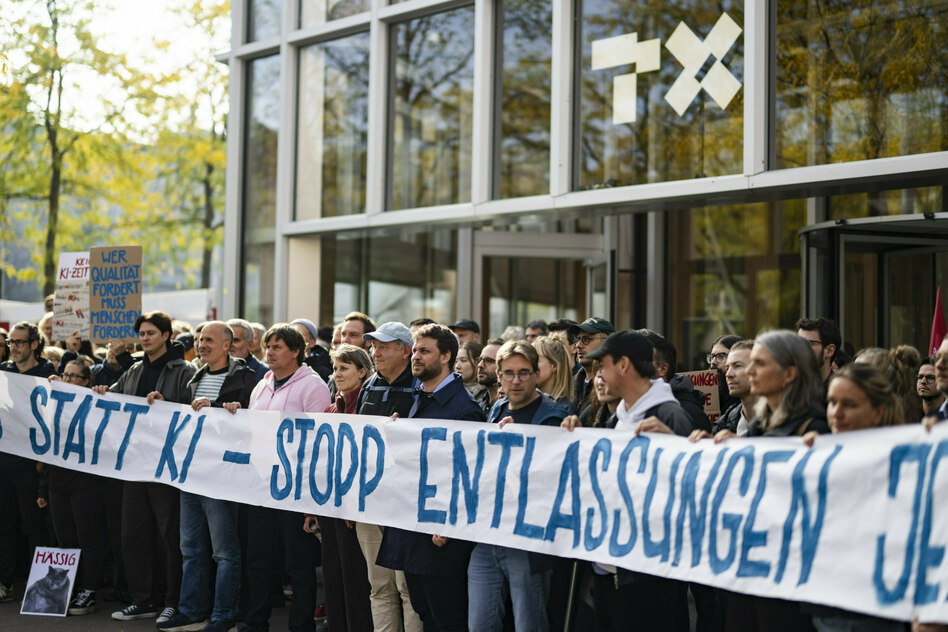
Nora Zukker, culture and literature editor of the Zurich daily newspaper Tages-Anzeiger and award-winning cultural journalist, is currently on unpaid leave. She was scheduled to return to her position in January 2027. Last Tuesday she took part in a protest against her employer: The reason is a recently announced job cut at the Tamedia publishing house, which includes the Tages-Anzeiger and the Basler Zeitung.
The reduction includes 41 editorial positions throughout the group. Tamedia employs around 1,300 people across all trades throughout Switzerland. Protest and indignation are also great among Zukker and her colleagues “because we lack a vision, an idea for the journalism of the future,” Zukker quotes one of her colleagues. This is already the seventh round of dismantling within six years. Most recently, a layoff ban for journalists was agreed until the end of September 2026. The new terminations were issued five days after the stop expired.
Zukker also receives an invitation to the interview. This is followed by “termination for economic reasons”. The real shock for her, however, was not the loss of her job, but rather that the “traditional” Tages-Anzeiger no longer had its own culture department. Because along with Zukker, other people are losing their jobs in culture.
In a statement, the Tages-Anzeiger justifies the 41 layoffs with the pressure that is on the media industry, for example due to the fact that usage is shifting to digital platforms: “Our income and our current organization no longer fit together.” However, says Zukker, that doesn't really fit with the profits that Tamedia continues to make. In 2025 the profit margin was 3 percent. However, the company sets a goal of 8 to 10 percent instead of investing in journalism.
The job cuts are just one aspect of the restructuring at the Tamedia publishing house. At the same time, the media company is increasingly relying on artificial intelligence and is also coming under criticism for this. The left-wing Zurich weekly newspaper WOZ wrote in March of this year that Tamedia's AI regulations state that the AI can write in every text that appears in the Tages-Anzeiger and other media published by the publisher - in most cases without expulsion. Furthermore, Tamedia's AI boss, Nadia Kohler, announced to "astonished" journalists that even texts with an AI content of up to 95 percent do not need to be marked for readers.
In response to a request from the taz, Tamedia writes that the 95 percent refers to the possible support from AI in the work process, for example with research, structuring or wording suggestions, not to the proportion of a text that is written by AI. Texts that are created entirely by AI, such as hyperlocal reports based on community announcements, would be shown to the audience. However, the supportive use is not indicated for every article.
In an interview with taz, ethics professor Peter G. Kirchschläger, who teaches at the University of Lucerne and who also advises the Pope on AI and is a visiting professor at ETH Zurich, warns of the consequences of “data-based systems” in journalism. Their use poses risks for media professionals and audiences.
For Kirchschläger, the list of dangers is long: journalists find it more difficult to maintain their professional ethics. The systems generate content without respecting the truth criterion and, above all, reproduce what is known. That's why Kirchschläger compares it to a "ruminating cow": nothing really new is created. At the same time, human thinking threatens to adapt to generated content, which impoverishes public discourse and thus also a central component of democracy.
The technical infrastructure is also concentrated in the hands of a few large US and Chinese companies. “Should they of all things shape the political and public discourse?” asks Kirchschläger and warns that manipulations go unnoticed: “You can think critically, question and check things – but these manipulations are so subtle that I often don’t notice that it’s happening to me.”
In addition, the quality of the data plays no role when training AI and, for example, data-based systems use reputable media and right-wing extremist publications equally as a basis. This is unacceptable for church thugs. Numerous systems also violated copyright, data and personal rights. Their high consumption of resources also remains problematic.
Given these risks, labeling AI content becomes a key issue. Tamedia's announcement that it does not have to mark strong use of AI is serious for readers, says Kirchschläger. “Transparency would be the necessary condition for me to be able to deal with these texts particularly critically and question them particularly critically.”
The non-transparent and unbridled use of AI at Tamedia also concerns the cultural journalist Nora Zukker. Of course, programs for transcribing interviews, for translations or for research are a great advantage in editorial offices. “But when I conduct an interview with Salman Rushdie, it requires critical questions, classification and a feeling for nuances – no AI can do that,” says Zukker.
Media diversity and quality strengthen democracy
For Kirchschläger, the criticism of Tamedia also points to a structural problem: the financing of media diversity and quality journalism. Criticism of Tamedia and other media is legitimate because the use of AI can be very problematic from an ethical perspective. At the same time, one must recognize that there is a fundamental problem in the area of media financing.
“That’s why we have to think about state funding – knowing that media diversity and quality contribute to a functioning democracy.” At the moment, says Kirchschläger, he “unfortunately has the impression that many things regarding the media landscape need to be put in order much more quickly.”
In addition to financing, clear rules for the use of the technology are needed. Kirchschläger therefore advocates a very cautious approach to AI. Media companies in Switzerland and Germany deal with this very differently. Some would use the technology too uncritically for purely economic reasons. This would weaken or undermine journalistic standards and create risks for democracy. It must also be ensured that neither personal rights nor copyrights are violated during training.
Kirschläger goes on to say that it makes sense to use AI where it is clearly superior to humans, for example when evaluating huge amounts of data such as the Epstein files. Media companies should participate in and benefit from human rights-based regulation of AI and the creation of an International Agency for Data-Based Systems (IDA) at the UN to enforce global regulation.
However, where interpersonal interaction, social intelligence or ethical decisions are required, people should remain at the wheel. So essentially the way Zukker uses the technology. She continues to advocate for man-made journalism, including in the culture section: If you are lucky enough to “live in a functioning democracy with free media, journalists have the task of offering orientation with critical and strong texts.” AI would only reproduce existing content and opinions.