
Germany · taz · · 47m
City tour with road damage: Which layer is the damage?
Deutsch (original) · Auto-translated to English
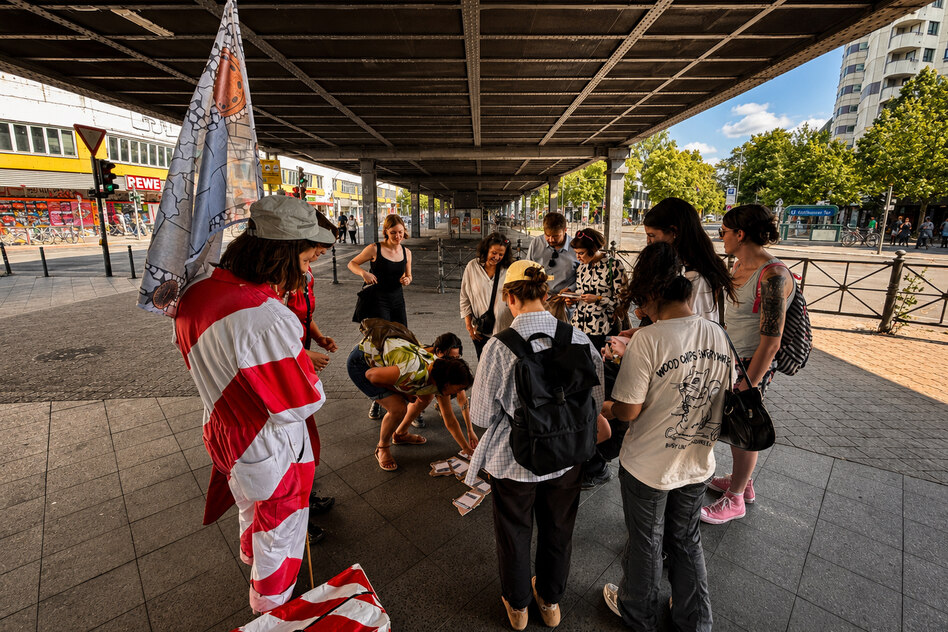
But is this art or what?" asks the woman from the café in Kreuzkölln, in front of which a small group has just stopped, led by a guy in red and white overalls and an asphalt-gray flag. This isn't the first time this has happened, she says, and now she wants to know: What exactly is there to see here?
That at least is easy to answer: an incoherent pattern in the pavement. A few weeks ago, before the streets in Reuterkiez were torn up everywhere to lay fiber optic cables, there were yellow and green markings here. Now the paving stones, newly laid, have lost all sense of meaning, but have gained a new aesthetic quality.
When asked whether this is art, the man in overalls becomes a little more hesitant: "It's something that is so interesting that it could inspire art," says Peter Behrbohm, Berlin artist and architect, who since May has been regularly showing gaps, cracks and fine improvisations in paving stone, tar and concrete around the Kotti as the personified "Society for the Promotion of Exemplary Road Damage" (GzFvS).
In Behrbohm's “Road Damage City Tours” what is otherwise a nuisance takes center stage as inspiration. Just before the election. A fictional game “The Bollard Zone” is posted on posters. The party, the CDU, warns against “bollardization” – politics in Berlin has long been street politics. Who is allowed to drive where, fast or slow or is excluded is not just a distribution battle, but also seems to be rumbling deep in people's identities during the election campaign. At least when it comes to the road damage, which everyone always wants to repair, the expert knows right from the start that it's futile.
A road without damage is not possible, says Behrbohm under the elevated railway right at the meeting point at Kottbusser Tor, a road network is constant work, it is never finished, everything is never intact. A statement that you usually hear about Gothic cathedrals. Next door, a local group of the Greens swarms out with garbage bags to clean the street.
In any case, what constitutes damage is a question of the power of definition. If, for example, a cat runs through the damp concrete, as can be discovered in road damage archaeology on Reichenberger Strasse, and then a person steps in with tar to fix the glitch, leaving shapeless black tar traces in the smooth concrete - which layer is actually the damage?
This is often how it is when you walk through the neighborhood with your eyes on the ground: repair seams, repairs that are laid with other street stones, tar areas that make the order in which the sidewalk slabs broke legible. The beach may be under the pavement, but the asphalt is above the pavement, and traces of aerial bombs can still be found in some granite slabs, as well as stumbling blocks in front of the doors.
For Behrbohm, one of the inspirations for the tours lies in the tectology of the Russian revolutionary and polymath Alexander Alexandrowitsch Bogdanov, co-founder of the Bolsheviks and one of Lenin's main opponents. His theory attempts to understand the dynamics of the organization.
"She looks for organizational principles in all structures - in cosmic or biological structures, in crystal lattices, wherever elements interact with one another. From this he tries to draw conclusions about the structuring of society after the revolution," explains the artist. And locate it right on the street, where sidewalk systems clash with each other, small paving stones enter the rough patterns of larger concrete slabs. What can we learn from this for conflict-ridden positions in society?
Is he serious or is this simply another level of Kreuzberg as a laboratory for artistic negotiation in and from public space? The tour repeatedly touches on the city's history, from the left-wing struggles to preserve the green space along the old Luisenstadt canal to the administratively relocated boulders that make parking under the elevated railway impossible. The contributions of building service providers who find their own solutions in the interaction of the buildings with public space are repeatedly visible - Behrbohm calls this “caretaker art”. During the tour, what is ironic, what is performative-artistic and what is actually something like research work is repeatedly blurred.
Kreuzberg as a place for collective art creation, that fits with the work of Peter Behrbohm. Sometimes he works alone with fictitious but performatively located authorities and institutions such as the GzFvS. But he is also part of collectives like PARA and Sonder, whose work “Hunt for the Great Bear,” two cowboy equestrian statues, was on display at Alexanderplatz for a long time. Exposing the public space in its fabrication and looking for utopian potential in its cracks is always central to his approach.
The road, with its constant aches and pains and repairs that feel like artistic interventions, is of course grateful material - damage comes and goes, so every tour is different for the guide. However, no follow-up date for this tour in mid-September has been announced yet - as Behrbohm says, while he is sweeping a yellow leaf with his foot from a defect in the asphalt, the view of the ground is lost along with the leaves. With the election campaign and summer, the road damage monitoring season is slowly coming to an end.
Read the full story at the source
Source: taz