
Germany · taz · · 3h
More stable wind power yield: wind energy from a height of 365 meters
Deutsch (original) · Auto-translated to English
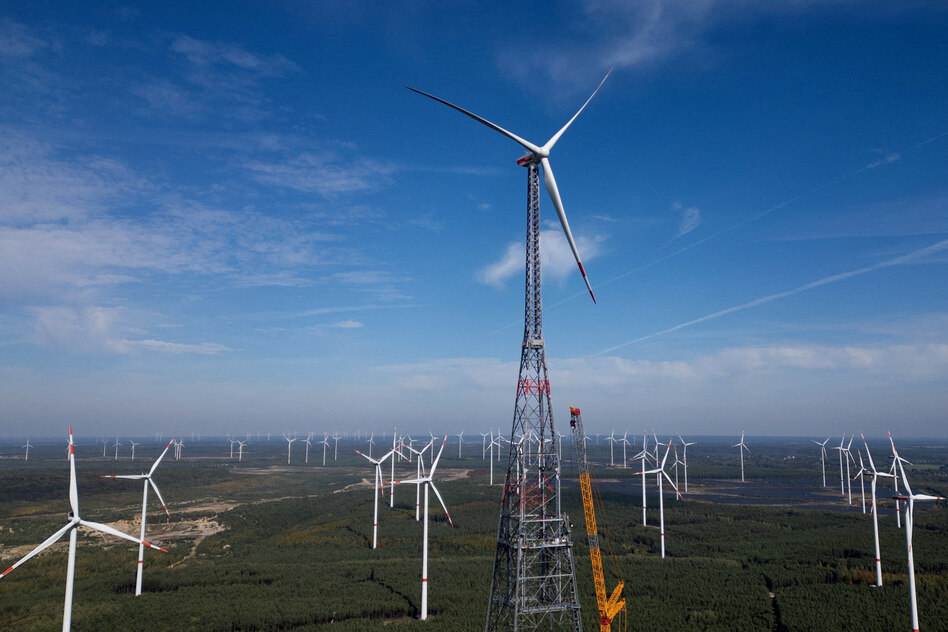
Germany is top in the east. At 368 meters, the Berlin TV Tower is the tallest structure in the Federal Republic. As of this week, the second tallest structure is only 3 meters lower: in the south of Brandenburg, the high-altitude wind turbine has reached its final hub height. Because there is no crane that could have assembled the rotor blades at such a high altitude, the wind turbine was assembled lower down and then pushed hydraulically into the sky.
The project was developed by the Dresden engineering service provider Gicon: Compared to current conventional wind turbines in the neighboring Schipkau wind farm, the height is expected to increase performance by up to 220 percent.
The rotor is not new, as it comes from series production by the Saarland manufacturer Vensys. With an output of 3.8 megawatts, the new wind power plant is rather technologically mediocre. The new thing is in the high lattice mast: The engineers are using it to reach heights where the wind blows stronger and more steadily.
“It’s not so much about stronger wind, it’s about more stable wind,” says Jochen Großmann, managing director of Gicon. The more stable wind means that the rotor generates more than twice the yield of a conventional wind turbine. The advantage: The argument “when the wind blows” no longer applies: high-altitude wind turbines practically always provide electricity. In the energy industry, this electricity is referred to as “base load capable”, but the accusation against photovoltaics and wind power has so far been that they cannot supply such “base load electricity”.
Gicon has been working on this project since 2010. In order to research the wind conditions, the company first set up a wind measuring mast. Ultimately, it left no doubt: at a height of 300 meters, the wind actually turned out to be steadier and stronger than at the usual heights of wind power harvesting.
At the end of 2024, 19 meter deep concrete piles were inserted into the subsoil to form the supporting foundation: the high-altitude wind turbine weighs a total of 2,000 tons. Construction of the lattice mast began at the beginning of the year and consisted of around 22,000 individual parts, including massive screws each weighing two kilograms. The project costs between 20 and 30 million euros and is financed by the Federal Agency for Leap Innovations (Sprind).
Of course, there are a number of engineering challenges with a project like this. One is: How do you get the turbine, which weighs many tons, to be transported to such heights? Conventional cranes cannot do something like this, which is why the Dresden company has patented a telescopic device. First, the gondola was assembled at a height of 150 meters, which is how high a crane can reach. It was then extended to 300 meters. If a wind turbine blade is now vertical, the top edge is 365 meters.
According to the forecasts, the new wind turbine should be able to supply 7,500 four-person households; a comparable wind turbine at a “normal” height can supply a maximum of 2,900 – and that only in the optimal case. The high-altitude wind turbine is scheduled to go online in November and also provide research data. If the technology goes into series production, the manufacturer is planning power plants with an output of more than 7 megawatts.
2025 was a year with weak winds, “minus 6 percent of the long-term average,” says Jaqueline Drücke from the German Weather Service DWD. Wind energy covered 25.4 percent of gross electricity consumption. Things went a little better this year: Compared to the same period last year, wind energy on land increased by a good 9 percent, and that on the North and Baltic Seas even increased by almost 20 percent. So far this year, renewables have covered 61 percent of gross electricity requirements, as new figures from the Center for Solar Energy and Hydrogen Research Baden-Württemberg show. At the same time, electricity demand in the Federal Republic rose by 1.6 percent.
The federal government's decision is to increase the share of renewable energy in electricity consumption to 80 percent by 2030. The political framework will also decide whether high-altitude wind turbine technology plays a role in this expansion: Federal Minister of Economics Katherina Reiche (CDU) is currently planning massive cuts in the Renewable Energy Sources Act. Their reasoning: First, the network must be expanded. The hearing on Reiche's bill begins in the Bundestag on Monday.
Read the full story at the source
Source: taz