
Germany · taz · · 1h
Talking about the Middle East in Berlin: It takes a willingness to listen
Deutsch (original) · Auto-translated to English
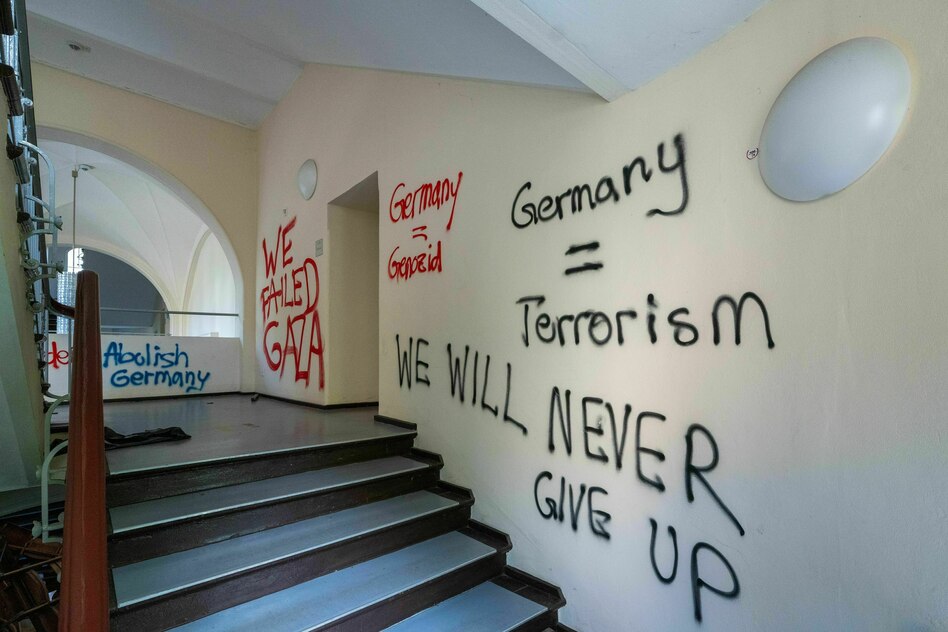
How and where is it possible to speak openly about Israel/Palestine in Berlin? About “the conflict”? In the third year after Hamas' murderous attack on Israel, what is particularly striking is the relentlessness and severity with which two supposed sides believe they have to destroy their respective "enemies".
In Berlin this is already visible on the walls of the houses in Kreuzberg, Neukölln, Friedrichshain and Mitte. Slogans for or against Israel or Palestine are crossed out, added to, and changed. Overall, this creates a picture of conflict. What a difference from the years before October 7th, for example in the early days of Corona, when the predominant message in public spaces was one of solidarity: “Leave no one behind” was written on banners hanging out of windows, in chalk on sidewalks – or was it sprayed on walls. Don't leave anyone behind. This meant the weaker people in the city as well as refugees in the camps at the European external borders or in the inflatable boats on the Mediterranean.
Just as the discussion on the walls hardens, the opposition is also reflected in the conversation. A Jewish interlocutor says she is always shocked at how much consensus there is now to portray violence as legitimate. Because anyone who presents violence as the appropriate means of resistance must also accept that this violence will affect real people. But for liberation, whatever it is supposed to look like, every means must be acceptable.
There are initiatives in Berlin such as Society in Change, ufuq or Miphghasch/Encounter that show how things can be done differently. They train team members who talk to young people in schools about the Middle East conflict, impart historical knowledge to them and sensitize them to anti-Semitism and generally devaluing ideologies. In this way, they do important work on the question of how the conflict can remain discussable.
But in recent years, the educational administration has used brochures and favoritism to spread approaches to consolidate a position in line with raison d'etre. It would be particularly important in the school sector to open up spaces discursively and to enable teachers to openly support the students' opinion formation.
Talking about the conflict is too often about broadcasting your own opinion to the world and having it confirmed by others. This is reflected in the audience attendance at events: Where people strive for real prospects for peace, where Israeli-Palestinian organizations such as Parents Circle Families in Berlin bring together people who are suffering from the ongoing conflict and violence, or where aid teams report on their experiences on site, there are significantly fewer people in the audience than at events that make it clear in the title that they are “pro-Israel” or “pro-Palestine”. Because such events aimed at understanding are a (strenuous) challenge in which your own long-held certainties may slip.
But that's exactly what helps in living together and in productive arguments. This requires the willingness to listen and to see and accept the openness, pain and suffering of the other person. And sometimes it helps to break away from all the terms that – like the much-used “genocide” – now shape how we talk and think about the conflict. Such words are often just markers that trigger reflexes and serve to pigeonhole the other person.
Read the full story at the source
Source: taz