
Germany · taz · · 1h
Sensational find in Maastricht Church: The Musketeer in front of the altar
Deutsch (original) · Auto-translated to English
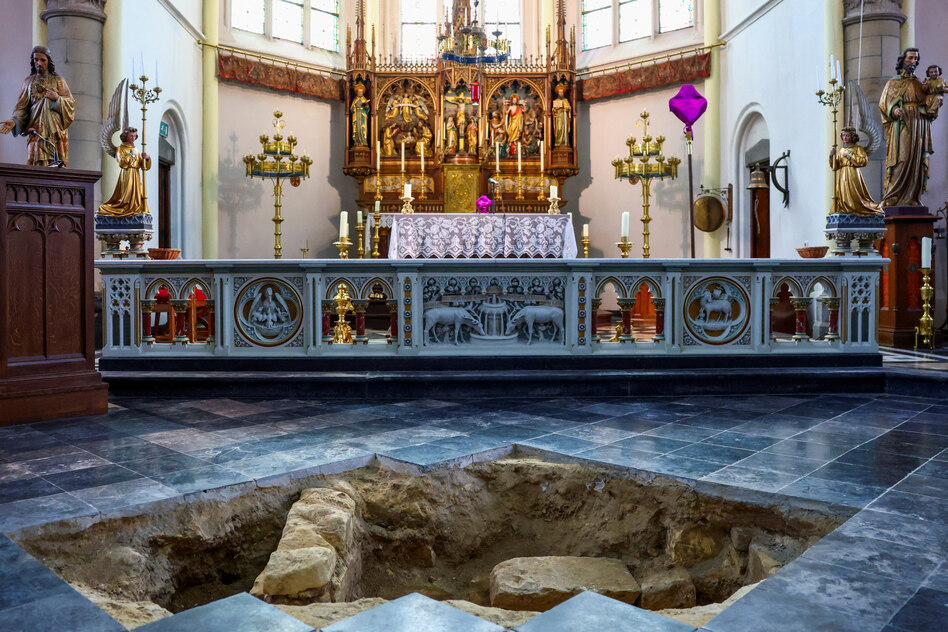
Nothing about this inconspicuous village church seems special. And yet in the Catholic Sint-Petrus-en-Pauluskerk in Wolder, a suburb of Maastricht, two things stand out in front of the altar. On the right there is a life-size figure of St. Anthony, to whom believers pray if they want to find something again. And there is the wooden structure in front of the altar, barely ten centimeters high, around four by three meters in size, painted brown and black, with a worn Persian carpet on it. The flat box wants to attract as little attention as possible, as if it always belonged here.
We don't know how many times Wim Dijkman, 70, stood here and asked Antonius for help. The archaeologist has been looking for the skeleton of Charles de Batz de Castelmore, better known as d'Artagnan, the most famous of the Four Musketeers, for almost 30 years, at least since the novel by Alexandre Dumas from 1844 and two film adaptations in 1973 and 1974.
Then the day came in February 2026. Eureka! Antonius had helped. Apparently the ground had sagged a bit. This had to be investigated for security reasons. The other version says that Dijkman simply dug at random. In any case, a skeleton appeared. This must be the great d'Artagnan! Honorably buried in the most central location of the neo-Gothic church, which stands on the same stone floor as its predecessor in the 17th century.
Is it him? A grandiose soap opera could begin, similar to the Musketeers' motto “One for all, all for one”, only now: “One for one, all against one”.
In 1673, the troops of the French Sun King Louis XIV besieged the fortress city of Maastricht. A battle of prestige: the king and his court were present. We know that d'Artagnan fell in Wolder, including the date: June 25, 1673. By a musket ball, it is said - who could have manfully defeated this hero hand-to-hand with a saber? Only d'Artagnan's remains were never found.
Maastricht has long honored the former enemy. There is a d'Artagnan monument with a threateningly drawn saber and a d'Artagnan street; He has already been called “a great European” in the city of EU treaties. And now the skeleton? Wim Dijkman: "It's one of France's greatest mysteries. You can't wait to solve this mystery."
Since 1985, Dijkman has been employed as an archaeologist by the city of Maastricht. After his retirement he was meritoriously knighted. But his life's work was not complete. At a congress in Paris a quarter of a century ago he met Odile Bordaz, d'Artagnan's biographer. She gave him a kind of assignment: "Are you an archaeologist? Then you have to find him." For Dijkman it became a lifelong mission, even in retirement.
The church had let Dijkman in under conditions of being careful and cautious, especially not to reveal anything to the public, said Deacon Jos Valke. But a few weeks later everything became known.
Two teeth and a piece of bone from the upper arm were removed, ground up and examined at the University of Munich. Result: no usable DNA material. New attempts, again nothing. The first people scoffed that in the end you would only have skeleton powder instead of a skeleton, but you still don't know who made it.
Dijkman acted on his own initiative without instructions from the city. “I had permission from the church.” But apparently, intoxicated by the discovery, he went beyond all scientific principles. He would have had to document the find millimeter by millimeter. Parts of the skull are now missing, and foreign DNA was also found on the skeleton. Maybe his own?
Deacon Jos Valke reports that there is a photo of Dijkmans standing in the grave next to the bones - a deadly archaeological sin. "When you excavate, you have to map centimeter by centimeter. But nothing has been documented. This is of course an immeasurable shame." Dijkman was “blind with ambition”. "He looked for the grave for more than 25 years. And then he messed it up in the last five meters."
End of May: a bang. The police temporarily arrest Wim Dijkman because he dug illegally and had bone parts examined on his own initiative in Munich. It turned out he kept more remains in a Tupperware container at home. Only when he handed her over to the authorities was he released. A criminal case is ongoing.
In July, the city of Maastricht announced the first supposedly sobering results: a metallic object was found in the kidney area. But this is not a musket ball made of lead, but a rusty part of a nail made of iron. But does that speak against d'Artagnan's identity or against the traditions?
DNA evidence? Still nothing. An analysis of tooth enamel revealed that the deceased ate a lot of fish. Untypical for an inland Frenchman of the 17th century, but salted fish was already sold in markets. And even then, a good Catholic ate fish on Fridays.
There is now also DNA from two descendants. It's in Munich and they don't release the results, supposedly data protection. Maastricht's current chief archaeologist Gilbert Soeters suspects vanity. He complained about the Germans in the regional newspaper de Limburger: "They worked with human remains that were illegally dug up and illegally brought across the border. This could well damage their reputation if they wanted to publish scientifically." “Guerre d’archéologues,” wrote Le Monde in Paris: war of the archaeologists.
The skeleton has been with specialists at the University of Deventer for months. It is said that reliable DNA results will hardly come this year.
Meanwhile, mass begins in Wolder on this August evening: the cantor sings the first song with a powerful timbre. The congregation's singing along is modest. Recounted: Three believers came to mass.
How different in March: as de Limburger reported somewhat indignantly after the first reports of the bone discovery, the very next day the first groups of pensioners stood in front of the church gate to catch a glimpse of the famous corpse. The next fair was full.
As we say goodbye, the cantor tells us optimistically: “It’s really very unlikely that it’s not him.” Deacon Valke: “It’s 99.9 percent him.”
And what if the DNA doesn't match in the end? Then legend believers can still cling to this volte: Among d'Artagnan's descendants there may have been a cuckoo child who falsified the comparison, resulting in an incorrectly negative result. In any case, it's time for a new film: “The Last Battle for the One Musketeer”. Opening credits: “En garde!”
Read the full story at the source
Source: taz