
Germany taz
Seniors in Korea: Ready for the AI future
South Korea's rapidly aging population is learning how to use artificial intelligence. Technological change is not only leaving positive traces in the country. more...
Deutsch (original) ·Auto-translated to English
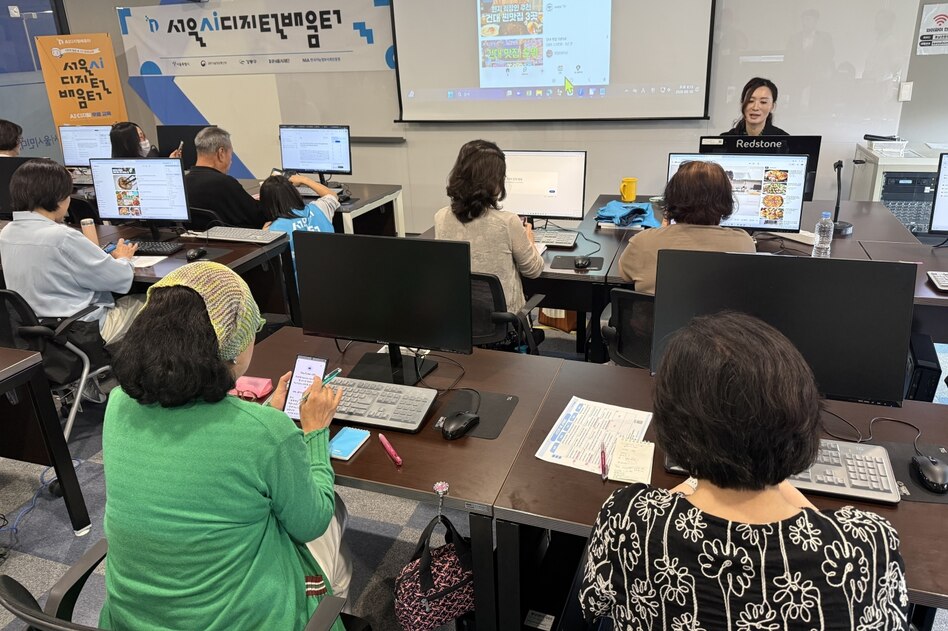
When Lee Eun-hwa starts class, her good mood is downright contagious. "You can copy the address. Does that work for you?" says the teacher slowly as she points to a huge screen behind her. The YouTube app is then open. “The copy symbol looks like two sheets of paper are on top of each other, doesn’t it?” Lee asks the group loudly.
Her students sit in the stands, each with a computer in front of them. The participants in the digital learning center on the eastern outskirts of Seoul are more exemplary in their curiosity and motivation than many high school classes. It's just that most people don't hear as well anymore, and some wear glasses with thick lenses. But that's exactly the point of the matter: Teacher Lee teaches older people how to use digital platforms and artificial intelligence.
“There is a growing digital divide and I want to break it,” says Lee after class: “Above all, I want to teach my participants how they can use technology to make their lives more entertaining.” After all, you should first learn what you enjoy.
Student Yoon Bok-soon, 72 years old, agrees. The Korean woman comes to the digital learning center twice a week. Your progress is impressive. "I used to always have to ask my children how to do things - like online shopping. Now I can do it myself," says Yoon.
But her passion for digital goes far beyond that. “I’ve always liked music and painting – now I’ve learned a new hobby with my smartphone,” says the senior citizen with a beaming smile. She proudly shows her cell phone display and scrolls through her own YouTube channel.
She started by uploading her own pictures, flower arrangements and landscape paintings, and using AI programs to transform them into small video sequences. She now also talks about Japanese anime series on her channel, analyzes books like “The Little Prince” and the Sisyphus myth, and publishes poems she has written herself. AI-generated video sequences run for this purpose.
There are now 69 such state-funded digital learning centers nationwide. By 2029, the Ministry of Science and Information Technology, or MSIT for short, wants to increase the number of these institutions to almost 230 over the next three years. "AI should not be reserved exclusively for experts, but rather be a tool that benefits everyone - including marginalized groups such as older people. It should noticeably improve their quality of life in everyday life," says Lee Do-gyu, Director General at MSIT.
According to the government official, it is also about arming seniors against the technological dangers of AI. In fact, scam calls from organized crime gangs, which often operate from Southeast Asia, are a major problem in South Korea. In so-called voice phishing, perpetrators are increasingly using artificial intelligence to, for example, imitate the voices of relatives and persuade their victims to transfer money. Last year, almost 8,800 transactions were registered as a result of such fraud at the five largest South Korean banks alone. That was more than twice as many as the year before. Older people are increasingly among the victims.
There is also another problem: AI-generated misinformation is exacerbating extreme polarization in South Korea's highly connected society. The political right-wing fringe in particular is able to lure mainly older people into demonstrations with conspiracy theories about alleged communist infiltration by North Korea or China. Anyone who speaks to the mostly older participants at right-wing conservative street protests in the center of Seoul often hears crude theses. When asked for evidence, they point to dubious short videos on social media.
Anyone who walks through the digital learning center on the outskirts of Seoul will encounter an almost surreal world of experience. An old woman with a permed hairstyle has just put on virtual reality glasses. In the next corner you can play with a robot dog. There is also a digital self-service terminal where you can order burgers on a trial basis.
What seems fun has a serious background. South Korea is the fastest aging society in the world. A fifth of the population is now over 65 years old, and the trend is rising. At the same time, the country on the Han River, with its world-leading chip industry, belongs to the digital avant-garde.
This leads to problems for some population groups. Everyday life in South Korea can hardly be managed without basic digital skills. You often need a smartphone app for doctor's appointments, and you also need a smartphone app to buy train tickets. And if you want to order in a restaurant or café, you usually have to do so using a digital machine.
"I'm 83 years old. But age doesn't play a role when it comes to learning," says Seo Jong-hyun, a handsome senior with a can-do attitude. He is also a student in the digital learning center. "At first I came here because I wanted to learn Excel. But it wasn't fun," says Seo. But his passion took hold of the AI course. "It really made my life better. The smartphone is now my personal assistant: the AI gives me information about medical things or helps me with my travel plans," says Seo. He now also has his own YouTube channel where he gives his peers advice on living a healthy life. Every now and then he gets a like.
However, digital change has also left negative traces in South Korea. Where there were lively market streets 15 years ago, there are now vacancies. Shopping is only done online. Spontaneous conversations in the neighborhood, while waiting for the bus or in office elevators have also become rare. Most Koreans go about their daily lives with their smartphone screens raised.
The extent to which digitalization is also exacerbating the loneliness crisis is difficult to prove empirically. But the fact is: South Korea has one of the highest suicide rates in the world, and the numbers rise disproportionately as people get older. Men over the age of 80 are most affected. A study published last year in the Journal of the Korean Medical Association cited social isolation as one of the crucial factors.
In 2025, the authorities registered almost 4,000 “godoksa” – in German: lonely dead. Most of them are older men who die without relatives or close acquaintances. The state often takes over the funeral ritual that, according to Korean tradition, is necessary so that the soul can find peace.
However, you can hardly find a nostalgic look along the lines of “everything used to be better” in South Korea. "After the Korean War, we were an agricultural country and now we live in the AI era," says Mr. Seo pragmatically: "Of course I am also worried about what future we will see. But that doesn't mean we should stop learning."
His classmate Yoon Bok-soon sees it similarly: "As soon as you win something in life, you also lose something. But the changes make me positive overall." Of course, once you get to a certain age, you don't communicate as much with your children, says Yoon. But now she shares her everyday life via the Internet.