
Germany taz
Rare disease: One in 83 million
Six-year-old Caroline suffers from PUS3 syndrome - the only known sufferer in Germany. Her parents have little hope for improvement - but they have a plan. more...
Deutsch (original) ·Auto-translated to English
Without hesitation, Caroline presses number 2 in the elevator. The transport service has just brought the six-year-old home from school. Even though she's been up since early in the morning, she seems alert - and presses two more keys. “She loves taking elevators,” says Caroline’s father André Arnold.
Outside: On the streets, trams and cars push through Dresden's rush hour traffic. “We also thought about moving to the village, somewhere quieter,” says Arnold. “But with Caroline, that’s not an option for us.” The nearest rescue station is two or three minutes by car from her apartment in the Striesen district, and it is only seven minutes to the university hospital. The elevator was also one of the reasons why the family moved to the new building on Glashütter Strasse three years ago. At that time, Caroline couldn't walk yet and her parents had to carry her up the stairs. Here the property is also fenced in so that the first grader can run around in the garden but not run away.
Inside: Having taken off her rain jacket, Caroline races from one room to the other in the apartment. She often shows where she wants to go. Or something she wants, for example her Tiptoi. The white-orange device is somewhat reminiscent of an electric toothbrush. When Caroline places the tip of the Tiptois on a point in one of her children's books, a song or a voice sounds. Just like the busy board learning game in the living room that Caroline's father built for her can do. Depending on which button on the wooden board you turn, a different song starts. “Music is her thing,” says André Arnold, who works as an engineer at the Helmholtz Center Dresden-Rossendorf.
PUS3: It wasn't clear that his daughter would move freely to music. Caroline is affected by the extremely rare PUS3 syndrome, which is caused by a genetic mutation in the pseudouridine synthase 3 gene. The PUS3 Foundation, which advocates for those affected, is only aware of about a dozen diagnosed cases worldwide. Caroline is currently the only known person affected in Germany, says her mother Constanze Rethberg. She still remembers the moment she realized something was wrong with her daughter. "We were sitting in the kitchen when Caroline was nine months old and something had fallen off the table. But Caroline didn't react at all when I picked it up, she didn't even look at me."
The seizure: The parents only received a diagnosis years later after their daughter suffered, among other things, a severe epileptic seizure. Epilepsy is one of the most common symptoms of PUS3 syndrome. In addition, there is delayed development. Caroline is fed and changed by her parents. She makes sounds but no words.
Surprises: “There are only four or five papers on the PUS3 syndrome and hardly any doctors who are familiar with it,” says Constanze Rethberg, who is currently training to become an internist. Which developmental steps Caroline will take and when, whether she will retain her new abilities or lose them again, whether she will grow old or whether her illness will be life-limiting: the parents did not receive an answer to any of these questions after the diagnosis. The joy was all the greater when Caroline started crawling at 17 months old, took her first steps two years ago and was able to do a safe lap on the balance bike with training wheels.
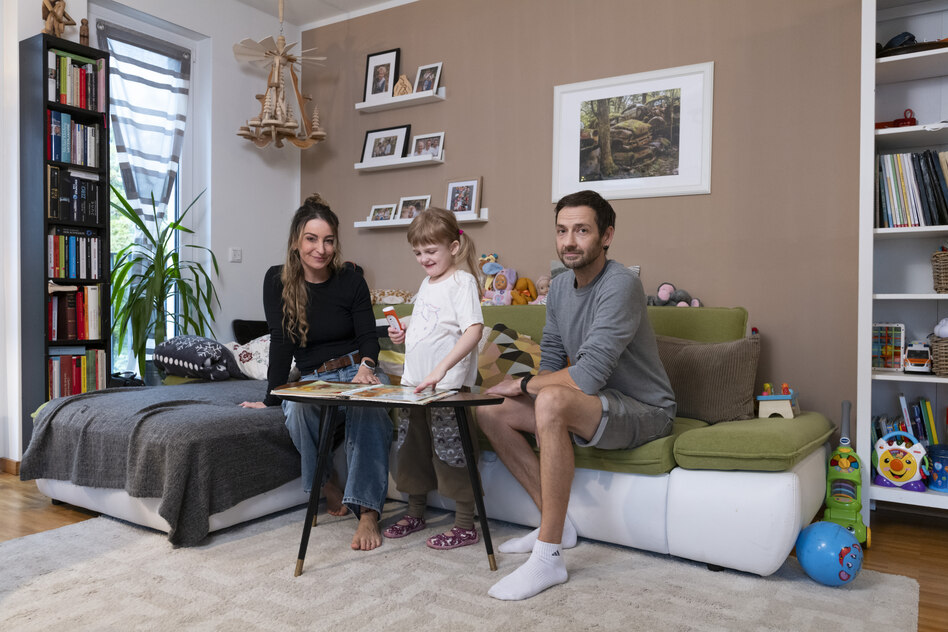
Exhaustion: As Caroline's mother talks about these moments, she wears a wide silver ring on her finger. He tracks her sleep. The ring shows 6.38 hours for last night, and Constanze Rethberg was in bed with her daughter for over ten hours. “That was one of the worse nights,” says Rethberg. Due to her illness, Caroline has a severe sleep disorder. Her parents take turns having someone sleep in bed with her to calm her down when she wakes up. The lack of sleep is particularly stressful for Caroline's mother; she works as an assistant doctor on a shift system in the hospital. A situation like this, in which they sit on the sofa for a photo and watch Caroline play, doesn't exist in their everyday lives, says André Arnold.
Alarm: Caroline is at the developmental level of a one to two year old and cannot assess dangers. This means their parents are always on alert. There is also their ten-year-old son Caspar, for whom they also want to be there, for example when he talks about school or needs help with his homework. “Our system only works if we are both fit,” says Constanze Rethberg.
Care: In addition to one-to-one care - one person is there just for her - Caroline is dependent on aids. Because she has weaker muscles than healthy children, she wears special splints around her lower legs to prevent her from twisting her ankle. She also needs glasses and several medications every day. There is also a talking computer to communicate with, emergency medication, diapers, baby monitors and urine test strips, because Caroline is prone to urinary tract infections due to a kidney malformation as a result of her illness. Many of their expenses are covered, explains André Arnold, also thanks to the current regulation of care levels. “But we don’t know how long the political system will tolerate this.”
Politics: Not only the AfD with its attitude towards people with disabilities worries him, but also the CDU with a chancellor who, among other things, questions the need for one-to-one care for children with disabilities. For Arnold's partner, it's also about the parents. “People with disabilities have the right to compensation for their disadvantages, but what about those who are behind them?” she asks. “As nurses, we should actually have the right to work less if the salary is sufficient.” Instead, she has to keep explaining to herself why she can't accept a shift or work an hour longer.
Hope: As with most rare diseases, the pharmaceutical industry lacks the incentive to research treatment options for PUS3. That's why Rethberg and Arnold founded the “small genes, big hope” association in the spring. They want to use it to draw attention to those affected and advance the development of therapy. To do this, they have teamed up with the PUS3 Foundation in Poland, where the highest number of cases are known in the world. Together they want to develop a therapy that directly addresses the genetic cause of the disease. The research is carried out by the Gene2Cure Foundation in the USA, which says it specializes in the development of therapies for extremely rare diseases. The project will be fully financed until the end of 2026, says André Arnold. In order to continue, the project relies on donations. The therapy could be used on humans for the first time in 2029. “We don’t hold out too much hope,” says Arnold, “But saying we’ll just sit back and relax wasn’t an option for us either.”
Lucky: Caroline has now sat down at the dining room table with her parents, headphones on her blonde hair. She keeps putting her hands up and moving along with the beat on her ears. "Life with Caroline is like living with a clumsy one-year-old who is just discovering the world. That's why we laugh a lot with her," says André Arnold as he watches his daughter. His partner sums it up this way: “We may have a different life, but we are no less happy.”