
Germany taz
South Tyrolean Dolomites: “Today Insta is the problem”
In Sesto, war history, Tyrolean identity and over-tourism collide. Landscape and people defend themselves against appropriation. more...
Deutsch (original) ·Auto-translated to English
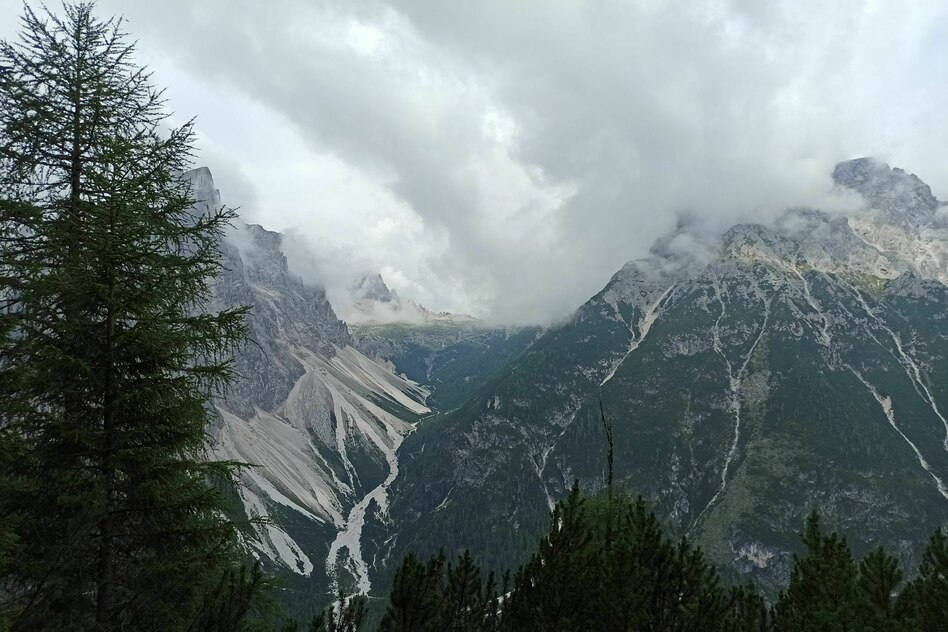
As the dark clouds roll over the edge of the mountain and the temperature drops, Rupert urges Gietl to hurry. He wants to get to the mountain station of the Rotwand cable car dry. Actually, there is no need to fear the bad weather here on the Anderter Alpe in the Dolomites, because there are shelters everywhere in the rock - remains of camps, positions, command barracks, trenches and shelters. Relics from the First World War, when the front between Austria-Hungary and Italy ran across the southern Limestone Alps. “You can definitely wait for a downpour,” says Gietl. But today he has a full calendar and no time for that.
Before we go back, he shows the remains of a cable car that was used to supply the soldiers with everything they needed. A simple winch construction that had to withstand a lot of hardship - as did the mountain soldiers, mountaineers, sons of small farmers and agricultural workers who were stationed here. There is no reliable figure as to how many people were killed on the mountain front between Trento and Sexten. From the Stelvio to the Isonzo there could have been up to 180,000 deaths - according to various sources, one to two thirds of these died not from weapons, but from avalanches, lightning strikes, mudslides and frostbite.
Nevertheless, some of them probably had “the time of their lives,” as can be found in the field post archives, says Gietl. He is a “conflict archaeologist” and has done a lot of research on the two and a half years from May 1915 to autumn 1917, when Italians and Austrians were hostile to each other on high mountain ridges and peaks. "It's actually not surprising when you know how hard and life-threatening the everyday work in the mountains was for them - at least they were taken care of in the positions."
What still defines Sesto to this day is the experience of this war. The village directly at the front was completely evacuated in 1915. When people return two years later, they are faced with rubble. Then the next break: With the Peace Treaty of Saint-Germain, South Tyrol fell to Italy in 1919, without the German-speaking population being consulted. While the region is Italianized and the Three Peaks officially become the Tre Cime overnight, the Sesto residents are doing everything they can to save and rebuild their Tyrolean tradition. But it wasn't until another war and a few decades later, in 1972, that the Second Statute of Autonomy for South Tyrol equated the German language with the Italian one.
It may be that this feeling of having to defend oneself against heteronomy is triggered by the current conflict over overtourism - too many tourists - among people here: On the Italian side, long queues form at the bus stop in Misurina, Veneto, as early as six in the morning, hundreds of tourists wait tightly for a place on the shuttle bus to the Auronzo hut in order to get as close as possible to the Tre Cime. During the peak season, up to 14,000 people come to the area every day, which is actually under special protection as a nature park and UNESCO World Heritage Site. At crisis summits in the region, mayors wanted an upper limit of 2,000 people.
However, regulation has so far only been half-hearted, and the regulation ends at an administrative border: since 2025, those arriving via Dobbiaco have needed an online reservation, while those arriving via Misurina have not yet needed one.
Social media is full of videos and posts of crowds of people, sometimes wearing flip-flops in the summer, pushing their way along the circular path around the peaks or queuing hundreds of meters in front of a hut that sells donuts filled with cream. “The Sesto people no longer come up here,” says archaeologist Gietl.
And it's not just the locals who feel excluded from their own world. At the Sesto Tourism Association, chairman Walter Holzer is worried – and above all extremely annoyed: “Insta is the problem,” he says. “Humans are moving away from individuality towards participation in swarms.” Apparently “the townspeople” these days “wanted to be where there are a lot of people.” This deters regular guests, hikers and mountaineers who have been coming to the area for decades. “They see the pictures and think Sexten is too crowded.”
This can be easily refuted. Because if you take the path from the Moos district into the Fischleintal, which alternatively leads to the Drei Zinnen, you will have a different experience. The 1,000 meters of altitude over almost 14 kilometers there and back are a tough day hike. And in the Fischlein Valley, which is characterized by flower meadows and larch forests in summer and autumn, you will soon no longer see anyone, especially not when the rock becomes more bare further up.
In general, the area offers around 700 kilometers of marked and signposted hiking trails and twice as many that are marked with cairns and are only suitable for experienced hikers. “There’s everything here,” says Holzer. In summer and autumn, easy hiking and mountain hiking, rock climbing, in winter snow hiking, alpine and Nordic skiing. “And there are the battlements too, just seen from different points.”
And history can also be experienced - not only in the open-air museum on the Anderter Alpe, but also much more comfortably in the Hotel Drei Zinnen, which was built between 1929 and 1931 according to plans by the architect Clemens Holzmeister, a co-founder of Tyrolean modernism. It was created ten years after the annexation, at a time when the Italian administration of fascist Italy systematically took action against everything German. Building a house in the Alpine architectural style of the German-speaking region was certainly a nationalistic statement, but above all it was the continuation of a centuries-old building tradition - at a time when this tradition was being violently suppressed.
To ensure that the mass of the six floors fit harmoniously into the townscape, Holzmeister used the slope so that the front of the building only protrudes four floors above the street, as well as a white facade and balanced proportions. The heated outdoor swimming pool was a sensation when it opened.
The entrance hall is joined by a traditional parlor, card room and reading room, which are decorated with frescoes by Rudolf Stolz, folkloristic figures in everyday scenes, but always in lively movement. Holzmeister is said to have hired the painter with the words: “If Rudolf Stolz paints it, I don’t need to see a draft.” A sentence from a time before the next catastrophe. While Stolz was honored in 1940 by Nazi Gauleiter Franz Hofer in Innsbruck with the Mozart Prize for “work that was pleasing to the National Socialist rulers,” Holzmeister was driven out of his job and his country by the same regime.
To this day, the card room in the hotel is presented as part of a lovingly preserved work of art, as Traudel Watschinger, the third generation to run the hotel, calls it. The entire house is a listed building, she says. Not even the furniture should be changed without prior consent. The careful renovation of a few windows can cost “five figures”.
Only the wooden fence, which had to shield bathers in the outdoor pool in the 1930s - ordered by the priest - for moral reasons, is now gone, leaving a clear view of the Sesto sundial, a structure in the Dolomites that is just as interesting as the famous pinnacles. “Otherwise we always have to repair everything exactly as it was,” says Watschinger. “If we are not sustainable, who will?” Then the Grande Dame has to say goodbye; a group of architects is a guest. They are interested in the history of the house, the Tyrolean modernity of the border region, whose future has so often been decided by others, and which is being challenged again today - this time by the sheer number of those who are only interested in a photo of the outside view.