
Germany · taz · · 3h
Swiss watch locations: These cities tick differently
Deutsch (original) · Auto-translated to English
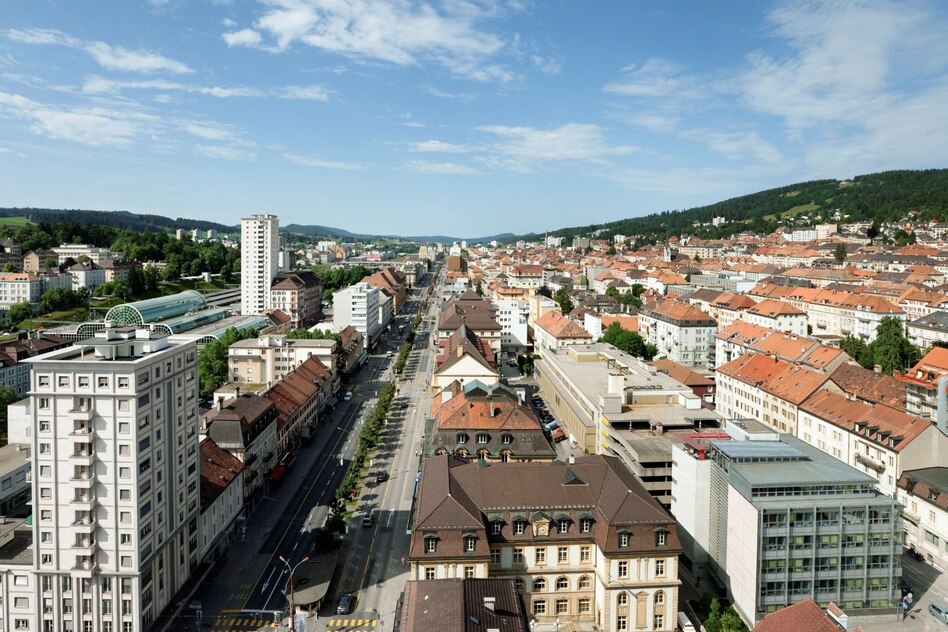
You might not really believe that La Chaux-de-Fonds has 37,000 inhabitants when you stand on the Boulevard des Eplatures. The city must be at least twice as big! The highway seems to stretch endlessly through the valley in the Swiss Jura Mountains, just a few kilometers from the French border.
The boulevard is ultimately the result of a major fire in 1794. When the city was rebuilt in the middle of the 19th century in a checkerboard pattern with straight streets, the watch industry had long since become the dominant economic factor in the Jura. The new La Chaux-de-Fonds was so perfectly attuned to the industry that it even made it into “Das Kapital,” where Karl Marx described it as “a single watch factory.” The number of residents rose from 12,000 to 24,000 within a few years. The workshops that were housed in the houses had plenty of sunlight thanks to the large distance between the individual buildings.
No, La Chaux-de-Fonds is not a place that fits into the postcard picture of Switzerland, and neither is Biel, 40 minutes by train to the east. Both are cities based on work: together with the smaller Le Locle, they formed the heart of the Swiss watch industry for a long time. Little of the economic splendor of the old days remains today. The unemployment rate is high by Swiss standards and cities have to reinvent themselves.
In Biel, buildings from the 1920s and 1930s shape the cityscape, especially in the center. The imposing Volkshaus by Eduard Lanz with its clinker brick facade seems almost Hanseatic. Here comes the snow-white double gymnasium of the Neumarktschule without any ornamentation, memories of the Dessau Bauhaus come to mind. The Jurahaus is round, bold and sky-blue, lounging on a street corner. There is the Grand Garage du Jura - an apartment building with a workshop and extensive covered parking spaces on the ground floor - one of the oldest examples of automotive architecture in Europe.
“With over 300 buildings, Biel now has one of the most closed ensembles of its time in the world; only Tel Aviv can compare with it,” says Matthias Grütter. He is a kind of one-man company when it comes to Biel's modernism, gives tours of the city, publishes postcards and calendars, and knows every stairwell. Four factors came together at the time, he explains: The relocation of the train station ensured that there was building land in the middle of the city. At the same time, Biel grew strongly during this time. “Then there was a political change: in 1921 Biel became social democratic. All of this was met by the new architectural form of modernity.”
A second architectural boom had already begun in La Chaux-de-Fonds at the beginning of the 20th century, which also led to the modern era. A unique style of Art Nouveau was established: the so-called style sapin (“fir style”) integrated alpine natural motifs into the decor. This creative milieu also influenced Le Corbusier, who was born in the city. He first learned to be an engraver and chaser at the local arts and crafts school before turning to architecture. With early works such as Villa Fallet (1905), which was still based in Art Nouveau style, and the much more reduced Maison Blanche (1912), he transformed himself from an artisan into a pioneer of international modernism.
Of course, those interested visit these houses. Amazed by the open room concepts in the white villa, trying to somehow find a connection to the living machines with which “Corbu” later became famous. And Biel, with its monuments, is definitely on the list of architecture fans. Nevertheless, tourism, traditionally one of Switzerland's most important economic sectors, has not yet arrived in the two cities. Matthias Grütter shrugs his shoulders. "Industrial cities are underestimated, it's like that everywhere. People don't necessarily want to spend their days off there. But cities like Biel are low-threshold. It's not about representation or expensive clothes. You can be who you are."
The Swiss watch industry, without which La Chaux-de-Fonds and Biel would not be important cities, flourished in the first half of the 20th century - only to be overrun by the emergence of the quartz watch in the 1960s. It only cost a fraction of the mechanically driven models to produce, ran more precisely and was primarily produced in the Far East. For the watch cities, this was a turning point that still has an impact today. On paper they have recovered from the so-called quartz crisis, especially thanks to the Swiss quartz watch Swatch and an uncompromising focus on the absolute luxury segment. But the money earned is largely taxed elsewhere.
At the same time, Biel and La Chaux-de-Fonds act as a social safety net for low-income households and households at risk of unemployment thanks to their comparatively affordable housing. While the overall Swiss average social assistance rate is around 2.9 percent, in Biel 9.1 percent and in La Chaux-de-Fonds 8.5 percent of the population are dependent on official support. Average incomes are well below the Swiss average.
But precisely because the two cities are comparatively poor, open spaces are created that are used in very different ways. La Chaux-de-Fonds will be able to call itself “Swiss Capital of Culture” next year. The newly created title, which will be awarded every three years in the future, is intended primarily to strengthen medium-sized Swiss cities. “We saw with the European Capital of Culture program that cities that are already recognized as cultural centers do not benefit from this type of program,” explains project leader Olivier Schinz. In his hometown, however, the conditions are ideal. La Chaux-de-Fonds is well known for its role in the watch industry. At the same time, the cultural scene is constantly growing, also due to the affordable rents.
The focus will be on the Anciens Abattoirs, the city's former slaughterhouses, which will serve as an area for twelve actors from the region, among others. The spectrum ranges from the Fédération Africaine des Montagnes Neuchâteloises, which aims to show the importance of the African diaspora in the region, to the anarcho-musicians of the Watchmaking Metropolis Orchestra.
The “Bilbao effect” is the name given to the successful revival through cultural projects; the Spanish city experienced rapid change after the opening of the Guggenheim Museum in 1997. There will be no new construction in La Chaux-de-Fonds, but the year should still have an impact. The creators assume that urban life will shift towards the slaughterhouses as a result of the numerous events. And they hope that the Abattoirs will remain as a cultural site even after the festival.
There is another flagship project in Biel: The Gurzelen terrain is a hybrid of an autonomous cultural center, public park, sports facility and socio-cultural experimental field on a total of 24,000 square meters of a former football stadium. Around 50 initiatives found a home here after FC Biel moved its games to a newly built arena in 2015. What was originally intended as an interim use for three years will soon be entering its eleventh year.
Board member Matthias Rutishauser describes the terrain as a “pragmatically made realistic utopia”. "In the beginning, the city was afraid. They thought we would arrive here with construction trailers and then possibly derive some sort of resale right from that. But we had people in politics who believed in the project. And that's exactly what something like this is about."
Today the Gurzelen terrain has become established. If you stroll around the site with Rutishauser, past the children's construction site or the inclusive gardening project "Slow", you quickly notice: He is proud because he knows about the singularity of the place, which now attracts numerous visitors. “Other temporary use projects are interested, city planners, architects, we easily give thirty or forty tours a year,” he says.
Rutishauser himself is also one of the driving forces behind “Tennis Champagne”, the only lawn tennis court in Switzerland that is accessible to everyone for a low fee. “We have democratized a luxury good here,” he says. It also fits that there is a football field a few meters away where the kids from the district play football. "In the beginning, some people in the area thought we were freaky. But acceptance has grown over the last few years. People who work at Swatch also come by for an aperitif or the construction workers for their lunch. Nevertheless, we remain an alternative place."
But for how much longer? There has long been a master plan for developing the area. But everyone involved is in good spirits that there will be another ten years left: the development of the former Beaumont Hospital is a priority in the city.
The Swiss Tages-Anzeiger, which crowned Biel the “most misunderstood city in the country” in 2020, headlined three years later: “Strikingly many Zurich residents are moving to Biel”. So there seems to be a bit of something in the air. Gentrification is not a big issue in either city. The housing market is still too relaxed for that. La Chaux-de-Fonds also protects its location: you have to want to live at 1,000 meters above sea level.
Transparency note: The research trip was supported by Jura & Drei-Seen-Land.
Read the full story at the source
Source: taz