
Politics · taz · · 2h
Student protests in France: Protest sets a precedent
Deutsch (original) · Auto-translated to English
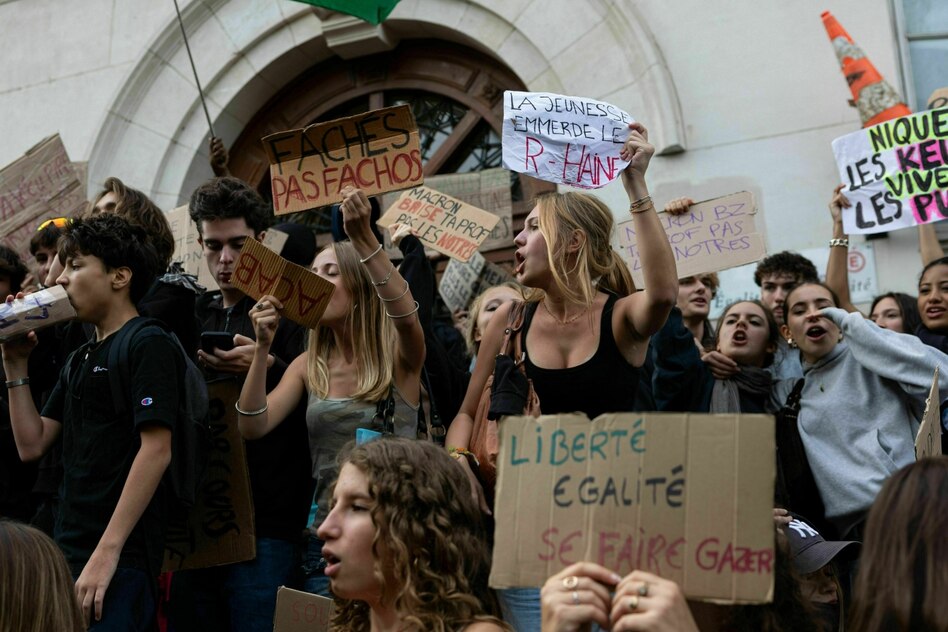
Around 150 students blocked the entrance to the Lycée Montaigne in Paris on Monday morning. They are sitting in front of the large wooden gate on a barricade that they built very early in the day from garbage containers. On the other side of the street, with their backs to the Jardin du Luxembourg, some parents and members of the school staff are standing and looking concerned. The adults fear that incidents could occur or that particularly agitated participants among the demonstrators could cause harm. Elsewhere, law enforcement officers used tear gas to clear such blockades that had been declared illegal, without taking the young age of the protesters into account.
The young people on the barricade encourage each other by singing the “Marseillaise”. “Jeunesse en colère” (“Youth in Anger”) is written on a banner above the entrance. There are cardboard signs attached to the windows next to them that read, among other things, Antifa slogans.
Her son is also there, says Emma-Kate Symons and points to the protesters. But she is outraged because the blockade is preventing her younger daughter from getting into the school building for classes. The mother, who has dual French-Australian citizenship, fears that outside masked activists will incite students to violence. In any case, she is convinced that these actions would be “instrumentalized by groups like La France insoumise and Révolution permanente”. Her son showed her views from these networks that clearly demonstrated this.
When the young people on the barricade are asked about it, they find it ridiculous or offensive. “We are big enough to decide for ourselves what we do. And our anger has existed for a long time,” protests a student who wishes to remain anonymous for fear of reprisals. Today's blockade was improvised because the director announced that he wanted to close the school on Tuesday "for security reasons." “We anticipated that as a preventive measure,” laughs the student. The principal had complained to the parents that he had been “attacked with a dumpster” early in the morning.
The leaflet distributed by her colleague, who introduces himself as Léo, is also anonymous. “La seule voie: continuer la lutte” (“The only solution is to continue the fight”) is the title, no imprint, no reference to the authors or an organization. Below it says: “What future does this society offer us, with rulers and entrepreneurs who behave irresponsibly in the face of climate change, the advance of reactionary ideas and the multitude of wars?”
The student Ilan adapted the motto of the French Republic “Freedom, Equality, Fraternity” for his sign: “Freedom to demonstrate, equality of opportunity, fraternity among students.” “We are here to fight for our rights,” he says. "At the Lycée Montaigne we are certainly rather privileged compared to other schools. That's why we want to show solidarity with our comrades, for example in the banlieue, where the conditions are much worse," he says.
The week before, videos of the dilapidated “condition” in certain schools, filmed by students, were shown on television. At the Lycée Paul Elouard in Saint-Denis, north of Paris, rats run through the stairwell, and some walls are so damp that water sprays out when you press against them. They are extreme, but not isolated, examples. It is no coincidence that the current student movement began on September 17th in the “banlieue” of the Lycée Saint-Exupéry in Créteil, in the southeast of the capital.
Analyzes of network activity suggest that Tiktok and Snapchat in particular play a significant role in organizing the actions and accelerating the movement. Videos and views are read and shared by thousands and sometimes millions of users. At the end of last week, more than 1,200 of the 3,700 middle schools nationwide were mobilized.
In any case, Ilan and Léo want to take part with their comrades in the nationwide student rally on Tuesday and in the strike day in the public sector and possibly support comrades in occupying another lycée beforehand. The fact that the authorities have explicitly declared such actions illegal does not seem to impress them. “The government should listen to us instead of provoking us,” says Ilan.
On Monday, the police used surveillance drones for the first time in front of the lycées in the Paris region. The authorities had hoped in vain that by ordering the closure of around 500 lycées at the beginning of the week, they would break the momentum of the movement, which had reached its first peak on Thursday and Friday.
During the actions and confrontations with the police, 5,000 young people were temporarily arrested, 200 students and on the “opposite side” more than 300 officers were injured. There were violent clashes with the police in numerous provincial towns. In Lens, a 15-year-old lost a hand due to a police grenade; according to police, he tried to pick up the grenade and throw it back.
At numerous middle schools, traces of last week's clashes were only superficially removed over the weekend. They silently bear witness to great violence, like the completely charred door of the Roger-Verlomme vocational secondary school in the south of Paris. The material damage is estimated at more than 30 million euros.
“What a senseless waste!” complains the conservative leader of the capital region, Valérie Pécresse, in the media. She is forced to also use expensive private security companies to protect the schools. The mostly conservative Senate wants to pass a law that would extend individual liability for riot damage to members of a group.
The longer the conflict lasts and the more it spreads to other areas (universities, public services), the higher the political price that the government will ultimately have to pay to end it will likely become. Their priority so far is to stop the mobilization before it escalates into a revolt. A nationwide call for a social uprising on October 17th is already circulating.
In addition to repression, the state leadership is left with political counter-propaganda: the young people are being manipulated by La France insoumise (LFI) and other left-wing extremists. Political scientist Antoine Bristielle from the Jean-Jaurès Foundation also expects that LFI presidential candidate Jean-Luc Mélenchon can benefit politically from the youth protests. According to a study by this think tank, Mélenchon could indeed gain up to 9 percentage points in the next election as a result of a movement of social anger. But his main opponent, the right-wing extremist Marine Le Pen, even got 10 points.
Read the full story at the source
Source: taz