
World taz
Russia-Africa summit in Moscow: Africa is increasingly becoming Russia's shadow front
Russia is expanding its power in Africa with military bases, weapons and businesses. A two-day summit is now taking place in Moscow. more...
Deutsch (original) ·Auto-translated to English
The Russians stand out on the waterfront in Benghazi. They live in the beach resorts and new developments on the outskirts of the city. Hundreds are said to have moved to the Libyan city on the Mediterranean last year: officers, often with their families. They don't want to talk about the reason for their stay.
“They are obviously well-trained soldiers,” says an executive at the Golden Palm Tree Resort Hotel in the Qar Yunis district. "They only stay with us for a short time. Many are now renting apartments or relaxing from missions in Central Africa."
Libyan General Khalifa Haftar rules Benghazi. With his Libyan Arab National Army (LNA) he controls eastern and southern Libya. For years he has been the counterforce to the internationally recognized transitional government in Tripoli in the northwest of the country. Russia wants to expand its influence through Haftar: in the Mediterranean and deep into Africa.
“Like the Turkish officers in Tripoli, the Russians in Benghazi never appear publicly in uniform,” says a local journalist with whom the taz searched for Putin’s fighters in Benghazi. "We live with a ghost army of several thousand soldiers. But anyone who speaks publicly about them disappears into the dungeons of the Tariq Ben Zeyad Brigade, which does the dirty work for the Libyan army."
The 3rd Russia-Africa Summit will take place in Moscow on October 28th and 29th. Russian President Vladimir Putin wants to receive representatives of almost all African states there together with the incumbent chairman of the African Union, Burundi President Évariste Ndayishimiye. According to official information, it is about “the further development of Russia’s diverse relations with African nations.” The summit is expected to adopt a “Partnership Action Plan” for 2027-029 as well as a cooperation agreement on the “civil application of AI”.
Premiere 2019 The first Russia-Africa summit took place in Sochi on the Black Sea in 2019, when 43 heads of state from Africa came to Russia. A second was planned in Ethiopia in 2022, but was canceled because of the Ukraine war and rescheduled for 2023 on the sidelines of an economic summit in St. Petersburg. At that time only 17 heads of state came.
This year a few more participants are expected again. However, the presidents of the most economically important countries, South Africa and Nigeria, are missing. Reports from Russia-friendly media in Africa say that Western countries tried in vain to stop state guests from flying to Moscow with reports of epidemics and insecurity. Moscow's airports are repeatedly closed and air traffic stopped because of Ukrainian drone attacks.
The military cooperation between Russia and Haftar is old. It goes back to the time of the dictator Muammar al-Gaddafi. At that time, many Libyan officers were trained in the military academies of the Soviet Union, including General Haftar, who is now 82 years old. He was once Gaddafi's comrade-in-arms, then broke with him, went into exile and finally joined the rebels who overthrew Gaddafi in 2011. After that, Haftar went his own way again.
The majority of the LNA's military equipment comes from Russia. Haftar and his son Saddam, deputy commander of the LNA, have repeatedly traveled to Moscow in recent years. Saddam Haftar last met President Vladimir Putin in August. A few days later, a convoy of ships accompanied by Russian warships called at the Mediterranean port of Tobruk, the only deep-sea port in eastern Libya. The freighters "Anastasiia" and "Yuriy Arshenevskiy" had tanks, air defense systems and drones on board - probably the largest arms shipment to Libya since Gaddafi's fall. According to journalists, the military equipment is now at military bases in Libya operated by the Russian army.
Russian weapons and gasoline are being forwarded to the south, Libyan observers confirm to taz. The deliveries go to the RSF (Rapid Support Forces) militia in Sudan. The RSF controls large parts of the Darfur region and is waging a brutal war against Sudan's military government that has left hundreds of thousands dead. According to UN expert reports, a large proportion of these Russian deliveries go through the United Arab Emirates. The Emirates is a hub for arms deliveries from many countries to the RSF via Libya. “On the way back, the planes bring gold from the mines in Sudan and dollar bills,” says a local activist from the southern Libyan Toubou minority.
Russia is now further expanding its military infrastructure in Libya. Next to the newly built headquarters of the Russian Afrika Korps south of Benghazi, where a training area for 5,000 soldiers is being built, Russian MiG-29 fighter jets are parked on one of the largest airstrips in the Sahara in southern Libya near the Kufra oasis. Libyan airports are also being modernized near the border with Algeria in the area under the control of the LNA. The Libyan Development and Reconstruction Fund is investing the equivalent of more than one billion euros.
“In recent years, a veritable network of Russian bases has emerged in the Libyan Sahara,” says a Libyan journalist. "Both the Kremlin and Haftar want to control the entire country. But no longer by force, but by quietly taking over strategic positions in southern Libya's Fezzan Province, which borders Egypt, Chad, Sudan, Niger and Algeria."
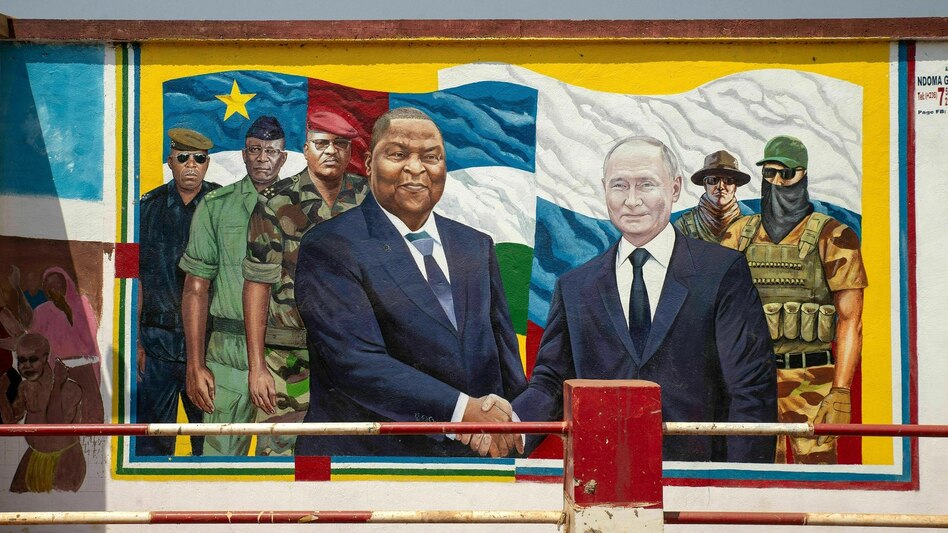
With the Afrika Korps of its armed forces, which replaced the private Russian Wagner mercenary force in 2023, Russia is creating supply routes in eastern and southern Libya for its expansion in the Sahel and Central Africa. The Afrika Korps has expanded its presence in Mali and also in the Central African Republic. Wagner fighters used to protect President Faustin-Archange Touadéra there. But when Touadéra was sworn in for his third term in the capital Bangui on March 30 this year, his Russian bodyguards were already wearing the Afrika Korps badge on the red carpet.
Until the presidential elections in December 2025, Touadéra had resisted replacing his Wagner protection force with the Afrika Korps. The reason: The bankrupt state in Bangui did not have to pay for the Wagner mercenaries. Wagner financed himself through his own companies in Bangui, which primarily mined and exported gold. Moscow, on the other hand, demands money for the Afrika Korps, estimated at around $15 million a month. That's why Touadéra flew to Moscow shortly before his inauguration in March and met President Putin there. “This new term will allow us to strengthen our cooperation in security as well as other sectors,” he said.
So now Touadéra's Russian bodyguards wear the Afrika Korps badge. However, the Russian businessmen who came to Bangui with Wagner and who enjoy Touadéra's trust remain active. Pavel Prigoshin, the 28-year-old son of Wagner boss Yevgeny Prigoshin, who died in 2023 after his failed mutiny in Russia, lives in Bangui and has direct access to the presidential palace there.
A deal was apparently arranged through him to secure financing for the Russian soldiers in Bangui: the gold company Midas Resources, founded by Wagner, took over the concession for the largest gold mine, Ndassima, in 2024. According to the latest report by the “Global Initiative against Transnational Organized Crime” (GI-TOC), it is investing in industrial mining. Last year, according to official figures, five tons of gold worth $250 million were flown from Bangui to Dubai via Somaliland and Puntland - money that could be used to pay for weapons from Moscow.
The expansion of Russia's presence in North Africa does not go unnoticed in the West. Italian soldiers and US liaison officers are stationed in Misrata, the port city in northwest Libya that is hostile to the Haftar regime. At the end of last year, drone experts from Ukraine came to the Air Force Academy in Misrata. On March 3, they set fire to the Russian tanker “Arctic Metagaz,” which was loaded with liquid gas, with a torpedo off Misrata.
The war in Ukraine has long had an African front, especially since Russia's army is hiring more and more African mercenaries due to a lack of its own recruits. This means that Russia's Africa strategy has changed drastically, says Ivan Klyszcz. He is an expert on Russian-African relations at the International Center for Defense and Security in Estonia. Previously, the focus was on economic interests, but today the commitment is subordinated to the goal of winning the war in Ukraine: “There is only one foreign policy, and it is entirely geared towards the Ukrainian war,” says Klyszcz
“The Ukrainian-Russian war is also being fought in Africa,” confirms a former Libyan commander who fought for years against the Islamic State and then against Haftar’s LNA. “The Russian bases in the Sahara will be the Ukrainians’ next targets.”
A photo that appeared in the Afrika Korps Telegram channel in May underlines this statement. It shows a dead African in a camouflage uniform, whose hand holds the insignia of the Ukrainian foreign military intelligence service into the camera. Under the picture it says: “Insignia of the Main Reconnaissance Directorate of the Ukrainian Defense Ministry was discovered on terrorists in Mali.” The article cites “Malian bloggers” as the source. The message is clear: Russia is also fighting against Ukraine and the West in Africa.
The accusation that Ukraine was equipping Mali's Tuareg rebels led to Mali and Niger breaking off their diplomatic relations with Kyiv as early as 2024. In September, the US broadcaster CNN reported that 15 military experts from Ukraine were training fighters from the Tuareg separatist army FLA (Awazad Liberation Front) in drones in Mali. At the same time, there were reports of numerous Russian deaths in fighting in Mali.
In Mali, the Islamist group JNIM, an offshoot of al-Qaeda, and the Tuareg rebels of the FLA are fighting against the Russian-backed military government. In April they captured the city of Kidal. Videos show JNIM fighters attacking abandoned Russian military equipment. Media later reported additional Russian soldiers killed elsewhere in Mali.
Russia is responding to the setbacks with increased supplies. Heavy weapons and tanks reach Mali via Guinea and Togo, whose governments are friendly to Moscow. Both countries have deep-sea ports that Russia uses. As early as 2025, Moscow relocated military equipment from Syria to Mali after the Assad dictatorship was overthrown, a source from security circles confirmed this to the taz. A little later, Togo's authoritarian government concluded an agreement with Russia that allowed Moscow to send military trainers and military equipment.
The transports often take place via the so-called “shadow fleet” - ships that circumvent Western countries' sanctions against Russia by transporting oil and other sanctioned goods for export. This not only finances Russia's war in Ukraine, but also secures supplies for the Afrika Korps.
In order not to be located, the ships often sail with their transponders switched off and under changing flags. In November 2025, the Russian Mersin, loaded with 39,000 tons of fuel, remained in the port of Dakar, Senegal for several weeks after four hull leaks left it unable to maneuver. The obvious damage caused by explosive devices indicated a targeted act of sabotage. Ukraine's military intelligence service was suspected. In January, the Russian Maritime Authority announced that it would allow commercial ships to be accompanied by military ships in the future.
In July 2026, the freighter “Mikhail Britnev” reached the port of Lomé. On board: armored transport vehicles and infantry vehicles that are now being used in Mali. At the beginning of October, Mali's army was able to recapture the city of Kidal - the result of "intensive ground-to-air operations", as it explained, "together with our Russian partners".
The Mikhail Britnev left the Russian Baltic Sea port of Pillau in June under the escort of the Russian warship Aleksandr Shabalin, according to data from the Global Fishing Watch website. Tracking data shows that after the passage through the English Channel, the transponder was switched off and became visible again three weeks later in the port of Lomé.
Business is booming, but the direct presence of Russian troops in Africa has been reduced since Wagner's largely withdrawn. Russia's General Staff only sends small units of a maximum of several hundred men under the label Afrika Korps. The target countries are Mali, Algeria, Burkina Faso and Niger - states that, from a Russian imperial perspective, are being liberated from the clutches of the former colonial power France.
This strategy gives Putin's megalomania an anti-colonial veneer. In this sense, Africa policy should not only be understood in purely military terms, explains expert Klyszcz. It is also about Russia's image in the world and new economic ties that can circumvent Western sanctions.
The nuclear company Rosatom sells nuclear energy to African countries, and Russian companies supply fertilizer and wheat. Discarded military equipment from Ukraine, such as wheeled tanks and trench diggers, is finding new buyers in Africa. Surveillance and encryption software from Russia is also in demand. African delegations regularly visit Moscow's cybersecurity festival.
Numerous signatures on new cooperation agreements are also expected at this year's Russia-Africa summit in Moscow at the end of October. “This is intended to be a showcase event, so to speak, demonstrating how far relations have now progressed,” said Klyszcz.
According to him, many Russian diplomats emphasize that this summit is no longer about the initial enthusiasm that was seen at the previous summits in 2019 and 2023. "Rather, the focus now is on concrete implementation; it is also about giving credibility to Russian support - which goes beyond pure arms deals."
In order to cement this credibility, Moscow has built a powerful propaganda machine on the continent, which is part of a hybrid warfare and takes advantage of the existing skepticism towards the West, especially towards the former colonial power France, which tried to maintain zones of influence in Africa for the longest time.
While the Russian House in Berlin was closed, more and more such institutions are springing up on the continent. They offer free Russian courses in 16 cities, including Bangui, Niamey and Kampala. Eight more houses are planned, for example in the Democratic Republic of Congo, Madagascar and Togo. The aim is to get Africa's youth excited about Russia - as students, workers or mercenaries.
An “alternative worldview”, as it is called in the Russian Telegram channels, is also being promoted. This worldview is spread by a propaganda network, as a consortium of investigative media recently revealed. These include around 90 PR specialists from the Russian organization Africa Politology, who have been traveling through Africa as “political scientists” since 2023. They specifically pay local journalists and influencers.
An important component is the Africa Initiative platform, which provides news in English, French and Russian. Successes are emphasized there. From a rumored new Russian vaccine against Ebola to the International Youth Festival in Yekaterinburg, Russia in September, where 46 African bloggers and journalists were guests. At the same time, Russia is expanding its media presence. The state broadcaster Russia Today (RT) announced its entry into the Senegal market, although it still lacks broadcasting permission.
Russian influence now extends to the equator. Grass-green wheeled armored vehicles of Russian design are lined up in the parking lot in front of the sky-blue building in Uganda's capital Kampala. “We have decided,” said General James Mugira at the opening ceremony of the first military vehicle showroom last year, “that we want to bring our products closer to our customers.”
Mugira, once head of military intelligence, has headed the state-owned arms company NEC (National Enterprise Corporation) since 2015. NEC has wheeled tanks built at an air force base 140 kilometers north of Kampala. For decades, the company has been repairing old Russian Kalashnikovs from Africa's war zones and overhauling Russian helicopters and jets.
Russian military instructors, pilots and engineers have recently started working there. They are modernizing Uganda's military industry - one of Africa's leading - for technological warfare and expanding the air base. Russian cargo planes are landing from Dubai more and more frequently. In the future, African armies should be able to buy their Russian weapons directly in Kampala, without complicated flight or shipping routes.
The Dubai-based Streit Group financed and built the new wheeled tank factory. Your boss, Guerman Goutorov, likes to emphasize that he lives in Canada. But the Russian and his company have been on the EU sanctions list since 2025 because they equip Russian troops in the Ukraine war. Goutorov is still a welcome guest in Uganda. Streit produces 40 wheeled tanks there every month for export throughout Africa.
Last week, Ugandan President Yoweri Museveni broke ground on three new military facilities funded by Russia to the tune of $53 million. The centers are intended to teach modern warfare, including the use of Russian-made drones and AI. In his speech, 82-year-old Museveni personally thanked Putin: “Our cooperation with Russia should help us build local capacity, protect our sovereignty and strengthen our ability to defend Uganda.” Another Putin ally on Africa's chessboard.
Editor's note: This text was jointly researched by our correspondents in Africa.