
Germany · taz · · 3h
Russian house in Berlin: Eerie emptiness
Deutsch (original) · Auto-translated to English
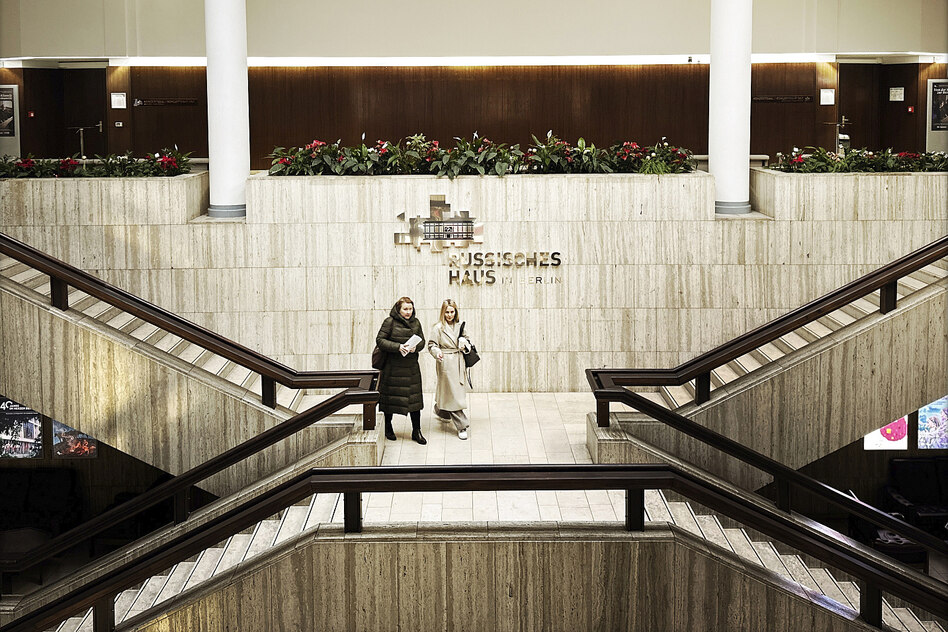
“The Russian House in Berlin was always deserted,” remembers Arkadi. As a so-called late repatriate, he came to Baden-Württemberg with his mother in 1994. Nine years later he began studying Eastern European Studies in Berlin and discovered the house by chance while strolling along Friedrichstrasse.
It looks like a huge fortress, as the building stretches over an entire block. At the same time, between the delicate old buildings and the glass facades of the new buildings, it appears like a gigantic spaceship that has somehow landed incorrectly. The very strict facade structure, made of concrete and clad with large panels, gives it a massive, defensive appearance.
When designing the “House of Soviet Science and Culture” at the end of the 1970s, the GDR architect Karl-Ernst Swora, who had been deputy chief architect on the “Palace of the Republic” project a few years earlier, was based on the architectural language that was then prevalent in the USSR: the combination of massiveness with geometric form.
At 29,000 square meters, the Russian House in Berlin is larger than all other Russian houses that exist in over 70 countries. Arkadi reacted to the architectural language as a young student. The building didn't seem particularly inviting to him, and he stayed away from it for the time being. When he ventured in for the first time, he was negatively surprised by the security check at the entrance, which he had only seen in airports and government buildings in Germany.
Arkady had heard about the Russian bookstore there. And since the selection of contemporary Russian literature was good, he came regularly to the Russian House for a few years to stock up on books. Once, while exploring the sprawling building, he discovered a “kitsch” art exhibit. Otherwise emptiness.
“The events that were announced didn’t appeal to me,” is how he describes his impressions. "Not the content and not the design. It all seemed old-fashioned and reminded me of my Soviet school. The Russian House had the same atmosphere as a cultural center somewhere in Russia." It was clear that no effort was being made to appeal to the local population, let alone tourists. You were enough for yourself.
During his studies, Arkadi often attended events related to the region with his fellow students. “But none of us thought of going to the Russian House for this.” The fact that the FSB (Russian secret service) uses the building complex, which also has apartments, to accommodate its foreign agents "has long been clear in my environment and not only there. The closure seems to me to be a late but logical reaction," he explains his position in relation to the federal government's announcement that the Russian House will be closed at the earliest possible date, in June 2027.
Meanwhile, Igor Tschaika, head of the operating agency “Rostrudnichestvo” announces the opening of eleven more “Russian Houses”: eight in Africa, two in Armenia and one in Thailand. Maria Zakharova, spokeswoman for the Russian Foreign Ministry, commented on the announced closure with the memorable sentence: “It defies all logic to accuse Russia of sins of which it is not guilty and, on the other hand, to come to our Russian courses every goddamned day.”
Last Friday, people demonstrated for and against the closure in front of the Russian House. These include the “Vesna” (German: Spring) initiative by Russians in exile. For them, the term “Russian House” carries with it the imperial idea. She is campaigning for a new opening as the “House of the Peoples of Russia”, in which, in addition to the Russian language, all other languages spoken in Russia are given space.
She is convinced that the focus must move away from the state level and towards the civil society groups of Russians in exile in Germany. “Let’s give this building a new life!” writes the initiative enthusiastically. With education, art and political commitment from below. The property will remain in Russian state ownership even after the Russian House is closed.
The basis is a bilateral agreement from 2013, which has a term of 99 years. So will there be a gigantic haunted house in the heart of Berlin starting next summer? Or will there at some point be such major tectonic changes in the Russian political situation that will take up the utopian ideas of the “Vesna” initiative? The last time Arkadi was in the Russian House was years ago. Then he had to go to the interpreter. What he remembers is the eerie emptiness that surrounded the building.
Read the full story at the source →
Source: taz