
Politics taz
Raw materials boom in Brazil: A village defends itself
In the Brazilian state of Bahia, residents have enforced an anti-mining law. Nevertheless, the exploration work continues. more...
Deutsch (original) ·Auto-translated to English
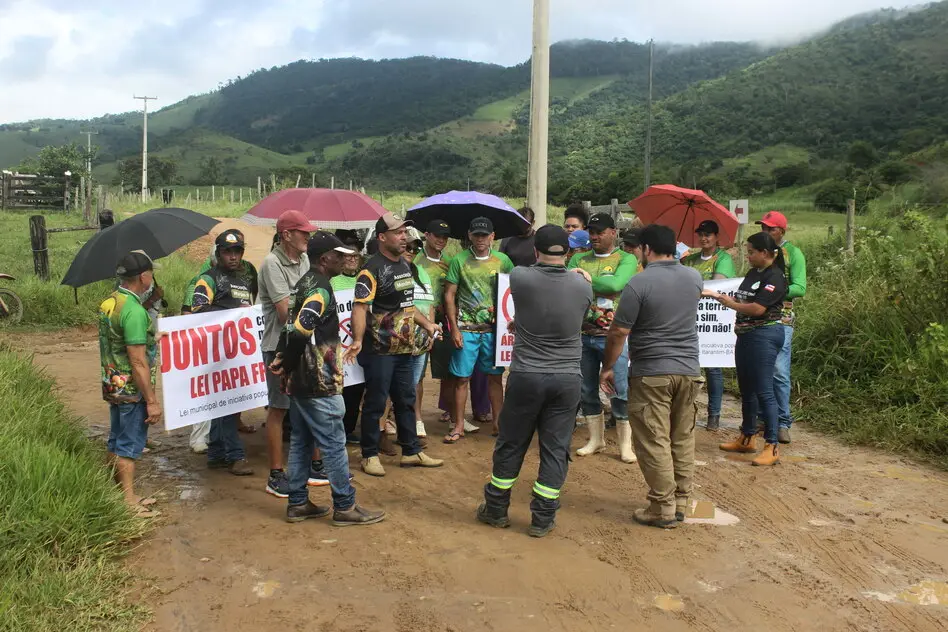
First, strangers suddenly appeared in the area. They came by car, stopped in the middle of the road and collected sand. They later began entering properties and placing markers on the site. Finally, residents of the rural areas of Itarantim, a town in the southwest of the Brazilian state of Bahia, spoke directly to the strangers. They wanted to carry out drilling on their properties and offered some money and numerous promises.
“They gave the impression that they had found something as valuable as oil,” says 43-year-old Juliano Coelho, a resident and chairman of the municipal council of Corgão in Itarantim.
15 journalists from 12 Latin American countries are taking part in the “Euromérica” workshop organized by the taz panter foundation. It's about the opportunities and challenges of the EU-Mercosur agreement and Latin American-European relations. A supplement will appear in the taz on December 5th, and there will be a public talk in the taz canteen on December 9th. All texts can be found here.
The strangers had come to look for the raw materials that are currently being traded as the world's new wealth: critical minerals and rare earths. When the residents understood what was at stake, they decided to organize against the exploration work in their region.
Together they developed a proposed law and got it passed. It prohibits all exploration and mining activities on its territory. In view of the increasing speculation with raw material deposits in Brazil, which has the second largest reserves of rare earths in the world after China, the people of Itarantim are now fighting to ensure that their law is actually observed.
The law, passed unanimously by the city council in August 2025 and signed by the city administration just ten days later, protects the municipality's six mountain ranges. From now on they are considered natural, landscape and tourist heritage and are protected from activities with a high environmental impact such as mining.
In Brazil, citizens of a municipality can submit a legislative proposal to the city council themselves without having to rely on the support of a representative. However, this right enshrined in the constitution requires that at least five percent of the community's eligible voters support the proposal.
When residents of the municipality of Água Vermelha noticed that strangers were entering their land for mining projects, a widespread mobilization for the later law began in August 2024. People set up a protest blockade to demand explanations from the exploration company Cacto Consultoria about the planned work. The action ended with the company's employees having to leave the area.
As a result, resistance emerged among small farmers, rural associations, teachers and religious communities against the exploration of the heavy metal niobium and rare earths. Residents from the city and the countryside came together and founded a citizens' commission for environmental issues. They quickly collected the necessary signatures, organized educational events and two demonstrations.
The demand for raw materials for the energy transition and digitalization has put Brazil in a strategically important position in the global race for natural resources. The deposits of niobium, natural graphite, nickel and rare earths, as well as the potential to mine copper, lithium and silicon, could help reduce the US and European Union's dependence on the Chinese raw materials market.
Brazil, for example, produces more than 90 percent of the niobium produced worldwide. The mineral is also one of the reasons for the exploration work in Itarantim. At the same time, the country is already an important supplier of raw materials for foreign markets. A study by the Brazilian Agency for Export Promotion and Investment (ApexBrasil) shows that in 2025 the European Union took a total of 37.6 percent of Brazilian exports of nine critical raw materials: copper, niobium, silicon, nickel, lithium, graphite, rare earths, phosphate and potassium.
According to the study, European regulatory frameworks and special support programs such as the Critical Raw Materials Act (CRMA), the Global Gateway Initiative and the European Raw Materials Alliance (ERMA) could make Brazil an important partner in the diversification of European raw material suppliers. There is no formal agreement on the supply of raw materials like there is with other Latin American countries. However, the EU speaks of already established cooperation with Brazil in this area.
The international demand is directly reflected in the exploration activities on site. The aim is to expand funding capacities. According to the Brazilian mining authority ANM, Itarantim has 158 mineral exploration permits issued. 44 of these concern niobium and rare earths.
Itarantim is located in Bahia, one of the Brazilian states at the center of the race for rare earths and critical raw materials. As of July 2026, Bahia accounted for 37 percent of the more than 2,700 rare earth mining operations in Brazil.
“The applications for land for mineral exploration and mining largely overlap with the areas of indigenous and traditional communities,” explains Valdirene Rocha, professor at the Federal Institute of Education, Science and Technology of Bahia. According to her, the race for raw materials is exacerbating the historical socio-ecological conflicts in the region. “These projects are based on a capitalist logic that is geared towards profit,” says Rocha. “They contradict the forms of coexistence with the territories that people have fought for for a long time.”
Support the taz panter foundation and its international projects with a donation. Learn more
The difficulty of enforcing the law is demonstrated by the fact that exploration work in Itarantim continues despite its adoption and entry into force. The city administration would have had to submit a management plan for the protected area within a year. However, this has not happened to date, criticizes Mateus Britto from the Center for Studies and Social Action (Ceas).
Mineral exploration also continues. In April 2026, the community mobilized again to stop the Cacto Consultoria's activities. The residents accuse the company of creating roads and changing watercourses.
The company is said to have received permission from some local landowners to continue its work. According to the residents, it used this consent as justification for its activities. Civil society organizations then filed a complaint with the Bahia State Public Prosecutor's Office. Neither the public prosecutor's office nor the city administration answered a query from the taz.
Cacto Consultoria, on the other hand, confirmed that it would continue to carry out technical field work and hydrogeological investigations. “The dispute over municipal restrictions has been referred to the courts,” the company said in a statement. A court then issued an interim injunction in favor of the company. However, this does not allow the commercial mining or processing of minerals.
Alice de Souza is an environmental journalist from Brazil. She works for The Intercept Brasil, among others.
Translated from Portuguese by Niklas Franzen