
Germany · taz · · 1h
Director May el-Toukhy: “Woman Unknown” wins Golden Lion
Deutsch (original) · Auto-translated to English
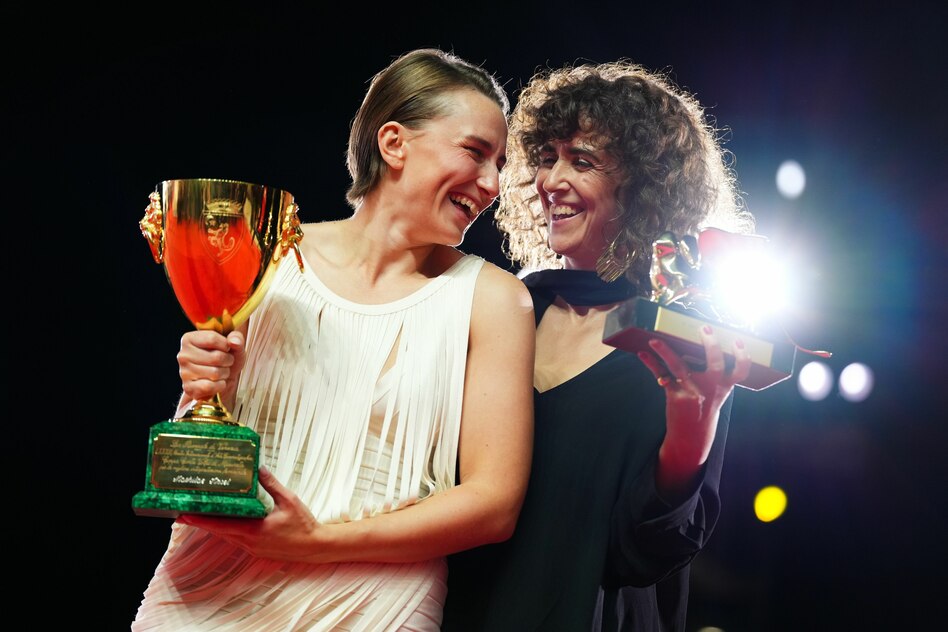
dpa | She was the only solo director in this year's competition - and is now taking home the film festival's Golden Lion. Danish director May el-Toukhy won the main prize in Venice for “Woman Unknown”. Not only she, jury president Maggie Gyllenhaal also criticized the structural inequality in the film industry, where there are still many more films by men.
Gyllenhaal said after the award ceremony that she was tired of constantly talking about this imbalance, but would continue to do so. But now she “just wants to pay tribute to a brilliantly directed film that had the effect of a laser beam on me.”
May el-Toukhy's victory is a plea for a cinema that refuses simple political messages. Although “Woman Unknown” tells of the oppression and invisibility of women, it does not look for a clear victim-perpetrator narrative.
The focus is on a young Danish woman who is about to marry her wealthy employer shortly after the Second World War. However, her imminent social advancement is threatened by a secret: During the occupation, she had an affair with a German soldier. The main role is played by Mathilde Arcel, who also won the award for best actress.
After the end of the German occupation, there were violent acts of revenge by the population in Denmark against women who had had relationships with German soldiers. The young woman in the film risks everything to protect the existence she has carefully built from being exposed.
The decisions she then makes are difficult to classify morally. As el-Toukhy says, the audience should rub themselves against the character and ask themselves how they themselves would act.
Another woman was involved in only one of the remaining 20 films in competition: Rachel Szor, who made the documentary “NAZA” together with Yuval Abraham. The two won the special jury prize for their work about Israel's military actions in the Gaza war.
Already at the premiere it became clear what political impact the film would have: the audience applauded for around 25 minutes - a record length. “NAZA” takes a look at the alleged system behind the Israeli military’s conduct of war.
Recorded at night on the rooftops of Tel Aviv, Abraham interviews 24 members of the Israeli secret service - their voices digitally distorted, their faces in shadow. In a shockingly matter-of-fact, bureaucratic tone, the soldiers describe how targets in Gaza are selected, what number of civilian casualties is considered acceptable and how technical systems are used.
The Israeli army rejects allegations from the film. In response to the film, a spokesman accused the terrorist organization Hamas of deliberately embedding military infrastructure in civilian areas. At the beginning of the film, October 7, 2023 is also the subject of the massacre by the Islamist Hamas and other extremist groups, when around 1,200 people were killed in Israel and more than 250 others were taken hostage to Gaza. The unprecedented attack sparked the Gaza War with Israeli attacks.
At the award ceremony, the political impact of “NAZA” was unleashed once again: When Szor and Abraham accepted their award, the audience stood up again and applauded for a long time. The two Israeli filmmakers used the stage to criticize not only the Israeli, but also the Italian and German governments.
The cinema in Venice this year was particularly political in many different ways. The Russian-born director Ilja Chrschanowski, who now lives in Berlin and London, was awarded the award for best director for “Dau”.
“Dau” is about a physicist who falls into the clutches of the totalitarian Soviet system and has to help build the atomic bomb against his will. The film was shot in Kharkiv, Ukraine from 2008 to 2011.
The main role is played by Greek-Russian actor Teodor Currentzis, who has not publicly distanced himself from Russia's war against Ukraine. The Ukrainian Foreign Ministry recently criticized these and other points in a statement about the film. Khrzhanovsky said on stage: "I would like to dedicate this award to Kharkiv and the Ukrainians who are fighting for freedom, peace and victory in this terrible war. I believe in them."
The festival's second most important award - the Grand Jury Prize - went to the poetic social drama "Possible Love" by South Korean director Lee Chang-dong.
His drama tells of two married couples in South Korea who live in completely different social spheres. The wealthy filmmaker Ye-ji makes a documentary about working class families and labor disputes and follows the unemployed Ho-seok and his wife Mi-ok, who are still suffering from the consequences of a failed strike.
While Ho-seok is traumatized and can hardly open up in front of the camera, a cautious closeness develops between Ye-ji, her husband Sang-woo and Mi-ok. But the relationship soon turns sour and the boundaries between empathy, observation and exploitation become blurred.
The almost three-hour film is a reflection on the power of the cinematic gaze. It is also about the question of who observes whom, who determines the perspective and who decides which stories can be told. These are questions that hang over all of the winning films at this festival.
Read the full story at the source →
Source: taz