
Germany taz
Director about her film “Faith”: “Fear makes conversations so binary”
A private decision shatters certainties: in Alauda Ruiz de Azúa's film “Faith,” a young woman emancipates herself by going to a monastery. more...
Deutsch (original) ·Auto-translated to English
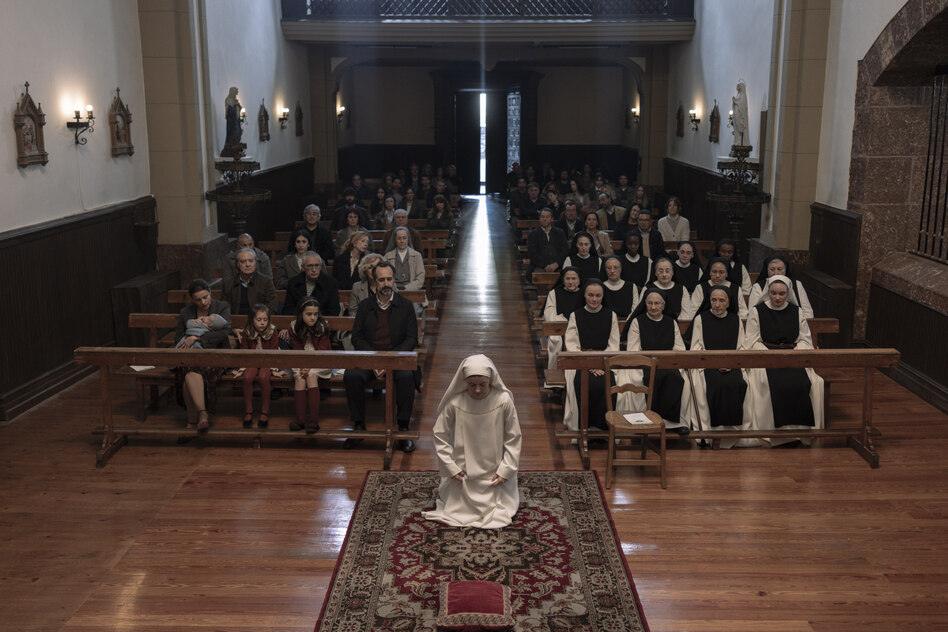
In the feature film “Faith,” director Alauda Ruiz de Azúa tells of a 17-year-old’s desire to go to a monastery as a nun: This puts her family’s solidarity to the test. At the German cinema release of the award-winning film, the atheist talks about religious comfort, female anger and the difficulty of understanding people whose beliefs you don't share.
taz: A year ago, before “Faith” won the Golden Shell in San Sebastián, you hoped that the film would make viewers question themselves. What has surprised you about the reactions since then?
Alauda Ruiz de Azúa: I didn't realize at first how uncomfortable this film is for some people. Some viewers were primarily looking for ideological confirmation: Who will win here? Who loses? The film doesn't draw a clear line between the good guys and the bad guys. Others got involved in the contradictions: Is this girl seeking protection and at the same time has genuine religious feelings? How do I deal with this as an adult? This resulted in very deep conversations, regardless of the beliefs of each viewer.
Born in 1978 in Barakaldo near Bilbao, studied audiovisual communication and English literature in the Basque Country. In 2023, she received the Goya Film Prize from the Academia de las Artes y Ciencias as the best young director for her first feature film “Cinco lobitos”. “Faith” won five awards at the San Sebastián Film Festival, including the coveted “Golden Shell,” received the Antigone d’Or at the Montpellier Mediterranean Film Festival, and was honored in five categories at the 2026 Goyas, including Best Film.
taz: Why is it so difficult for us to understand someone without having to agree with them?
Ruiz de Azúa: There is almost a fear of understanding others, as if that would legitimize their stance. But understanding does not mean justifying or approving. This fear is what makes conversations so binary. I'm interested in whether we can put aside our moral superiority when we want to understand someone. When I write, I need to understand at least some of the motives of each character without ignoring the dark side of the conflict.
taz: You yourself don't believe in God. Why did you want to tell us about a young woman who wants to go to a cloister?
Ruiz de Azúa: When I was around 19 or 20, I heard a similar story from acquaintances. I didn't understand why someone of that age would want to choose this path, one of the most radical forms of religious choice. This fascination remained. While researching, I discovered the conflicts that this can cause in families. Even traditional families who send their daughters to religious schools and celebrate first communion often react with shock: We may be believers, but we don't want that kind of life for you. I was very interested in this contradiction.
taz: Your main character Ainara is 17, has lost her mother and feels alone. How can one understand her desire without explaining her faith in terms of this vulnerability?
Ruiz de Azúa: Maybe we can't understand their religious feelings, but we can understand their loneliness. As a teenager, she realizes how painful the world can be. I know this fear from my youth. But people can feel contradictory things at the same time. And it's important to me that something remains mysterious. When I spoke to young women about their calling, they described real feelings: pain, relief, love. Almost something physical. Perhaps this is the result of her upbringing, a period of particular vulnerability, or both. But you can't just tell a person: what you feel, you don't feel at all.
"Believe". Directed and written by Alauda Ruiz de Azúa. With Blanca Soroa, Patricia López Arnaiz and others Spain 2025, 115 min.
taz: Ainara's father says he respects her decision. When does respect become abandonment?
Ruiz de Azúa: This is exactly the question the viewer should ask himself: Is he acting out of respect, out of convenience, out of selfishness or out of several of these motives at the same time? Perhaps he is trying to be generous and is mistaken about his own motives. According to current law, you become an adult at 18. But what responsibility do I have as a father? Can I just step back and say do whatever you want? I'm talking about emotional responsibility, not legal responsibility.
taz: Aunt Maite, on the other hand, tries to dissuade Ainara from her decision. Is their desire to protect them also a form of control?
Ruiz de Azúa: What concerns me most about Maite is how difficult it is to actually practice tolerance. Most of us want to be tolerant. But sometimes we have good reasons not to be. What do we do as adults? Do we say what we think, do we try to help or do we let the girl go? Maite reaches a point where she despairs and explodes. She wants to protect her niece out of love.
taz: Some critics see your treatment of Maite as a punishment for an independent, atheist woman. How do you answer that?
Ruiz de Azúa: The real punishment for women, for me, is that some viewers don't allow female characters to explode, to be angry, or to behave in an uncomfortable, imperfect way. Men can kill people on screen and are considered fascinating. A woman shows anger and immediately it is said: She will be punished. I didn't write Maite as a punishment for an atheist. But you can be right about a lot of things and have good reasons for your stance. Nevertheless, the feeling of moral superiority can break the connection with another person.
taz: What did you learn about your own attitude through your encounters with religious people?
Ruiz de Azúa: I have become a little more tolerant. I have met people who found comfort in faith after the death of a loved one. I can continue to represent my own beliefs. But is the right way to deal with it is to attack this comfort? I don't believe in God myself. But the comfort is real for this person. Furthermore, one must distinguish between the church as an institution and the people. Some believe without practicing, others practice without believing. Some are very critical of the church and still have their faith. Even among atheists there are varying degrees of tolerance. My father belongs to a generation that was severely hurt by religious upbringing and is very defensive about anything religious. There are far more than two camps.
taz: You are working on a series about OnlyFans. There, too, you are interested in how self-determined young women make their decisions. What connects these substances for you?
Ruiz de Azúa: Again there is this dilemma: Why do these women want to do what they do? And how bad do they want it? It's about free will, about the system, about money. I'm interested in such gray areas: situations in which it remains intellectually and ideologically difficult to know what is right.
taz: Your first feature film was made when you were already over 40. Has life experience helped you to endure such contradictions?
Ruiz de Azúa: Of course, your own experiences shape your view of the world and the films. The fact that I am a mother, a woman, and come from the Basque Country, all of that plays a role. Age has given me a good distance. I've learned not to judge everything so quickly. When I was younger, I could judge very quickly and be sure about many things. The funny thing is: as I get older, I become less sure about more and more things. Actually it should be the other way around. But that's how it is for me.